


- What is Computer Vision?
- How Computer Vision Systems Process Images
- Deep Learning's Role in Modern Computer Vision
- Real-World Applications Across Industries
- Challenges in Computer Vision Development
- Emerging Trends and Future Directions
- Ethical Considerations and Privacy Concerns
- Building Effective Computer Vision Solutions
- Conclusion
- FAQs - Computer Vision
Computer Vision: Transforming How Machines See the World
Computer vision represents one of the most transformative fields in artificial intelligence, enabling machines to interpret and understand visual information from the world around us. This technology has evolved from simple pattern recognition to sophisticated systems that can analyze complex scenes, identify objects, and make decisions based on visual data. By mimicking aspects of human vision through mathematical algorithms and neural networks, computer vision systems can process millions of images, extract meaningful patterns, and provide insights that were previously impossible to obtain at scale.
What is Computer Vision?
Computer Vision is a field of artificial intelligence that enables machines to see, interpret, and understand visual information from images and videos. By using algorithms, deep learning, and image processing techniques, computer vision systems can detect objects, recognize patterns, classify scenes, and make decisions based on visual data. It powers applications like facial recognition, autonomous vehicles, medical imaging, retail automation, and quality inspection. Essentially, computer vision helps machines mimic human visual perception to deliver faster, more accurate insights.
Core components of computer vision systems:
- Image sensors and cameras that capture visual data in digital format, converting light into electrical signals that computers can process.
- Preprocessing algorithms that enhance image quality, remove noise, and prepare data for analysis through techniques like normalization and filtering.
- Feature extraction methods that identify distinctive characteristics within images, such as edges, corners, textures, and color patterns.
- Machine learning models that learn to recognize patterns and make predictions based on training data.
- Post-processing tools that refine results, eliminate false positives, and present information in actionable formats.
How Computer Vision Systems Process Images
When a computer vision AI system analyzes an image, it goes through several processing stages that transform raw pixels into a meaningful understanding. The initial step involves image acquisition, where visual data is captured through cameras or other sensors. This raw data contains millions of pixel values, each representing color and intensity information at specific locations.
The preprocessing stage prepares this data by adjusting contrast, reducing blur, and correcting distortions. Edge detection algorithms then identify boundaries between objects by finding areas where brightness changes dramatically. Shape analysis examines geometric properties, while texture analysis looks at patterns of pixel intensity variations across regions.
Key processing techniques include:
- Convolutional operations that apply filters to detect specific features like horizontal lines, vertical edges, or circular shapes throughout the image
- Pooling layers that reduce image dimensions while preserving important information, making processing more efficient
- Activation functions that introduce non-linearity, allowing neural networks to learn complex relationships between features
- Classification layers that assign probabilities to different categories, determining what objects are present in the image
Deep Learning’s Role in Modern Computer Vision
The integration of deep learning has revolutionized computer vision capabilities over the past decade. Convolutional neural networks have become the backbone of most modern vision systems, enabling unprecedented accuracy in image classification and object detection tasks. These networks automatically learn hierarchical representations of visual data without requiring manual feature engineering.
Training these networks requires extensive datasets containing millions of labeled images. Through repeated exposure to diverse examples, the networks learn to generalize and recognize objects even when they appear in new contexts, under different lighting conditions, or from unusual angles. Transfer learning techniques allow models trained on large general datasets to be fine-tuned for specific tasks with smaller amounts of specialized data.
Advantages of deep learning approaches:
- Automatic feature learning eliminates the need for manual feature engineering, allowing models to discover optimal representations
- Scalability enables processing of massive datasets and continuous improvement as more training data becomes available
- End-to-end learning optimizes the entire pipeline from raw pixels to final predictions simultaneously
- Adaptability allows the same architecture to be applied to diverse tasks, from medical imaging to satellite analysis
Real-World Applications Across Industries
Computer vision has found applications in virtually every sector of modern society, fundamentally changing how industries operate and solve problems. The technology enables automation of visual inspection tasks, provides insights from visual data at unprecedented scale, and creates entirely new capabilities that were previously impossible.
Healthcare and Medical Imaging
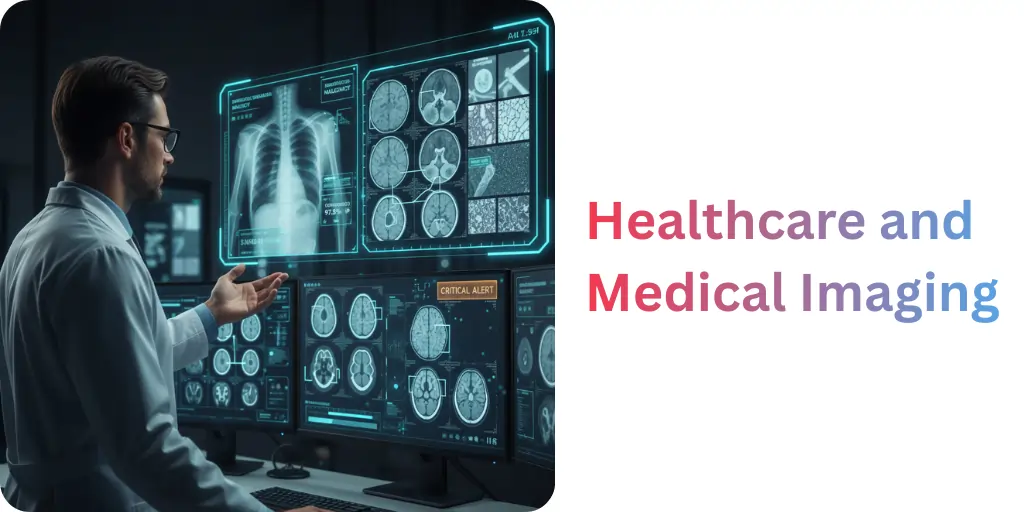
Medical professionals use computer vision to analyze X-rays, MRIs, CT scans, and pathology slides. These systems can detect tumors, identify fractures, measure organ dimensions, and assess disease progression. In dermatology, vision algorithms analyze skin lesions to identify potential melanomas. Ophthalmology applications screen for diabetic retinopathy and age-related macular degeneration. The technology augments physician capabilities, enabling faster diagnosis and potentially catching subtle indicators that might be overlooked during manual review.
Autonomous Vehicles
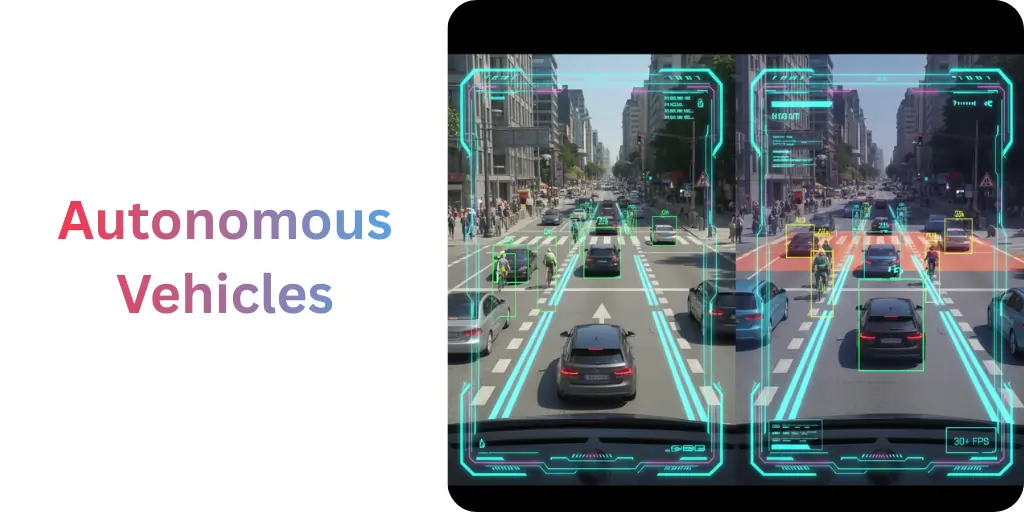
Self-driving cars rely heavily on computer vision to navigate roads safely. Multiple cameras create a comprehensive view of the environment, while algorithms detect pedestrians, cyclists, other vehicles, traffic signs, lane markings, and obstacles. The system must process this information in real-time, often at rates exceeding 30 frames per second, to make split-second driving decisions. Depth estimation algorithms determine distances to objects, while semantic segmentation creates detailed maps of the surrounding environment.
Retail and E-Commerce

Vision technology enables cashierless stores where customers simply pick items and walk out, with purchases automatically detected and charged. Visual search allows shoppers to photograph products and find similar items online. Inventory management systems use cameras to monitor stock levels, detect misplaced items, and optimize shelf arrangements. In warehouses, vision-guided robots locate, pick, and sort products efficiently.
Agriculture and Environmental Monitoring
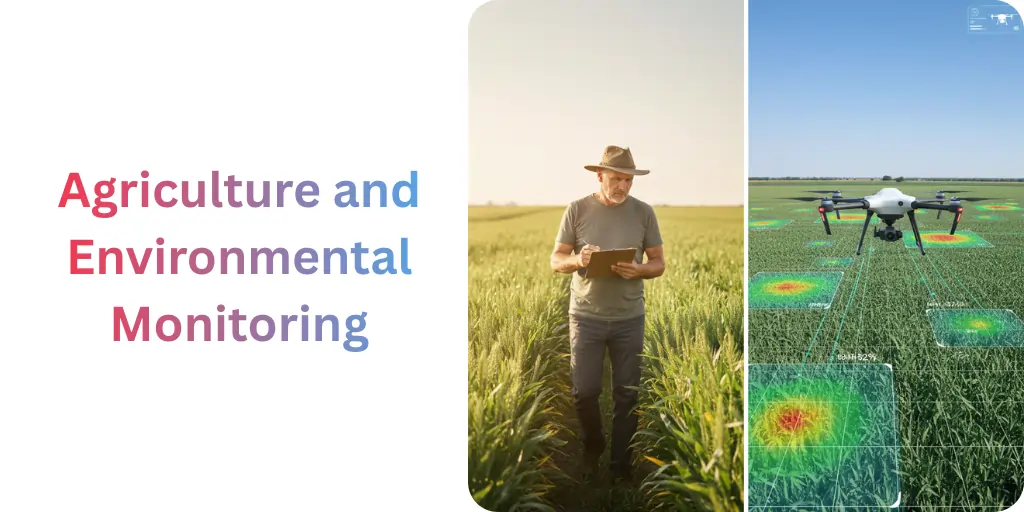
Farmers use computer vision for precision agriculture, with drones and satellites providing aerial imagery for crop monitoring. Algorithms assess plant health through multispectral imaging, detecting stress before it’s visible to the human eye. Automated systems count fruits, estimate yield, and identify weeds for targeted herbicide application. Wildlife conservation efforts use camera traps with vision algorithms to identify and track endangered species without human intervention.
Manufacturing and Quality Control

Production lines employ vision systems to inspect products at speeds impossible for human inspectors. These systems verify assembly accuracy, detect surface defects, check dimensions, and ensure proper labeling. In electronics manufacturing, vision algorithms inspect circuit boards for soldering defects or missing components. Automotive factories use vision to verify correct part installation and paint quality.
Challenges in Computer Vision Development
Despite remarkable progress, computer vision still faces significant challenges that researchers and engineers work to overcome. Understanding context and reasoning about visual scenes remains difficult for machines, as they lack the common-sense knowledge that humans apply effortlessly.
Current technical limitations:
- Adversarial examples where small, imperceptible changes to images can fool sophisticated models into making incorrect predictions
- Domain shift occurs when models trained on one type of data perform poorly on visually different data, even for the same task
- Data requirements as training robust models typically requires millions of labeled examples, which are expensive and time-consuming to collect
- Computational demands especially for real-time processing of high-resolution video streams across multiple cameras
- Interpretability challenges make it difficult to understand why a model made a particular decision, limiting trust in critical applications
Lighting variations present ongoing difficulties, as the same object can appear dramatically different under various illumination conditions. Shadows, reflections, and extreme brightness or darkness can confuse vision algorithms. Occlusion occurs when objects partially hide other objects, making complete recognition challenging. Three-dimensional understanding from two-dimensional images requires sophisticated spatial reasoning.
Emerging Trends and Future Directions
The field continues evolving rapidly with several exciting developments reshaping what’s possible. Video understanding capabilities are advancing beyond frame-by-frame analysis to comprehend temporal relationships, track objects across frames, and predict future events. This enables applications like activity recognition, anomaly detection, and behavioral analysis.
Innovative approaches on the horizon:
- Self-supervised learning reduces dependency on labeled data by training models to predict parts of images from other parts
- Neural architecture search automatically designs optimal network structures for specific tasks rather than relying on human expertise
- Edge computing brings vision processing to cameras and devices, enabling real-time analysis without cloud connectivity
- Multi-modal learning combines visual information with text, audio, and sensor data for richer understanding
- Few-shot learning enables models to recognize new object categories from just a handful of examples rather than thousands
Attention mechanisms allow models to focus on relevant image regions, improving efficiency and interpretability. Transformer architectures originally developed for natural language processing are now achieving state-of-the-art results in vision tasks. Generative models can create synthetic training data, helping overcome data scarcity challenges.
Ethical Considerations and Privacy Concerns
As computer vision becomes ubiquitous, important ethical questions arise that society must address thoughtfully. Surveillance capabilities raise privacy concerns, particularly when systems can identify individuals in public spaces, track movements across multiple locations, or infer sensitive attributes from appearance. Balancing legitimate security needs with personal privacy rights remains an ongoing societal challenge.
Bias in ai training data can lead to systems that perform differently across demographic groups. Studies have shown that some facial recognition systems exhibit higher error rates for certain ethnicities and genders, reflecting imbalances in training datasets. Ensuring fairness and equity requires careful dataset curation, diverse representation, and continuous monitoring of system performance across populations.
Key ethical considerations:
- Consent and control over when and how individuals are captured, analyzed, and identified by vision systems
- Purpose limitation ensuring systems are used only for stated purposes rather than mission creep into unintended applications
- Transparency requirements so individuals know when vision systems are monitoring spaces and what data is collected
- Data retention policies that specify how long visual data and derived information are stored
- Accountability mechanisms establishing who is responsible when vision systems make errors with harmful consequences
Building Effective Computer Vision Solutions
Developing successful computer vision applications requires careful consideration of numerous factors beyond just algorithm selection. Understanding the specific problem domain, gathering representative training data, and designing appropriate evaluation metrics are crucial steps.
Dataset creation involves collecting diverse images that represent the full range of conditions the system will encounter. This includes variations in lighting, weather, angles, distances, and backgrounds. Annotation quality directly impacts model performance, making clear labeling guidelines and verification processes essential.
Best practices for implementation:
- Start with existing models through transfer learning rather than training from scratch, saving time and computational resources
- Establish clear performance metrics aligned with business objectives, whether accuracy, speed, or specific error types matter most
- Create robust test sets that include challenging edge cases and out-of-distribution examples to reveal model limitations
- Implement monitoring systems to detect performance degradation when deployed models encounter data different from training conditions
- Plan for iterative improvement with feedback loops that identify failures and enable continuous model refinement
Conclusion
Computer vision has emerged as one of the most impactful technologies of the modern era, fundamentally transforming how machines perceive and interact with the visual world. From its theoretical foundations to practical applications across healthcare, transportation, agriculture, and manufacturing, this field demonstrates the remarkable potential of artificial intelligence to augment human capabilities and solve complex real-world problems.
The journey from basic image processing to sophisticated deep learning systems reflects decades of research, innovation, and incremental breakthroughs. Today’s computer vision systems can perform tasks that seemed impossible just years ago, achieving human-level or even superhuman performance in specific domains. However, significant challenges remain, including handling diverse environmental conditions, reducing data requirements, improving interpretability, and addressing ethical concerns around privacy and bias.
FAQs – Computer Vision
Computer Vision is a field of AI that trains machines to interpret and understand visual data from images and videos.
It works through image processing, machine learning, and deep learning models that analyze pixels, detect patterns, and classify objects.
Autonomous vehicles, facial recognition, healthcare imaging, retail automation, surveillance, and manufacturing QC.
It enables automation, improves accuracy, enhances decision-making, and unlocks new capabilities across industries.
No. Image processing enhances images, while computer vision focuses on understanding and interpreting them.
 Previous Blog


You Might Like

February 18, 2026
Prebuilt vs Custom AI Training Datasets: Which One Should You Choose?
Data is the fuel that powers artificial intelligence. But just like premium fuel vs. regular unleaded makes a difference in a high-performance engine, the type of data you feed your AI model dictates how well it runs. The global market for AI training datasets is booming, with companies offering everything from generic image libraries to […]

February 17, 2026
Building an AI Dataset? Here’s the Real Timeline Breakdown
We often hear that data is the new oil, but raw data is actually more like crude oil. It’s valuable, but you can’t put it directly into the engine. It needs to be refined. In the world of artificial intelligence, that refinement process is the creation of high-quality datasets. AI models are only as good […]

February 16, 2026
The Hidden Cost of Poorly Labeled Data in Production AI Systems
When an AI system fails in production, the immediate instinct is to blame the model architecture. Teams scramble to tweak hyperparameters, add layers, or switch algorithms entirely. But more often than not, the culprit isn’t the code—it’s the data used to teach it. While companies pour resources into hiring top-tier data scientists and acquiring expensive […]