


- What Are AI Training Datasets?
- What Are Prebuilt AI Datasets?
- Advantages of Prebuilt AI Training Datasets
- Limitations of Prebuilt Datasets
- What Are Custom AI Datasets?
- Advantages of Custom AI Training Datasets
- Challenges of Custom Dataset Development
- Prebuilt vs Custom AI Datasets: Side-by-Side Comparison
- When Should You Buy Prebuilt AI Datasets?
- When Should You Build Custom AI Training Datasets?
- Hybrid Approach: Using Prebuilt + Custom Data
- Key Factors to Consider Before Choosing
- How to Evaluate Dataset Quality
- Cost Comparison: Prebuilt vs Custom AI Datasets
- Common Mistakes to Avoid
- Decision Framework: Which One Should You Choose?
- Why Custom AI Training Datasets Are Often Better for Production
- Your Data, Your AI Success
- FAQs
Prebuilt vs Custom AI Training Datasets: Which One Should You Choose?
Data is the fuel that powers artificial intelligence. But just like premium fuel vs. regular unleaded makes a difference in a high-performance engine, the AI training datasets you feed your model dictate how accurately, efficiently, and reliably it performs.
The global market for AI training datasets is booming, with companies offering everything from generic image libraries to highly specialized medical records. This abundance creates a critical dilemma for businesses: Should you buy AI datasets off the shelf to save time, or invest in custom dataset creation to ensure precision?
Your choice impacts everything from your budget and development timeline to the ultimate accuracy of your model in the real world. A generic dataset might get a chatbot running in a day, but it won’t help a fintech app detect complex, region-specific fraud patterns.
In this guide, we will break down the differences between prebuilt and custom AI training datasets, explore the pros and cons of each, and help you decide which path aligns with your specific business goals—whether you’re building computer vision for retail or NLP for healthcare.
What Are AI Training Datasets?
At its core, an AI training dataset is a collection of labeled or unlabeled data used to teach machine learning models how to make predictions or perform tasks. These datasets are the foundation of machine learning, deep learning, and generative AI.
Without quality data, even the most sophisticated algorithm is useless. Datasets come in various forms depending on the application:
- Image datasets: Used for computer vision tasks like facial recognition or object detection.
- Text datasets: Essential for Natural Language Processing (NLP), chatbots, and sentiment analysis.
- Audio datasets: Used in speech recognition and voice assistants.
- Video datasets: Critical for autonomous driving and security surveillance.
- Sensor/IoT datasets: Used for predictive maintenance in manufacturing and smart home devices.
The challenge is that “one-size-fits-all” rarely works in production AI. A model trained on clear, studio-lit photos of cats will fail miserably if asked to identify cats in grainy, low-light security footage. This is where the distinction between prebuilt and custom data becomes vital.
What Are Prebuilt AI Datasets?
Definition
Prebuilt, or off-the-shelf datasets, are ready-made collections of data that have already been gathered, cleaned, and often labeled. Dataset vendors, academic institutions, open-source communities, or government bodies create them. They are designed to be downloaded and used immediately.
Common Examples
You’ve likely heard of some of the most famous prebuilt datasets that serve as benchmarks in the AI industry:
- ImageNet: A massive database of images organized according to the WordNet hierarchy, used to train visual recognition software.
- COCO (Common Objects in Context): A large-scale object detection, segmentation, and captioning dataset.
- Open NLP Corpora: Collections of text used to train language models.
- Speech Datasets: Publicly available libraries of spoken words and phrases.
- Autonomous Driving Datasets: Open-source data from companies like Waymo or NuScenes used to advance self-driving technology.
Key Features
The defining characteristic of prebuilt datasets is their broad appeal. They feature generic labeling and cover wide categories (e.g., “car,” “person,” “dog”). They are designed for general-purpose models rather than specific business problems.
Advantages of Prebuilt AI Training Datasets
For many startups and researchers, the decision to buy AI datasets is an easy one. Here is why:
Faster Time-to-Market
The most significant advantage is speed. You can download a prebuilt dataset and start training your model within minutes. There is no need to wait months for data collection and annotation.
Lower Upfront Cost
Buying a license for a dataset—or using a free open-source one—is significantly cheaper than commissioning a custom data project. This makes it attractive for teams with limited budgets.
Ideal for Proof of Concept (POC)
If you are trying to prove to stakeholders that an AI solution is viable, you don’t need perfect data; you need enough data. Prebuilt sets allow you to build a Minimum Viable Product (MVP) quickly.
Benchmarking
Prebuilt datasets provide a standard yardstick. If you want to compare your model’s performance against the industry standard, you need to test it on the same data everyone else uses.
Limitations of Prebuilt Datasets
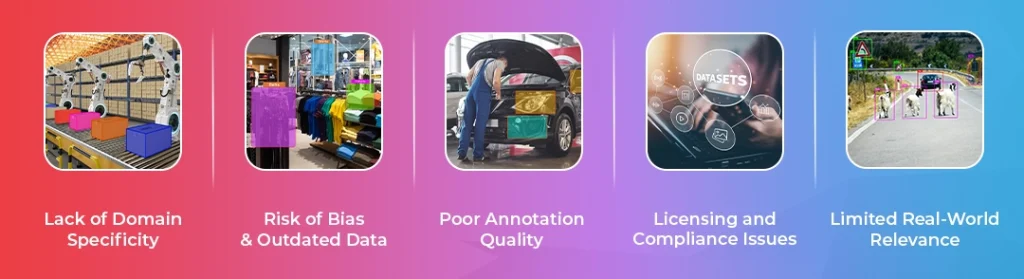
While convenient, off-the-shelf data often falls short when moving from a research environment to a real-world product.
Lack of Domain Specificity
A prebuilt dataset of “receipts” might include generic grocery store receipts. If you are building an expense management tool for the construction industry, generic receipts won’t help your model recognize invoices for lumber or concrete.
Risk of Bias and Outdated Data
Many public datasets suffer from historical bias or are simply old. An image dataset from 2010 won’t include modern smartphones or current fashion trends, which can confuse a model meant to analyze current social media trends.
Poor Annotation Quality
Not all datasets are created equal. Some may have inconsistent labeling or errors that you have no control over.
Licensing and Compliance Issues
Using open-source data for commercial purposes can be a legal minefield. Just because data is public doesn’t mean it’s cleared for commercial use, especially under regulations like GDPR.
Limited Real-World Relevance
Prebuilt data is often “clean.” Real-world data is messy, noisy, and chaotic. A model trained only on clean data will often fail when deployed in a messy production environment.
What Are Custom AI Datasets?
Definition
Custom datasets are built from scratch specifically for your unique business use case. This data is collected from your own proprietary sources—customer logs, security cameras, manufacturing sensors, web scraping—or gathered by a data services provider according to your strict specifications.
What Is Included in Custom Dataset Creation?
Building a custom dataset is a rigorous process involving:
- Data Sourcing: Capturing raw data relevant to your problem.
- Data Cleaning: Removing duplicates, errors, and irrelevant files.
- Annotation: Labeling the data (e.g., drawing bounding boxes around defects in a manufacturing line) based on specific rules.
- Quality Assurance: Reviewing labels for accuracy.
- Dataset Validation: Testing the dataset to ensure it represents the problem space correctly.
Advantages of Custom AI Training Datasets
When you choose custom dataset creation, you are investing in the long-term performance of your model.
Tailored to Business Objectives
Every data point serves your specific goal. If you are building a delivery drone system, your dataset will contain images of the exact packages and environments your drones will encounter, not generic boxes.
Higher Model Accuracy
Models trained on domain-specific data perform significantly better. They learn the nuances of your specific industry, leading to higher precision and recall.
Better Generalization in Real-World Use
Because you control the collection, you can intentionally include “edge cases”—rare or difficult scenarios—that prebuilt datasets miss. This makes your model robust enough to handle the real world.
Full Control Over Ontology
You decide the labeling rules. If “customer satisfaction” means something specific to your brand, you can train your sentiment analysis model to recognize it.
Competitive Advantage
Proprietary data is a moat. If your competitors are all using the same public datasets, their models will all perform similarly. A custom dataset gives you a unique asset that no one else has.
Challenges of Custom Dataset Development
Custom comes at a cost. The primary barriers are:
- Higher Cost: Sourcing and labeling data is labor-intensive.
- Longer Development Time: It takes time to collect and clean data.
- Scalability: You need scalable annotation workflows and domain experts to ensure quality.
- Maintenance: Real-world data changes, so custom datasets require ongoing updates.
Prebuilt vs Custom AI Datasets: Side-by-Side Comparison
| Factor | Prebuilt Datasets | Custom Datasets |
| Cost | Low initial cost | Higher investment |
| Speed | Immediate access | Takes time to build |
| Accuracy | Generic performance | High domain accuracy |
| Scalability | Limited | Fully scalable |
| Ownership | Vendor-owned / Public | Business-owned |
| Compliance | Risky (licensing varies) | Fully controllable |
| Best for | Research & POCs | Production AI systems |
When Should You Buy Prebuilt AI Datasets?
You should lean toward prebuilt datasets when speed and budget are your primary constraints, or when the problem you are solving is very common.
Choose prebuilt when:
- You are in the early experimentation or “sandbox” phase.
- You need quick validation to prove a concept to investors.
- Your budget does not allow for a data collection team.
- Your use case is generic, such as standard object detection (e.g., identifying cars or pedestrians) or basic sentiment analysis.
- You are training baseline models to compare against future iterations.
Example: A university student working on a research paper regarding image classification, or a startup building an MVP for a hackathon.
When Should You Build Custom AI Training Datasets?
Custom data is necessary when performance is critical and the stakes are high.
Choose custom datasets when:
- You are deploying a production AI system that interacts with real customers.
- Your use case is industry-specific (e.g., detecting defects in a specific microchip).
- You need high precision (99% accuracy vs. 85%).
- Data privacy is critical, and you cannot risk using data with unclear lineage.
- Prebuilt data simply does not exist for your environment.
Example: A medical imaging company developing an AI to detect early-stage tumors in X-rays, or a retail chain implementing an automated shelf-monitoring system to track their specific stock keeping units (SKUs).
Hybrid Approach: Using Prebuilt + Custom Data
It doesn’t always have to be an “either/or” decision. Many successful AI teams use a hybrid approach known as Transfer Learning.
In this pipeline, you pre-train your model using a large, prebuilt dataset to teach it the basics (e.g., what “edges” and “shapes” are, using ImageNet). Then, you fine-tune the model using a smaller, high-quality custom dataset.
This approach offers the best of both worlds: it reduces the volume of custom data required (saving money) while still achieving high domain accuracy.
Key Factors to Consider Before Choosing
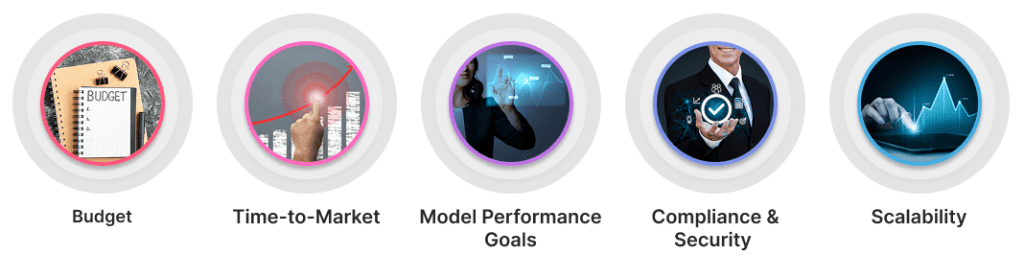
Before making your final decision, evaluate these five factors:
1. Budget
Consider the long-term ROI. A cheap dataset now might cost you more later if your model fails in production and requires a total rebuild.
2. Time-to-Market
Are you rushing to get an MVP out next week, or are you building a robust enterprise platform for next year?
3. Model Performance Goals
What is your error tolerance? A recommendation engine suggesting the wrong movie is annoying; a self-driving car missing a stop sign is catastrophic.
4. Compliance & Security
If you are in healthcare (HIPAA) or finance, you need strict control over your data sources. Custom data allows you to ensure all privacy regulations are met.
5. Scalability
As your AI grows, your data needs will grow. Custom workflows are generally easier to scale because you own the pipeline.
How to Evaluate Dataset Quality
Whether you buy or build, you must audit the quality. Look for:
- Annotation Accuracy: Are the labels correct?
- Consistency: Is the same logic applied across the entire dataset?
- Edge Cases: Does the data cover rare scenarios?
- Class Balance: Is there an equal representation of different categories (e.g., equal numbers of day vs. night images)?
Cost Comparison: Prebuilt vs Custom AI Datasets
Prebuilt Pricing: usually involves a per-dataset fee or a subscription to a data marketplace. Be wary of licensing fees that scale with your user base.
Custom Pricing: involves costs for collection (hardware, software, scraping), annotation (human labor), Quality Assurance (QA), and management. While the upfront cost is higher, the long-term cost of bad data—churned customers, failed products, reputational damage—is often much higher.
Common Mistakes to Avoid
- Choosing based only on price: Cheap data is often expensive to fix.
- Ignoring annotation guidelines: Ambiguous rules lead to ambiguous AI.
- Not validating samples: Always check a sample of the data before buying or scaling.
- Overfitting: Training on a generic dataset so long that the model memorizes it but can’t function outside of it.
Decision Framework: Which One Should You Choose?
Use this simple checklist to decide:
- Define your use case. Is it generic (e.g., “detect a face”) or specific (e.g., “detect my employee’s face”)?
- Evaluate existing datasets. Search open-source libraries. Is there something close to what you need?
- Test baseline performance. Download a sample prebuilt set. Does it work reasonably well?
- Identify gaps. Where does the prebuilt set fail?
- Decide: If the gaps are small, fine-tune. If the gaps are massive, build custom.
Why Custom AI Training Datasets Are Often Better for Production
For hobbyists and students, prebuilt is perfect. But for enterprise AI, custom is king. Custom datasets ensure your model aligns with real-world business scenarios, provides reliable results, and builds a competitive moat around your product.
While it requires more effort, the reliability and scalability of custom data are usually prerequisites for commercial success in the AI space.
Your Data, Your AI Success
The choice between prebuilt and custom AI datasets isn’t just a technical decision—it’s a strategic one.
If you need to move fast and break things, buy a dataset. But if you need to build a reliable, high-performing product that solves a specific customer problem, investing in custom data is the smarter route.
Don’t let poor data be the bottleneck of your innovation. Whether you choose to fine-tune a prebuilt model or start from scratch, ensure your data strategy is as robust as your code.
FAQs
Ans: – AI training datasets are labeled or structured collections of data used to train machine learning and deep learning models to recognize patterns and make predictions.
Ans: – It depends on your use case. Prebuilt datasets are ideal for experimentation, while custom datasets are better for production-grade AI systems requiring high accuracy and domain relevance.
Ans: – Prebuilt datasets can be useful for baseline training, but they often lack domain specificity and may introduce bias, making them less reliable for enterprise deployment.
Ans: – The timeline varies based on data volume and complexity. It can range from a few weeks for small projects to several months for large-scale datasets.
Ans: – Yes. Many teams use prebuilt datasets for pretraining and then fine-tune models using custom datasets for better performance in real-world applications.
 Previous Blog


You Might Like

August 26, 2026
Physical AI Data Providers: From Robotics Data Collection to Physical AI Annotation
Physical AI is moving AI beyond screens and into the physical world, where it will fuel robots, autonomous vehicles, and other kinds of intelligent machines that need to make sense of the environment and act accordingly. This development is expected to increase the demand for specialized data providers capable of generating multimodal Physical AI data. […]

August 17, 2026
Video Narration Annotation for Robotics Egocentric Data: Building AI Datasets for the Robotics Industry
Robotics has progressed beyond controlled lab settings and into Physical AI systems that can perceive, comprehend, and interact in the real world. In light of the rapid progress being made towards this technology, AI datasets that will feed the future needs of the robotics sector will no longer suffice without the context, structure, and multimodal […]

August 10, 2026
Annotation for Robotics: How High-Quality Data Improves Robot Intelligence
Robots today must be able to maneuver through complex surroundings, identify objects, perceive human intent, and make smart decisions. All of this can only be achieved with the use of robotics annotation and high-quality annotation for robotics, which convert unstructured sensory inputs into high-quality AI robotics training datasets. In all industries, ranging from manufacturing and […]