


- What Is Video Narration Annotation for Robotics Egocentric Data?
- Why Egocentric Data Matters for AI Datasets for the Robotics Industry
- How Video Narration Annotation Turns Raw Robotics Video into Structured Training Data
- Video Narration Annotation & Multimodal Sensor Fusion for Egocentric Robotics Datasets
- Key Elements of High-Quality Video Narration Annotation for Robotics AI Datasets
- How Video Narration Annotation Supports AI Robotics Training Datasets and VLA Models
- Bridging Egocentric Video Capture and Robotics Data Collection with Video Narration Annotation
- Applications of Video Narration Annotation in Physical AI & Robotics
- How Macgence Supports Video Narration Annotation and Robotics Training Data Collection
- Frequently Asked Questions
Video Narration Annotation for Robotics Egocentric Data: Building AI Datasets for the Robotics Industry
Robotics has progressed beyond controlled lab settings and into Physical AI systems that can perceive, comprehend, and interact in the real world. In light of the rapid progress being made towards this technology, AI datasets that will feed the future needs of the robotics sector will no longer suffice without the context, structure, and multimodal data. Video narration annotation provides additional context by adding natural language to egocentric data, thus, assisting in explaining actions, objects, interaction and task sequences. If combined with multimodal sensor fusion datasets, video narration annotation can help generate inputs for AI robotics training datasets. From household manipulation to automated processes in the industries, robust robotics training data collection is now crucial for the development of reliable AI systems. Macgence assists companies in collecting and annotating the required data to build these next-gen robotics applications.
What Is Video Narration Annotation for Robotics Egocentric Data?
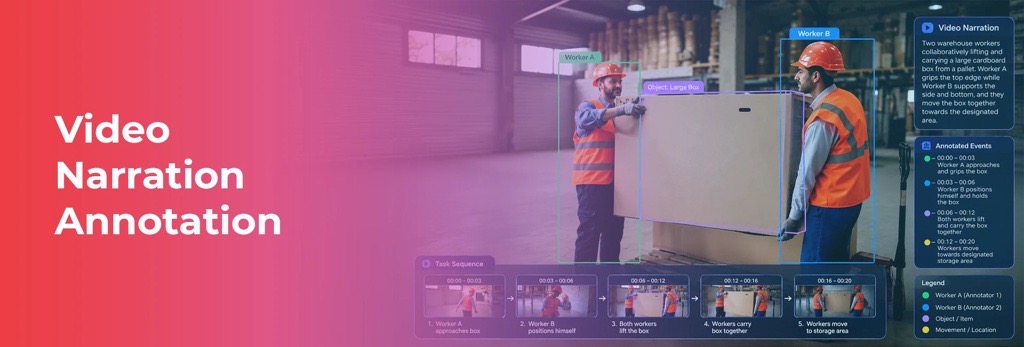
Video narration annotation refers to the addition of natural-language annotations that are time-aligned to video to help AI understand what is going on, the timing of the events, and the context of the activity. Video narration annotation becomes particularly valuable for robotics when applied to egocentric data captured from a first-person viewpoint.
From Video to Robotics Training Data
Video narration annotation differs from standard video captioning by providing descriptions of:
- Actions like reaching, grasping, pouring, or placing objects
- Object and hand interactions during manipulation
- Phase or context of the task/action
For instance, in a warehouse environment, video narration annotation for robotics will link the activity of the worker with the handling of the object and the sequence of actions involved in the task to generate more detailed robotics training data for AI robotics training datasets. The contextual information is a complement to object segmentation, 3D bounding box annotation, and multimodal sensor fusion datasets for Physical AI and vision-language-action models.
Why Egocentric Data Matters for AI Datasets for the Robotics Industry
For robots functioning in the physical world, comprehending the surrounding entails more than just identifying objects. Rather, it is about comprehending the way the acting agent sees and acts on the object. This is why egocentric data has relevance when creating realistic AI robotics training datasets.
What Egocentric Data Captures
- First-person point-of-view: Capture the same point-of-view that the robot sees with its own cameras.
- Object interaction: Capture touch, grasp, manipulation, and movement of objects by hand.
- Task sequences: Combine individual steps into sequences that make up a task.
- Real-world environments: Capture variations across different environments including homes, warehouses, factories and others.
- Human intent: Capture information about the intent behind actions, supporting Physical AI technology.
For example, first-person warehouse footage can provide additional training context for pick-and-place tasks that may be difficult to capture from third-person viewpoints alone.

How Video Narration Annotation Turns Raw Robotics Video into Structured Training Data
The raw egocentric data becomes more valuable for robotics when the visual events are turned into the structured time-aligned information. Video narration annotation adds a semantic layer that connects individual actions together into coherent task sequences.
From Raw Video to Structured Data
- Temporal segmentation: Accurate action boundaries are identified.
- Actions and object labels: Actions such as reaching, grasping, manipulating, moving, placing are recorded.
- Object/context annotation: The additional information on scene, hand-object contacts and object states is provided using methods like 3D bounding box annotation.
- Narration: Natural language descriptions are added like “The operator grasps the cup”.
For instance, annotation of warehouse videos for robots turns a pick-and-place task into a structured event. Macgence can support annotation workflows involving frame-level actions, object and scene segmentation, task phases, and natural-language descriptions.
Video Narration Annotation & Multimodal Sensor Fusion for Egocentric Robotics Datasets
A robot doesn’t perceive its surroundings only via a camera’s video input. Synchronization of multiple sensor streams results in more complex multimodal sensor fusion datasets and allows Physical AI systems to analyze the interaction using multiple sensor modalities.
How the Modalities Work Together
- RGB video → visual context and scene understanding
- Depth → spatial perception and distance of objects
- IMU → motion and orientation
- Audio → environmental and interaction cues
- Force/torque → physical contact and manipulation
- Motion/pose → movement and body dynamics
- Video narration annotation → semantic and contextual understanding of events
With the synchronization of these streams, video narration annotation becomes an integral part of the annotation process in general rather than a separate one. A good example is a robotic arm that learns how to manipulate objects; such a system may take into account multiple streams, including visual observation, depth, force feedback and narrated actions, thus generating more complex robotics training data. Macgence’s robotics data workflows can incorporate synchronized multimodal data collection, depending on project requirements.
Key Elements of High-Quality Video Narration Annotation for Robotics AI Datasets
It is important that the video narration annotation provides more than just the visible actions of the robot. The annotation schema should be able to meet the requirements of the downstream robotics model and task and dataset requirements.
Annotation element | What it captures |
Action | What the operator or robot is performing |
Object | Objects involved in the action |
Temporal segment | When an event starts and ends |
Interaction | How objects are manipulated |
Task phase | Where the action fits in the workflow |
Intent & context | Why the action occurs |
Spatial information | Where objects and actions occur |
Natural-language descriptions | Human-readable event descriptions |
For instance, in a warehouse setting, one can use video narration annotation alongside 3D bounding box annotation to correlate the location of the object with the action taking place. These structured annotations enable AI robotics training datasets to be more informative, consistent, and beneficial for model training.
How Video Narration Annotation Supports AI Robotics Training Datasets and VLA Models
Robots need to make associations between the scene in front of their eyes and what they have to do next. This is where video narration annotation becomes useful for training AI robotics, providing linguistic contextualization along with visual and sensor data.
From Observation to Action
- Video → captures the visual state of the environment through images.
- Sensor data → delivers spatial, movement, and interaction data.
- Narration → delivers information about actions, objects, and tasks in natural language.
- Annotations → relate observations to associated actions.
For instance, a domestic robot can be trained to recognize that a person takes a cup, brings it to the sink, and puts it down. Natural language descriptions allow making connections between the visual scenes and actions.

Bridging Egocentric Video Capture and Robotics Data Collection with Video Narration Annotation
Robotics training data collection that is effective must be a connected process where the correct task is recorded, annotated, verified, and formatted appropriately for model training.
From Recording to Model-Ready Data
- Define the task and schema needed.
- Record egocentric data in typical environments.
- Synchronize the multimodal input streams across available sensors.
- Segment activities down into events.
- Integrate video narration annotation describing the tasks and context.
- Add object, action, and spatial annotations.
- Perform human verification and operator-in-the-loop workflow.
- Provide robotics training data for your model development.
The Macgence workflow mirrors this progression from discovery to hardware deployment through capture, annotation, verification, and delivery. This allows us to transform your video recordings into robotics training datasets for your AI.
Applications of Video Narration Annotation in Physical AI & Robotics
The utility of video narration annotation is well understood as robotics solutions today evolve beyond controlled demonstrations and into real-world applications. Various environments need different AI datasets for robotics which include diverse actions, objects, and workflows.
Application of Narrated Robotics Data
- Manufacturing & warehouses: Pick and place, assembly, packing, sorting and tools manipulation could be a source of AI robotics training datasets for manipulation.
- Service & domestic robots: Cooking, cleaning, kitchen workflows and object manipulation can provide data for physical AI.
- Healthcare & assisted living: Human robot interaction, object manipulation and assistance workflows need context-rich demonstrations.
- Humanoid & embodied AI: Manipulation, demonstration learning, task perception and instruction following can be enhanced using video narration annotation.
- Autonomous systems: Narrated observation can support environment understanding, action recognition and human behavior context.
Thus, video narration annotation can be a valuable addition to a scalable robotics data pipeline.
How Macgence Supports Video Narration Annotation and Robotics Training Data Collection
Looking to collect high-end teleoperation datasets for your robotics or autonomous AI projects? Get in touch with Macgence for the creation, annotation and scaling of training data required for your models.
From Data Collection to Training Data
Macgence provides support across the entire lifecycle of collecting robotics training data by:
- Custom data sourcing and egocentric data collection for multiple types of AI datasets.
- Video narration annotation for robotics, with human-in-the-loop labeling and enhancement.
- Multimodal sensor data collection and fusion for improved physical AI datasets.
- Data validation, QA, cleaning and scalable data pipelines for AI robotics training datasets.
- Computer vision and autonomous vehicle data expertise for robotics and autonomous AI solutions.
With custom curation, annotation, validation, and sensor data collection, Macgence can help you turn raw data into scalable and reliable robotics training data.
Frequently Asked Questions
1. What is video narration annotation?
Video narration annotation is the process of adding natural language descriptions that are time-aligned with the video, allowing robotics models to understand actions, objects, task orders, and contexts.
2. Why is video narration annotation important for robotics?
It enriches robotics training data with semantic context, allowing Physical AI systems to relate visual observations to actions, interactions, and task intentions.
3. What is egocentric data in robotics?
First-person video and sensor data collected from the acting agent’s point of view. The egocentric data provides realistic inputs for AI datasets in robotics industry.
4. How does video narration annotation work for egocentric data?
It adds time-aligned descriptions to egocentric videos, resulting in structured robotics training data based on observed actions, objects, interactions, and tasks.
5. How does video narration annotation help with AI robotics training datasets?
Adding natural language descriptions to visual data helps to create richer AI robotics training datasets and vision-language-action models.
6. How can Macgence help with robotics training data collection?
Macgence helps with robotics training data collection with custom data sourcing, video narration annotation, multimodal data collection, validation, quality assurance, and scalable AI training-data pipeline.
 Previous Blog


You Might Like
October 12, 2026
DataRobot Training for Enterprises: How High-Quality AI Training Data Improves Model Performance
DataRobot Training refers to the data preparation process, followed by machine learning model creation and evaluation on the DataRobot platform. It requires AI training data to be reliable in terms of labels and datasets as well as consistency of records – otherwise, there will be no valid predictions. As businesses transition AI from pilot to […]

October 5, 2026
Data Annotation Company for AI Training: From Healthcare Data Labeling to Robotics & Multimodal Datasets
AI is transitioning from pilot to production, and models do not fail due to their architecture but due to the quality of the data which was used to train them. With the scaling of projects in computer vision, NLP, healthcare, robotics, companies need a data annotation company that will provide domain-specific labeling of all kinds […]

September 28, 2026
Annotation Provider for AI Training: Computer Vision, NLP, Healthcare and Robotics Annotation
All effective AI models, from robots to clinical NLP engines, require one crucial layer: annotation. As enterprises race to deploy computer vision, NLP, healthcare, and robotics solutions, the quality of an annotation provider now makes all the difference between the success or failure of a model outside of lab conditions. Generic labeling cannot meet the […]