


- 1. What Are Physical AI Data Providers and Why Do Robotics Companies Need Them?
- 2. From Static Images to Physical AI Annotation: The Limits of Traditional Datasets
- 3. Capturing the Real World: The Role of Physical AI Data Providers in Robotics Training Data Collection
- 4. Combining Egocentric Data and Sensor Data Collection for Advanced Physical AI Models
- 5. Physical AI Annotation: Turning Raw Robotics Data Into Training-Ready Data
- 6. Operator-in-the-Loop Training Data: How Physical AI Data Providers Capture Human Demonstrations
- 7. Advanced Physical AI Annotation: From Human Motion Capture to 3D Bounding Box Annotation
- 8. AI Robotics Training Datasets: Combining Real, Annotated, and Synthetic Data
- 9. How Does Macgence Function as an End-to-End Physical AI Data Provider?
- 10. Frequently Asked Questions
Physical AI Data Providers: From Robotics Data Collection to Physical AI Annotation
Physical AI is moving AI beyond screens and into the physical world, where it will fuel robots, autonomous vehicles, and other kinds of intelligent machines that need to make sense of the environment and act accordingly. This development is expected to increase the demand for specialized data providers capable of generating multimodal Physical AI data.
Contrary to the image or textual data used to create traditional AI datasets, the robotics industry needs egocentric data, sensor data, demonstrations from humans, motion, spatial information, and precise labeling. This makes robotics training data collection and Physical AI annotation critical to building production-ready AI robotics training datasets.
From multimodal sensor capture and teleoperation data to advanced Physical AI annotation, the right data pipeline can directly influence model performance and scalability. Macgence helps enterprises collect, annotate, and scale the mission-critical training data their Physical AI systems need.
1. What Are Physical AI Data Providers and Why Do Robotics Companies Need Them?
What are Physical AI data providers?
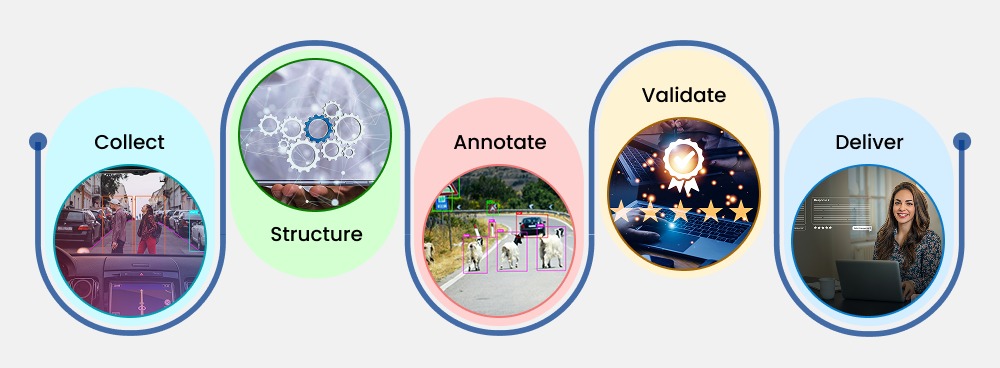
Physical AI data providers help robotics and autonomous AI teams to collect, structure, annotate, validate, and deliver real world training data for Physical AI.
Why they matter
Physical AI learns from actions, environments, objects, spatial relationships, and temporal behavior—not just pixels. Specialized Physical AI data providers support this through:
- Robotics training data collection across real-world environments and workflows.
- Physical AI annotation that makes actions, objects, and interactions machine-readable.
- AI datasets for robotics industry applications such as warehouse picking, kitchen automation, healthcare assistance, and other robotic workflows.
- AI robotics training datasets are used for perception, manipulation, imitation learning and policy learning.
Unlike conventional annotation vendors, Physical AI data providers connect data collection, Physical AI annotation, quality validation, and delivery into a robotics-ready pipeline—helping teams build more diverse, reliable training data at scale.
2. From Static Images to Physical AI Annotation: The Limits of Traditional Datasets
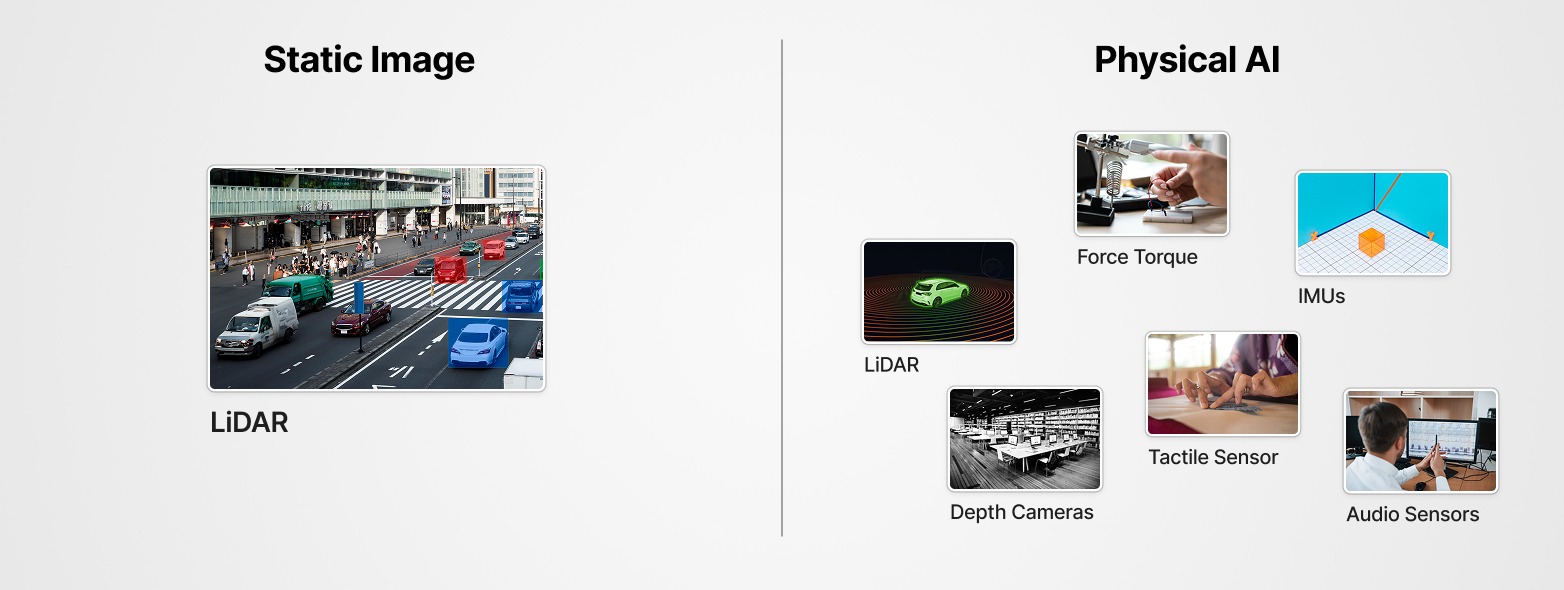
Static images may reveal what an object is, but Physical AI also needs to understand where it is, how it moves, and how it interacts with people. For robotics, context evolves across time and space and often requires multiple synchronized sensors.
Spatial context: object position, depth, distance, and relationships.
Temporal context: actions, motion, and what happens before and after an interaction.
Human behavior: movement, pose, grasping, and task intent.
Environmental signals: video, IMU, depth, and audio.
This is why Physical AI data providers increasingly build multimodal sensor fusion datasets from synchronized egocentric data and sensor data collection—not isolated images. For example, a warehouse robot needs to understand an operator reaching for a package, the package’s position, and the surrounding environment simultaneously.
For AI datasets for robotics industry, simply collecting more images is not enough; the challenge is collecting the right data from the right environments.
3. Capturing the Real World: The Role of Physical AI Data Providers in Robotics Training Data Collection
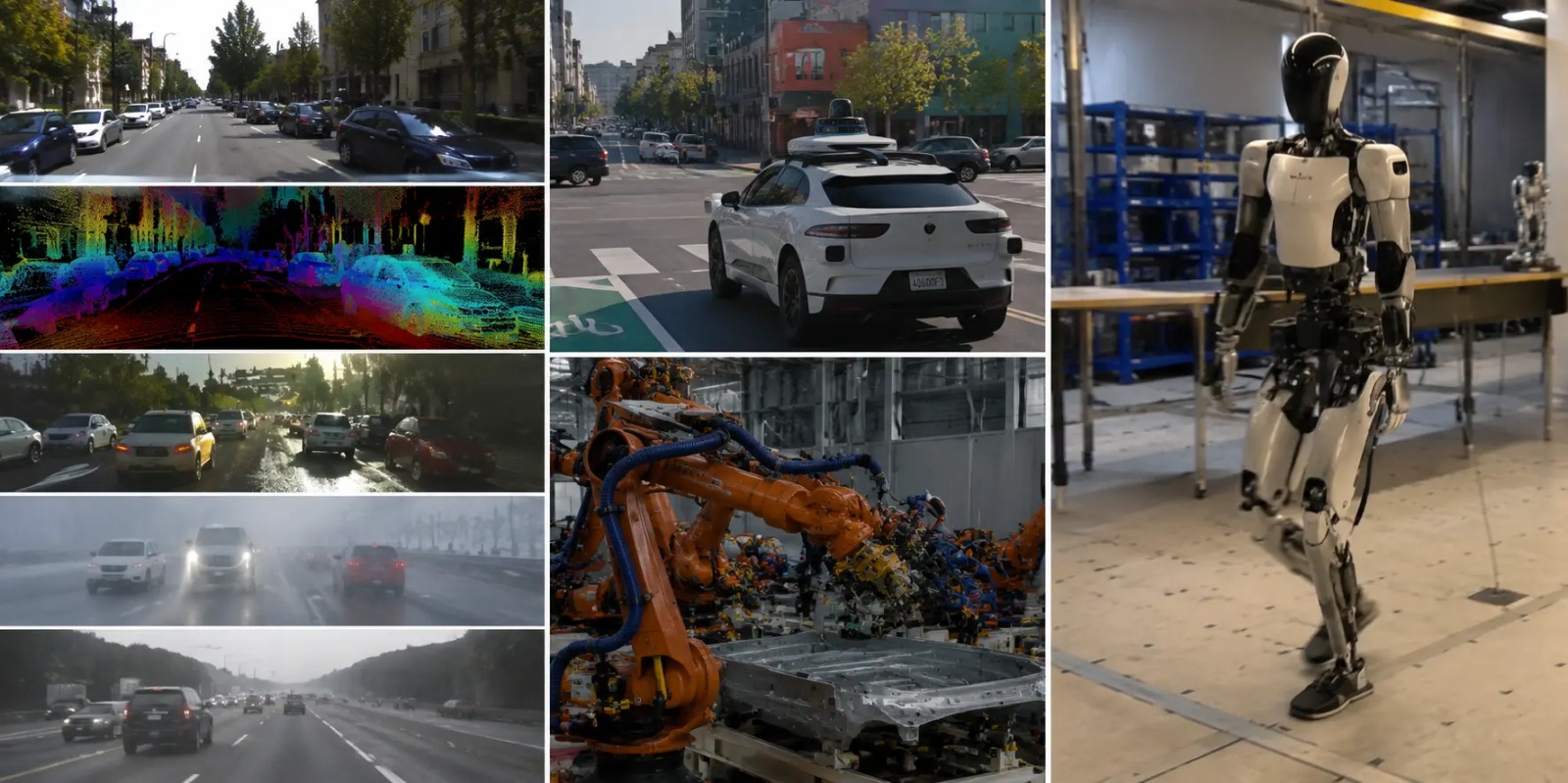
Effective robotics training data collection starts where robots will actually operate—not only in controlled labs. Physical AI data providers can capture diverse workflows across:
Houses: Cooking, cleaning and object manipulation.
Factory and Warehouses: Picking, packing, assembly and sorting.
Healthcare: Assisted-living and patient assistance workflow.
Retail and Food & Beverage: Shelf manipulation, serving and kitchen workflows.
Construction & outdoors: navigation and material handling.
Macgence’s network spans 150+ countries, 800+ languages, and 10,000+ verified sites, enabling a geographically diverse collection. This complements sensor data collection and specialized applications such as autonomous driving data collection, where environmental diversity also matters.
4. Combining Egocentric Data and Sensor Data Collection for Advanced Physical AI Models
A robot rarely relies on one signal to understand a physical task. Egocentric data becomes more valuable when synchronized with complementary sensor data, creating a richer view of movement, objects, and interactions.
Why Sensor Synchronization Matters
RGB/video: captures visual context and actions.
Depth + IMU: adds spatial and motion information.
Audio: provides additional environmental context.
Pose estimation: represents human movement and body position.
Force/torque and tactile data: capture physical interaction.
Building Multimodal Sensor Fusion Datasets
Physical AI data providers can combine these streams into multimodal sensor fusion datasets, giving Physical AI annotation pipelines more context than isolated modalities. Macgence supports frame-accurate synchronization across video, depth, audio, and IMU. This sensor data collection approach helps models learn not only what happened, but how movement and interaction unfolded.
5. Physical AI Annotation: Turning Raw Robotics Data Into Training-Ready Data
What is Physical AI annotation? It is the process of converting raw robotics data into structured labels that help models understand actions, objects, interactions, motion, and physical context. Unlike basic video annotation, Physical AI annotation captures richer relationships needed for robotics models.
What Does Physical AI Annotation Include?
Actions & time: Frame-level actions and temporal phases.
Objects & scenes: Segmentation, spatial relationships, and 3D bounding box annotation.
Interaction: Hand-object contact and grasp taxonomy.
Intent & pose: Task intent, phases, and pose estimation.
Physics: surface friction, object deformation, and applied force vectors.
Language: Natural-language descriptions for model training.
This six-layer approach combines robotics data annotation with deeper semantic annotation services, turning complex observations into training-ready data. For Physical AI data providers, this depth is what separates basic labeling from production-focused Physical AI annotation.
6. Operator-in-the-Loop Training Data: How Physical AI Data Providers Capture Human Demonstrations
What Is Operator-in-the-Loop Training Data?
Operator-in-the-loop training data captures human demonstrations that show robots how tasks should be performed in physical environments. It can support workflows such as:
- Picking, packing, assembly, and sorting
- Cooking, cleaning, and tool use
- Dexterous manipulation and object handling
How Teleoperation Data Captures Human Demonstrations
Physical AI data providers use teleoperation data, including VR-based and haptic setups, to record paired observations and actions. Macgence uses operators across 150+ countries to generate demonstration data, with trajectory validation and QA.
Why Human Demonstrations Matter
Human demonstrations provide behavioral examples that complement robotics training data collection, human motion capture, and Physical AI annotation, helping models learn task execution and manipulation rather than simply recognize objects.
7. Advanced Physical AI Annotation: From Human Motion Capture to 3D Bounding Box Annotation
Human Motion Capture for Robot Learning
Human motion capture adds movement context to robotics datasets through skeletal motion, joint positions, and temporal movement sequences, supporting imitation learning, sim2real, and VLA training.
Pose Estimation and 3D Spatial Data
Pose estimation helps models understand body movement and interaction, while 3D object localization captures where objects exist within a scene.
3D Bounding Box Annotation for Physical AI
3D bounding box annotation can represent object dimensions, occlusion, state, and spatial relationships—important for manipulation and navigation. In LiDAR-based robotics workflows, LiDAR annotation can provide additional 3D spatial information for perception and localization. Together, these forms of Physical AI annotation make robotics data more spatially informative.
8. AI Robotics Training Datasets: Combining Real, Annotated, and Synthetic Data
Real-World Data for Grounding
Strong AI robotics training datasets combine real-world observations with egocentric data, multimodal data, teleoperation demonstrations, human motion capture, and annotated video. This gives models varied examples of how objects, people, and environments behave in practice. Effective robotics training data collection provides the foundation, while Physical AI annotation structures that data for learning.
Synthetic Data for Scale and Edge Cases
Synthetic data can expand coverage through digital twins, domain randomization, and simulated variations. Synthetic Data and Sim2Real act as a Physical AI service pillar using digital twins, domain randomization, and synthetic variants to augment real-world datasets.
Building Datasets for VLA and Policy Learning
For AI datasets for robotics industry, specialised Physical AI data providers can combine real and synthetic sources to build AI robotics training datasets for VLA models and policy learning.
9. How Does Macgence Function as an End-to-End Physical AI Data Provider?
Choosing Physical AI data providers means looking beyond collection alone. Macgence supports the pipeline from robotics training data collection to Physical AI annotation and delivery.
Built for Scale
- 20K+ trained operators, 150+ countries, and 10K+ verified sites support diverse collections.
- Deep Physical AI annotation across actions, objects, pose, intent, and physics.
- Multimodal sensor fusion datasets and operator-in-the-loop training data support advanced robotics workflows.
Quality to Delivery
A six-stage QA pipeline validates capture, content, annotation, physics, provenance, and pipeline readiness. Data moves from discovery and capture through annotation and QA to S3 or preferred delivery formats. This helps enterprises build reliable AI robotics training datasets at scale.
10. Frequently Asked Questions
1. What are Physical AI data providers?
Physical AI data providers collect, annotate, validate, and deliver real-world data for robotics and autonomous AI systems, including AI robotics training datasets.
2. What is Physical AI annotation?
Physical AI annotation structures robotics data with labels for actions, objects, poses, interactions, intent, spatial relationships, and physical properties.
3. What types of annotation are used in Physical AI?
Common types include video annotation, 3D bounding box annotation, pose estimation, action labeling, object segmentation, grasp annotation, and physics-aware annotation.
4. What types of data are used to build AI robotics training datasets?
AI robotics training datasets can combine egocentric video, multimodal sensor data, teleoperation data, human motion capture, annotated video, and synthetic data.
6. How can enterprises choose the right Physical AI data provider?
Evaluate Physical AI data providers on collection scale, annotation depth, multimodal capabilities, QA, data provenance, operator networks, and delivery integration. Macgence supports this end-to-end pipeline.
 Previous Blog


You Might Like
August 17, 2026
Video Narration Annotation for Robotics Egocentric Data: Building AI Datasets for the Robotics Industry
Robotics has progressed beyond controlled lab settings and into Physical AI systems that can perceive, comprehend, and interact in the real world. In light of the rapid progress being made towards this technology, AI datasets that will feed the future needs of the robotics sector will no longer suffice without the context, structure, and multimodal […]

August 10, 2026
Annotation for Robotics: How High-Quality Data Improves Robot Intelligence
Robots today must be able to maneuver through complex surroundings, identify objects, perceive human intent, and make smart decisions. All of this can only be achieved with the use of robotics annotation and high-quality annotation for robotics, which convert unstructured sensory inputs into high-quality AI robotics training datasets. In all industries, ranging from manufacturing and […]

August 3, 2026
Custom Datasets Training: How the Right AI Training Data Provider Builds Better AI Models
Modern AI models depend heavily on the dataset used for its training. Although open source datasets can give a good head start, most times, such data lacks the specific knowledge that is required for enterprise-level applications. This is when custom datasets training comes into play. By partnering with an expert AI training data provider, organizations […]