


- 1. What Is an Annotation Provider and Why Is It Essential for Scaling AI Training Data and AI Robotics Training Datasets
- 2. Computer Vision Data Annotation: Transitioning from 2D Images to Complex 3D Environments with an Annotation Provider
- 3. How High-Quality NLP Data Annotation Services Transform Raw Text into Actionable AI Training Data
- 4. Healthcare Data Annotation: Building Reliable AI Training Data for Medical AI Applications
- 5. Why an Expert Annotation Provider Is Essential for Scaling Robotics Annotation and Physical AI Annotation
- 6. Multimodal Annotation: Connecting Vision, Language, Audio and Sensor Data
- 7. How a Trusted Annotation Provider Guarantees Quality and Scalability Across AI Training Data
- 8. The Ultimate Guide to Selecting an Annotation Provider for Specialized AI Training Data Pipelines
- 9. Ensuring Precision at Scale: Why Enterprises Choose Macgence as an End-to-End Annotation Provider for AI Training
- 10. Frequently Asked Questions
Annotation Provider for AI Training: Computer Vision, NLP, Healthcare and Robotics Annotation
All effective AI models, from robots to clinical NLP engines, require one crucial layer: annotation. As enterprises race to deploy computer vision, NLP, healthcare, and robotics solutions, the quality of an annotation provider now makes all the difference between the success or failure of a model outside of lab conditions. Generic labeling cannot meet the needs of increasingly complex, multimodal, and domain-specific AI training data that includes images, videos, text, audio files, point clouds, and sensor fusion streams. Enterprises are moving from ad-hoc labeling providers to dedicated annotation providers who know how to follow annotation guidelines, quality control practices, and industry context.
1. What Is an Annotation Provider and Why Is It Essential for Scaling AI Training Data and AI Robotics Training Datasets
The process of annotating language data is more complex than annotating image data – context, tone, and intent change with every new sentence. This is the reason why NLP data annotation is becoming a specialized practice, and why enterprises may benefit from working with an expert annotation provider rather than managing the entire annotation workflow in-house.
Annotation quality directly shapes model accuracy, bias, and real-world generalization. A trustworthy annotation provider works across:
- Images and video
- Text and conversational data
- Audio and speech
- 3D and sensor data (LiDAR, radar, depth)
- Multimodal, fused datasets
The difference between generic labeling and specialized data annotation services lies in domain expertise, structured workflows, and consistent QA — the foundation every enterprise AI training data pipeline needs.
2. Computer Vision Data Annotation: Transitioning from 2D Images to Complex 3D Environments with an Annotation Provider
Computer vision data annotation is where most AI training data journeys begin, but enterprise use cases quickly outgrow simple tagging. A capable annotation provider must move fluidly from flat image labels to spatially aware, three-dimensional understanding.
Image annotation services cover bounding boxes, polygons, keypoints, classification, and semantic or instance segmentation — the building blocks of object detection.
Video annotation extends this into object tracking, action recognition, temporal labeling, and scene understanding across frames.
Unlike 2D boxes, 3D bounding boxes represent an object’s spatial dimensions, position, and orientation in three-dimensional space — critical for:
- Autonomous vehicles navigating traffic
- Robotics grasping and manipulation
- Warehouse automation and shelf-picking
An annotation provider skilled in LiDAR and point-cloud annotation gives computer vision models genuine spatial intelligence, not just flat recognition.
3. How High-Quality NLP Data Annotation Services Transform Raw Text into Actionable AI Training Data
Language data is messier than pixels — context, tone, and intent shift with every sentence. This is where NLP data annotation earns its place as a specialized discipline, and why enterprises rely on an experienced annotation provider rather than in-house guesswork.
A capable annotation provider supports:
- Text classification and sentiment annotation
- Intent annotation for chatbots and virtual assistants
- Entity annotation and question-answer dataset creation
- Document and multilingual annotation
Named Entity Recognition and NLP Data Annotation
NER tagging allows identifying people, organizations, locations, dates, products, and medical terms within unstructured text, providing language models structured real-world context. For global businesses, multilingual AI training data created via systematic NLP data annotation is what distinguishes a chatbot that just answers queries from one that really understands customer intent regardless of language and region.
4. Healthcare Data Annotation: Building Reliable AI Training Data for Medical AI Applications
Healthcare annotation is not “computer vision with a different subject” — it demands clinical literacy, strict privacy discipline, and zero tolerance for ambiguity. An annotation provider entering this space must combine healthcare data labeling expertise with regulatory awareness.
Why Healthcare Annotation Requires Domain-Specific Expertise
Medical imagery, clinical notes, and radiology scans contain terminology that generic annotation workflows may not provide the domain expertise required to interpret such data consistently.
- Core healthcare annotation workstreams include:
- Medical image and radiology dataset annotation
- Clinical text and NLP data annotation for patient records
- Medical document annotation and terminology extraction
- Entity extraction supporting decision-support systems
Annotation strengthens the training data feeding medical imaging AI, clinical NLP, and healthcare document processing — though annotation quality alone does not certify clinical safety, which remains dependent on model validation, regulatory review, and healthcare provider oversight.
5. Why an Expert Annotation Provider Is Essential for Scaling Robotics Annotation and Physical AI Annotation
Robots don’t just see the world — they act inside it. This is why robotics annotation and Physical AI annotation demand far more than static labels, and why an experienced annotation provider becomes mission-critical for AI robotics training datasets.
Beyond object and scene annotation, robotics annotation captures:
- Pose, keypoint, and 3D bounding-box data
- Action, temporal, and human-object interaction labels
- Egocentric and teleoperation demonstrations
- Multimodal sensor fusion across camera, LiDAR, IMU, and depth
Physical AI models often require training data that captures observations, objects, actions, environments, and temporal relationships. High-level annotation pipelines include frame-level action labels, hand-object grasp taxonomy, intent and task phase labels, physics-related annotations (friction, force, deformations), and natural-language descriptions for every clip, which enables vision-language-action models capable of anticipating rather than reacting.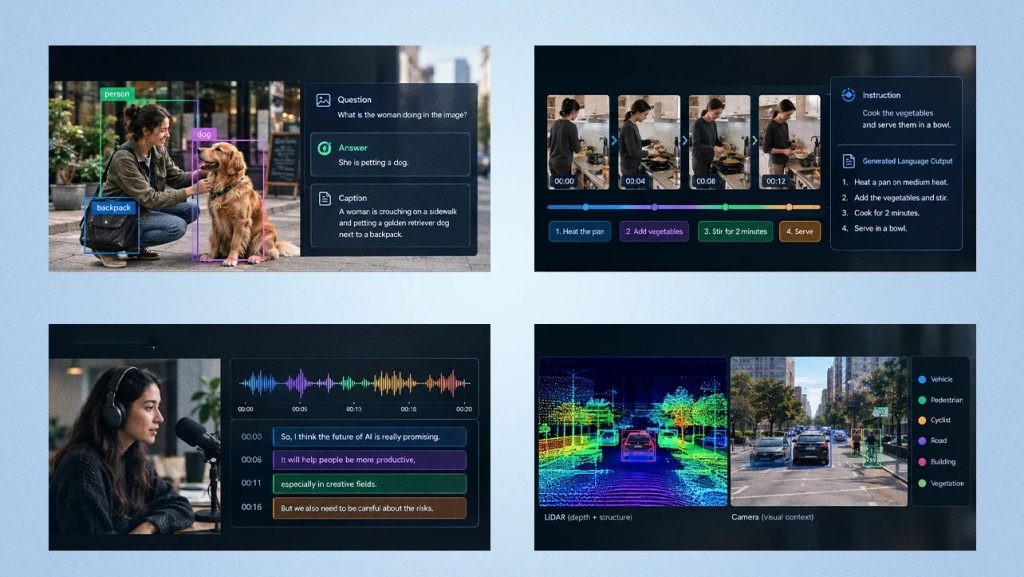
6. Multimodal Annotation: Connecting Vision, Language, Audio and Sensor Data
Many modern AI systems increasingly rely on multiple modalities rather than a single data type. Autonomous systems combine cameras with LiDAR; conversational AI combines speech with its transcription; robotics combines video, sensors, and language. This trend is what explains why an annotation provider should understand not only particular modalities but also their interrelation.
Multimodal annotation spans:
- Image + text (visual question answering, captioning)
- Video + language (instruction-following datasets)
- Audio + transcript alignment
- LiDAR + camera sensor fusion for autonomous and robotic systems
A good annotation provider unites all these streams into a single, well-referenced AI training dataset, rather than just isolated labeled files. When it comes to enterprise companies building autonomous vehicles, service robots, or multimodal assistants, this synchronization of data annotation services is crucial for scaling downstream model training and evaluation.
7. How a Trusted Annotation Provider Guarantees Quality and Scalability Across AI Training Data
Accuracy claims mean little without a visible process behind them. A dependable annotation provider builds quality into every stage of the pipeline, not just at final review.
The workflow typically follows:
- Annotation guidelines definition
- Annotator training and calibration
- Sample annotation and alignment checks
- Human-in-the-loop review and QA
- Error resolution and re-annotation
- Dataset validation and audits
- Delivery in the required schema
For robotics-grade pipelines, this extends into capture QA, content QA, annotation QA, physics QA, provenance QA, and pipeline QA — with chain-of-custody, consent records, and bias auditing built in.
Macgence has delivered 500+ projects, annotated 5M+ files, and maintains ~95% annotation accuracy across 200+ languages, proof that quality and scale can coexist.
8. The Ultimate Guide to Selecting an Annotation Provider for Specialized AI Training Data Pipelines
Choosing an annotation provider shouldn’t come down to price per label. Enterprises evaluating data annotation services should apply a structured framework before signing any contract.
Ask these questions:
- What data type needs annotating — image, video, text, audio, 3D, or multimodal?
- Is the annotation generic, or genuinely domain-specific?
- What accuracy and QA benchmarks does the provider guarantee?
- Can they scale from pilot volumes to production without quality drop-off?
- Do they support custom annotation guidelines and edge cases?
- Do they understand your industry — healthcare, automotive, robotics, retail?
- Can they support the full AI data lifecycle — collection, annotation, validation, delivery?
For enterprises looking beyond standalone labeling, a comprehensive annotation provider that covers the whole AI training data pipeline becomes more of an infrastructure partner rather than just a vendor.
9. Ensuring Precision at Scale: Why Enterprises Choose Macgence as an End-to-End Annotation Provider for AI Training
Macgence operates as an end-to-end AI data and annotation provider, covering data collection, annotation, validation, and custom dataset curation across multiple data modalities and AI applications.
- Computer Vision: Image annotation services, video annotation, and 3D bounding box annotation for autonomous and warehouse systems.
- NLP: NLP data annotation for entities, sentiment, intent, and multilingual text across 200+ languages.
- Healthcare: Healthcare data labeling for clinical, imaging, and document datasets.
- Robotics: Robotics annotation and Physical AI annotation powering AI robotics training datasets, teleoperation, and egocentric capture.
With a track record of 500+ successful projects, 5M+ annotated files, almost 95% accuracy rate, and more than 4000 off-the-shelf datasets, Macgence integrates custom sourcing, RLHF, and validation into one scalable AI training data pipeline.
Building AI models that need reliable, domain-specific training data? Macgence can help you collect, annotate, validate, and scale the datasets your computer vision, NLP, healthcare, and robotics systems need.
Talk to Macgence about your AI training data requirements →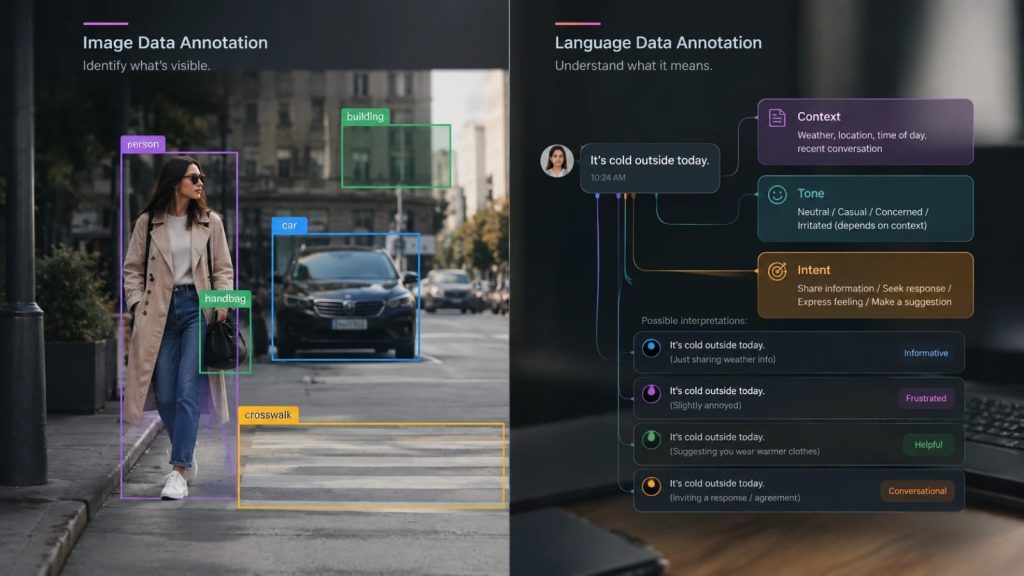
10. Frequently Asked Questions
- What is an annotation provider?
An annotation provider labels, structures, and validates raw data — images, text, audio, video, or sensor input — turning it into accurate, model-ready AI training data.
- What does an annotation provider do for AI training?
An annotation provider labels and structures raw data according to defined guidelines, applies quality-control processes, and delivers validated datasets in the required format. Some providers also offer data collection and sourcing as part of an end-to-end AI data workflow.
- What types of data can an annotation provider annotate?
Image, video, text, audio, 3D/sensor data, and multimodal combinations — covering computer vision, NLP, healthcare, and robotics use cases.
- How does annotation support AI robotics training datasets?
It provides structured information about objects, scenes, actions, poses, and temporal relationships that can be used to train robotics perception, imitation-learning, and policy-learning systems.
- Can Macgence provide customized AI training data and annotation services?
Yes. Macgence delivers custom data collection, annotation, validation, and dataset curation across 200+ languages with ~95% accuracy for enterprise AI teams.
 Previous Blog


You Might Like

September 21, 2026
Video Captioning Services for Multimodal AI Training, Video Annotation, Accessibility, and Multilingual Content
Businesses across industries use video for training, product demonstrations, marketing, education, internal communications, and more recently, AI development. But raw video is messy: spoken dialogue is embedded in audio, and visuals have not been labeled yet. This is where video captioning services come into play, which help transform unstructured video into structured, searchable, and AI-friendly […]
September 14, 2026
Teleoperations Robotics Data for Physical AI: Building Better AI Robotics Training Datasets
Physical AI only earns trust when it acts correctly in the real world, not just when it recognizes patterns on a screen. Robots performing tasks in warehouses, manufacturing facilities, hospitals, and urban environments need to translate their perceptions into safe and accurate physical action, which static training datasets alone cannot fully capture. Here, teleoperations robotics […]
September 8, 2026
Multimodal Datasets: The Complete Guide to AI Training Data for Modern AI Models
AI models do not perceive the world through just one sense, and neither should their training datasets. A self-driving car does not just “see”; it senses distance and tracks movements. In the same vein, conversational AI agents do not just analyze text; they hear, interpret tones, and process visual information. This is the very essence […]