


- What Are Pose Estimation Datasets?
- Why Pose Estimation Datasets Are Critical for AI Training
- Key Features of High-Quality Pose Estimation Datasets
- Types of Pose Estimation Datasets Macgence Supports
- Common Challenges in Pose Estimation Dataset Development
- How Macgence Builds High-Quality Pose Estimation Datasets
- Applications of Pose Estimation Datasets Across Industries
- Emerging Trends in Pose Estimation Datasets
- How to Choose the Right Pose Estimation Dataset Provider
- Power Your AI with Premium Motion Data
- FAQs
Pose Estimation Datasets: The Foundation of Human-Centric AI Systems
Teaching machines how to interpret human movement is one of the most exciting frontiers in computer vision. Algorithms can now track a runner’s stride, analyze factory worker ergonomics, and help robots safely interact with humans. At the core of all these breakthroughs is a foundational element: pose estimation datasets.
As industries increasingly rely on automation, behavioral analytics, and intelligent systems, the demand for accurate motion tracking has skyrocketed. AI models need to understand exactly how a human body bends, twists, and moves through space. To do this effectively, they require massive amounts of precisely annotated training data. Data quality directly dictates whether an AI model performs seamlessly in the real world or fails completely.
Building these highly accurate, diverse, and scalable datasets requires specialized expertise. That is where Macgence steps in. As a premier provider of high-quality AI training data and annotation services, Macgence ensures your pose estimation projects are built on a flawless foundation.
What Are Pose Estimation Datasets?
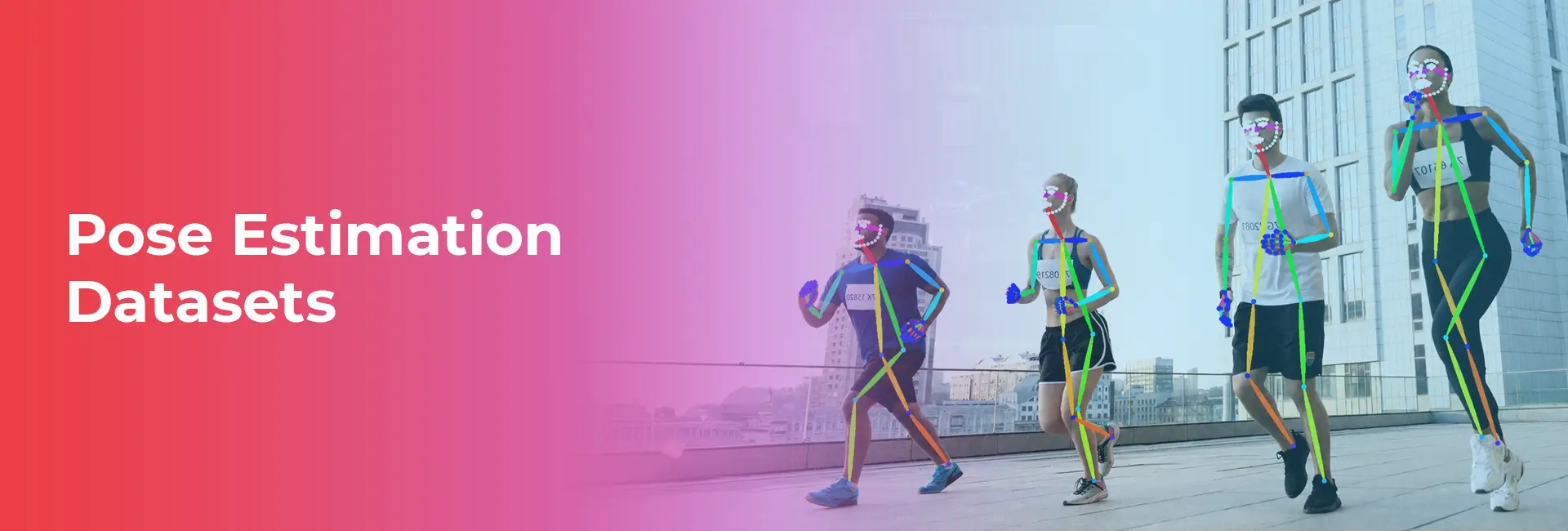
Pose estimation datasets are collections of images or videos where human joints and anatomical landmarks are precisely labeled. Through a process known as keypoint detection and skeletal tracking, annotators map out critical points like shoulders, elbows, knees, and ankles. This allows AI models to analyze the annotated body landmarks to understand motion, posture, and spatial positioning.
Common Types of Pose Estimation
- 2D pose estimation: Tracks human movement along X and Y axes, predicting joint locations on a flat image.
- 3D pose estimation: Adds depth (the Z-axis) to understand movement in three-dimensional space.
- Multi-person pose estimation: Identifies and tracks multiple individuals within a single frame.
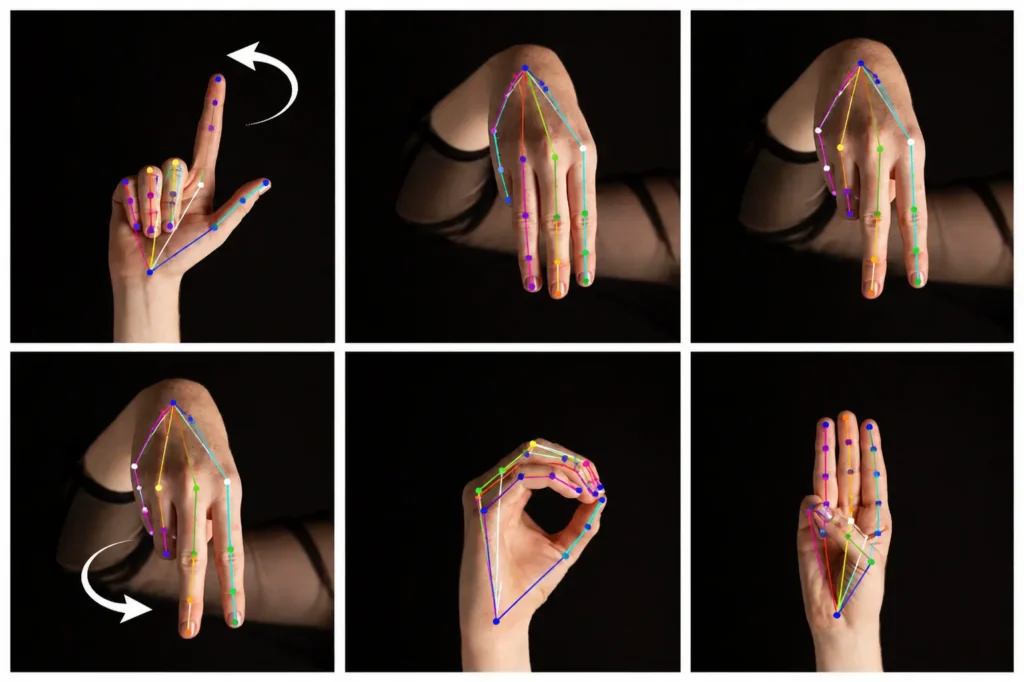
- Hand and finger pose estimation: Maps the complex articulation of the hand for gesture recognition.
- Full-body motion tracking: Captures the entire skeletal structure to monitor complex, dynamic movements.
Difference Between Pose Estimation and Object Detection
While object detection draws bounding boxes around items or people to confirm their presence, pose estimation goes much further. It maps skeletal keypoints to interpret exactly what that person is doing. It shifts the AI’s capability from simply recognizing a human to actually understanding their movement.
Why Pose Estimation Datasets Are Critical for AI Training
An AI system is only as smart as the data it learns from. High-quality pose estimation datasets are essential for training reliable, real-world applications.
Improving AI Model Accuracy
Accurate training data leads to better landmark detection and reduced tracking errors. When models are trained on precise datasets, they deliver enhanced real-time performance, smoothly processing video feeds without losing track of limbs or joints.
Supporting Human-Centric AI Systems
Advanced systems require a deep understanding of human behavior. Pose estimation data powers human activity recognition, motion analysis, and gesture understanding. This enables behavioral AI that can interpret body language and intent.
Challenges of Poor-Quality Training Data
Models trained on subpar data struggle in deployment. Missing keypoints, inconsistent annotations, and a lack of diversity lead to biased algorithms that fail across different body types or movements. This results in poor performance during real-world scenarios.
Why Enterprises Need Scalable and Diverse Data
To function universally, an AI model needs exposure to multi-environment coverage. Diverse datasets help models handle edge cases—like unusual postures or overlapping subjects—while ensuring cross-device compatibility regardless of the camera used.
Key Features of High-Quality Pose Estimation Datasets
Not all training data is created equal. The most effective pose estimation datasets share several vital characteristics.
Accurate Keypoint Annotation
Precision is everything. Annotators must execute exact skeleton mapping and clearly label joint visibility. Proper occlusion handling—guessing the correct location of a joint hidden behind an object—is vital for robust model training.
Diverse Human Motion Data
Datasets must represent reality. This means including people of different age groups and body types across both indoor and outdoor environments. The data should span various contexts, including sports, workplace settings, retail, and daily activities, captured under various camera angles and lighting conditions.
Multi-Modal Dataset Support
Modern AI often relies on multiple data streams. High-quality datasets incorporate RGB video data, depth maps, LiDAR point clouds, and IMU sensor fusion data to provide richer contextual learning.
Temporal Consistency in Video Sequences
For motion tracking applications, data must be consistent across time. Frame continuity ensures that a model tracks a moving arm smoothly from one frame to the next without jittery or erratic predictions.
Types of Pose Estimation Datasets Macgence Supports
Macgence provides comprehensive data solutions tailored to specific industry needs.
Human Pose Estimation Datasets
We collect and annotate data covering walking, running, exercising, and workplace actions, including complex multi-person activity datasets.
Hand Pose Estimation Datasets
Essential for gesture recognition and VR/AR interactions, these datasets focus on fine-grained finger tracking and intricate hand movements.
Industrial Pose Estimation Data
We support factory worker monitoring, ergonomic analysis, and workplace safety compliance by tracking movements in industrial settings.
Robotics and Embodied AI Datasets
Our datasets facilitate human demonstrations for robot learning, robot imitation learning data, and human-object interaction tracking.
Sports and Fitness Motion Data
We provide data for athlete movement analysis, fitness posture correction, and rehabilitation monitoring to power the next generation of digital coaching.
Common Challenges in Pose Estimation Dataset Development
Building these datasets is notoriously difficult. Several hurdles must be overcome to guarantee quality.
Annotation Complexity
Keypoint labeling requires high precision. Mapping a 3D skeleton onto a 2D image is a highly time-intensive annotation workflow that requires trained experts.
Occlusion and Crowded Scenes
Tracking individuals becomes complicated when body joints are hidden by objects or when dealing with overlapping individuals in a crowded street scene.
Real-World Variability
Models must handle unpredictable variables like baggy clothing, rapid motion blur, and low-light environments that obscure joint locations.
Scaling Large Video Datasets
Video requires massive frame annotation. A few seconds of video translates to hundreds of frames, creating significant storage and processing demands.
Maintaining Annotation Consistency
Keeping labels uniform across a massive dataset requires standardized QA processes and rigorous cross-annotator validation.
How Macgence Builds High-Quality Pose Estimation Datasets
Macgence uses a proven, end-to-end methodology to deliver superior training data.
Custom Data Collection Services
We orchestrate controlled and real-world data collection using multi-camera setups. We ensure diverse participant sourcing to eliminate algorithmic bias.
Advanced Annotation Workflows
Our teams utilize manual and AI-assisted keypoint labeling. We perform meticulous frame-by-frame motion annotation and strict skeleton tracking validation.
Multi-Level Quality Assurance
Quality is built into our process. We enforce expert QA reviews, consensus validation among multiple annotators, and automated consistency checks.
Scalable Data Production
With a large annotation workforce, we guarantee fast project turnaround and enterprise-scale dataset delivery without compromising precision.
Data Privacy and Compliance
We prioritize ethical AI. All data is gathered via consent-based collection, ensuring secure data handling and compliance-ready workflows.
Applications of Pose Estimation Datasets Across Industries
Accurate motion data is reshaping how businesses operate across multiple sectors.
Healthcare and Rehabilitation
Pose estimation assists physical therapy monitoring, powers elderly fall detection systems, and enables remote patient movement analysis.
Sports and Fitness AI
Fitness apps use this technology for motion coaching systems, elite performance tracking, and injury prevention analytics.
Robotics and Human-Robot Interaction
Robots rely on pose estimation for imitation learning, human behavior understanding, and safe collaborative operations in shared workspaces.
Retail and Workplace Analytics
Enterprises use motion data for customer movement tracking, workplace safety monitoring, and proactive ergonomic assessments.
AR/VR and Gaming
Immersive technology relies on motion-controlled experiences, gesture-based interfaces, and highly responsive virtual interactions.
Emerging Trends in Pose Estimation Datasets
The field of computer vision is evolving rapidly, bringing new data requirements to the forefront.
3D Human Motion Understanding
There is a massive shift toward spatial movement tracking and advanced biomechanics applications that require complex 3D datasets.
Multimodal AI Training Data
AI builders are combining vision, depth, and sensor data to facilitate richer contextual learning for their models.
Synthetic + Real-World Data Blending
To improve scalability and reduce annotation costs, developers are increasingly augmenting real-world datasets with highly realistic synthetic data.
Egocentric and First-Person Motion Data
Wearable camera datasets are becoming essential for human action learning, particularly for embodied AI and smart glasses.
Real-Time Edge AI Applications
The push for on-device motion processing is driving the need for optimized models that support low-latency AI systems.
How to Choose the Right Pose Estimation Dataset Provider
Selecting a data partner is a critical strategic decision for your AI initiatives.
Important Factors to Evaluate
When assessing providers, look closely at annotation accuracy, dataset diversity, and multi-sensor support. You also need a partner who offers true scalability, rigorous QA processes, and proven industry expertise.
Why Enterprises Choose Macgence
Leading companies trust Macgence for custom AI dataset solutions. Our deep expertise in computer vision and embodied AI, combined with high-quality annotation pipelines and flexible scaling, makes us the ideal partner for enterprise AI projects.
Power Your AI with Premium Motion Data
Pose estimation datasets are the driving force behind modern computer vision. High-quality annotated motion data is absolutely critical for building reliable, unbiased, and effective AI systems. By leveraging custom datasets, enterprises can drastically improve real-world AI performance and unlock new technological capabilities.
As a trusted partner for pose estimation data collection and annotation services, Macgence is ready to help you build the foundation for your next computer vision breakthrough.
FAQs
Ans: – They are collections of images or videos where human anatomical joints (keypoints) are precisely labeled to help AI understand movement and posture.
Ans: – They teach AI models how to accurately detect, track, and interpret human motion, which is necessary for creating human-centric AI applications.
Ans: – Major industries include healthcare, sports and fitness, robotics, retail, workplace safety, and AR/VR gaming.
Ans: – Annotations typically include mapped skeletal keypoints (like elbows and knees), joint visibility flags, and bounding boxes for spatial context.
Ans: – Yes, Macgence provides end-to-end custom data collection and annotation services tailored to specific enterprise use cases.
Ans: – Common challenges include handling joint occlusion (hidden body parts), maintaining consistency across video frames, and annotating complex multi-person scenes.
Ans: – 2D pose estimation tracks movement on a flat plane (X and Y axes), while 3D estimation includes depth (Z-axis) for spatial tracking.
Ans: – Absolutely. They provide the human demonstration and behavioral data required for robot imitation learning and safe human-robot interaction.
Ans: – We utilize multi-level QA processes, including automated consistency checks, expert human reviews, and consensus validation.
Ans: – Macgence collects a wide variety of data, including full-body movement, hand gestures, facial expressions, and multimodal sensor data across diverse environments.
 Previous Blog


You Might Like

October 5, 2026
Data Annotation Company for AI Training: From Healthcare Data Labeling to Robotics & Multimodal Datasets
AI is transitioning from pilot to production, and models do not fail due to their architecture but due to the quality of the data which was used to train them. With the scaling of projects in computer vision, NLP, healthcare, robotics, companies need a data annotation company that will provide domain-specific labeling of all kinds […]

September 28, 2026
Annotation Provider for AI Training: Computer Vision, NLP, Healthcare and Robotics Annotation
All effective AI models, from robots to clinical NLP engines, require one crucial layer: annotation. As enterprises race to deploy computer vision, NLP, healthcare, and robotics solutions, the quality of an annotation provider now makes all the difference between the success or failure of a model outside of lab conditions. Generic labeling cannot meet the […]

September 21, 2026
Video Captioning Services for Multimodal AI Training, Video Annotation, Accessibility, and Multilingual Content
Businesses across industries use video for training, product demonstrations, marketing, education, internal communications, and more recently, AI development. But raw video is messy: spoken dialogue is embedded in audio, and visuals have not been labeled yet. This is where video captioning services come into play, which help transform unstructured video into structured, searchable, and AI-friendly […]