



- Why Real-World Data Matters in Robotics
- Smart Home Interaction Data: The Rise of Interaction-Centric Robotics
- Warehouses: Precision, Scale, and Efficiency Through Data
- Retail & Workplaces: Activity Recognition at Scaley
- Cross-Environment Learning: Bridging Smart Homes and Warehouses
- The Role of High-Quality Data Annotation & Collection
- Future Trends in Robotics Data
- Building the Bridge Between Automation and Intelligence
From Smart Homes to Warehouses: Data Use Cases in Robotics
Robotics technology is rapidly expanding across a wide variety of environments. We now see intelligent machines operating seamlessly in homes, warehouses, retail spaces, and corporate offices. This widespread adoption relies heavily on one crucial element: high-quality data.
Data serves as the foundation of real-world robot intelligence. However, a single, universal dataset cannot train a robot to function everywhere. An unstructured living room requires an entirely different set of information than a highly organized fulfillment center. Environment-specific datasets are necessary to teach machines how to navigate their unique surroundings.
Specific types of information, like Smart Home Interaction Data and warehouse logistics datasets, are actively shaping how robots perform in our daily lives. By looking at these specific use cases, we can better understand how robotics adapts to diverse environments through specialized data collection and training.
Why Real-World Data Matters in Robotics
Training a robot often begins with simulation data. Simulated environments offer a safe, controlled space for machines to learn basic tasks. However, real-world data presents an entirely different set of variables.
When robots enter actual physical spaces, they face numerous unpredictable challenges. They must navigate dynamic human behavior, adjust to unstructured environments, and process sensor noise. A robot might encounter a misplaced chair in a hallway or a person suddenly walking across its path. Context-aware learning allows the robot to understand these sudden changes and react appropriately.
To achieve this level of understanding, developers must rely on continuous data collection and annotation. Embodied AI training depends heavily on diverse, real-world datasets. Without exposure to the messy, unpredictable nature of physical spaces, robots cannot safely or effectively perform their duties.
Smart Home Interaction Data: The Rise of Interaction-Centric Robotics
The domestic space is one of the most complex environments for a robot to navigate. To succeed here, developers rely heavily on Smart Home Interaction Data. This specific type of data focuses on human-object interaction, as well as gesture, voice, and intent recognition.
Practical use cases for this technology are growing rapidly. Domestic assistants use this data to clean floors, organize items, and assist elderly individuals with daily routines. Personalized automation systems also rely on these datasets to learn household habits and adjust lighting or temperature accordingly.
Collecting this information involves multiple data types. Systems process vision through RGB video, listen to audio commands, track physical motion, and utilize sensor fusion from various IoT devices.
Gathering this information presents significant challenges. Privacy-sensitive data collection is a major concern for consumers. Furthermore, home layouts and human behaviors vary wildly from one household to the next. This creates a massive need for high-quality annotation to ensure the AI truly understands user intent. As AI-powered home ecosystems grow, the demand for human-centric training datasets will only increase.
Warehouses: Precision, Scale, and Efficiency Through Data
While homes are unpredictable, industrial spaces operate on strict routines. Robotics play a massive role in modern warehouses by handling automated picking and packing, inventory tracking, and moving goods via autonomous mobile robots (AMRs).
These machines learn their environments through warehouse logistics datasets. These are highly structured datasets that capture object detection for boxes, pallets, and specific SKUs. They also map complex navigation paths and facilitate multi-agent coordination so multiple robots can work in the same aisle without colliding.
Key data modalities in this sector include LiDAR and depth sensing, indoor tracking via camera feeds, barcode or RFID data, and precise robot trajectory logs.
Even in structured spaces, challenges remain. Robots must make real-time decisions while maintaining high accuracy requirements. They also have to handle edge cases, such as identifying damaged goods or navigating temporarily cluttered spaces. Ultimately, accurate data drives massive business impact. It leads to faster fulfillment, reduced operational costs, and improved scalability for logistics companies.
Retail & Workplaces: Activity Recognition at Scaley
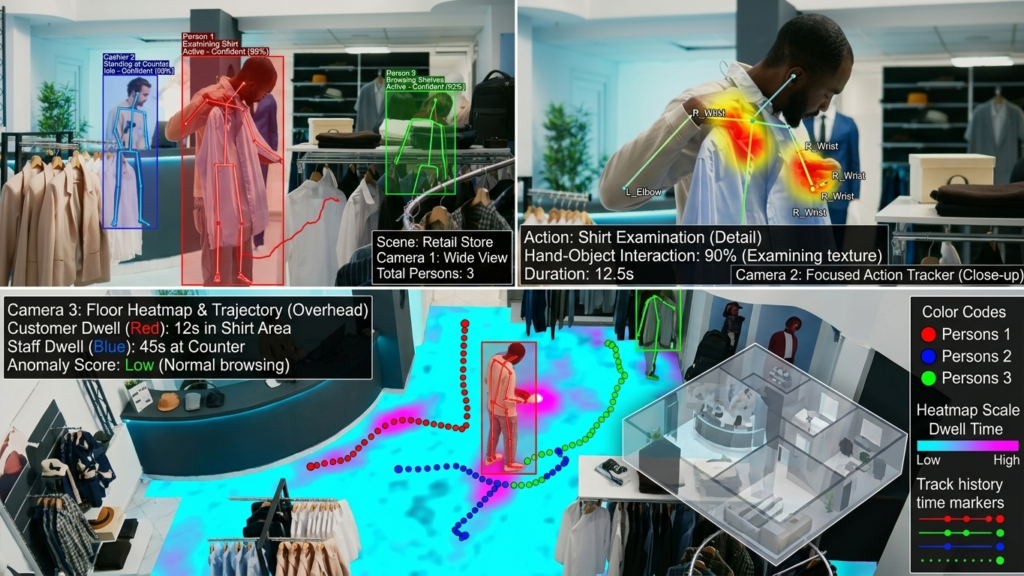
Public and commercial spaces introduce another layer of complexity. In these environments, retail and workplace activity recognition becomes essential. This involves tracking human movement and actions to understand workflows and behavior patterns.
In retail settings, this technology enables customer behavior analysis. Stores can automate shelf monitoring and restocking by tracking which items are removed. In corporate workplaces, activity recognition helps monitor safety compliance, gather productivity insights, and facilitate safe human-robot collaboration on factory floors.
Meeting these goals requires highly specific data requirements. Developers need annotated video datasets, temporal activity labeling, and multi-camera synchronization to track actions seamlessly across a large space.
The challenges in this sector are distinct. Complex human interactions and crowded environments often cause visual occlusions, making it difficult for cameras to see everything clearly. Additionally, companies must carefully navigate ethical considerations and potential bias when tracking human behavior at scale.
Cross-Environment Learning: Bridging Smart Homes and Warehouses
Homes are unstructured and highly human-centric. Warehouses are structured and driven by pure efficiency. Despite these differences, cross-domain datasets are becoming increasingly valuable.
Developers use transfer learning and multimodal robotics datasets to share knowledge across different environments. For example, a robot originally trained to grasp and move boxes in a warehouse might use those same foundational skills to adapt to household tasks, like picking up toys or organizing a pantry. Sharing data across domains accelerates the training process and creates more versatile machines.
The Role of High-Quality Data Annotation & Collection
Raw data is useless without proper context. Accurate labeling and context-aware annotations are vital for teaching a robot exactly what it is looking at. Common types of annotation include object detection, pose estimation, and activity tagging.
Many companies choose to outsource this labor-intensive process. Outsourcing provides scalability and grants access to specific domain expertise. Providers like Macgence specialize in building robust robotics data pipelines. By offering custom dataset creation tailored to real-world environments, they help robotics companies deploy smarter, safer machines faster.
Future Trends in Robotics Data
The way we train robots is constantly evolving. Multimodal datasets that combine vision, audio, and touch are becoming the new standard. Real-time data feedback loops allow machines to learn from their mistakes immediately. We are also seeing a rise in synthetic and real hybrid datasets, which blend simulated environments with physical world data.
Looking forward, there will be an increasing demand for personalized robotics and highly industry-specific datasets. The rise of foundation models for robotics will likely accelerate this trend, giving machines a broader base of general knowledge to build upon.
Building the Bridge Between Automation and Intelligence
Environment-specific data will remain the most critical factor in robotics development. A machine’s ultimate success depends entirely on data diversity and its ability to adapt to real-world conditions. From smart homes to highly efficient warehouses, high-quality data serves as the bridge between simple automation and true artificial intelligence.
FAQs
It is data that captures how humans interact with their domestic environments and objects. It includes voice commands, gesture recognition, and movement tracking used to train household assistant robots.
These datasets teach robots how to navigate structured spaces safely. They provide the necessary information for object detection, inventory tracking, and path planning, which improves warehouse efficiency.
Activity recognition involves tracking and analyzing human movement. It is used to monitor customer behavior in stores or ensure safety compliance and smooth workflows in industrial workplaces.
Robotics training utilizes multimodal data. This includes RGB camera video, LiDAR depth sensing, audio recordings, motion tracking, and sensor feedback from IoT devices.
Key challenges include managing privacy concerns, handling unpredictable human behavior, dealing with sensor noise, and accounting for the massive variability in physical environments.
High-quality annotation gives raw data context. Accurate labeling, such as bounding boxes or activity tags, ensures the robot correctly interprets its surroundings and makes safe decisions.
Yes, through a process called transfer learning. Foundational skills learned in a warehouse, such as object manipulation or spatial awareness, can be adapted to help a robot perform unstructured tasks in a home.
 Previous Blog


You Might Like

October 21, 2026
Best Image Annotation Companies in 2026: Compare Services, Accuracy and Pricing
Leading image annotation companies help computer vision teams create consistent, high-quality labels that support model training and evaluation. In 2026, enterprise teams train their detection, inspection, and robotics models on millions of images, so one poor vendor selection can delay full-scale implementation. Image annotation providers generally fall into two broad categories: managed annotation services and […]

October 12, 2026
DataRobot Training for Enterprises: How High-Quality AI Training Data Improves Model Performance
DataRobot Training refers to the data preparation process, followed by machine learning model creation and evaluation on the DataRobot platform. It requires AI training data to be reliable in terms of labels and datasets as well as consistency of records – otherwise, there will be no valid predictions. As businesses transition AI from pilot to […]

October 5, 2026
Data Annotation Company for AI Training: From Healthcare Data Labeling to Robotics & Multimodal Datasets
AI is transitioning from pilot to production, and models do not fail due to their architecture but due to the quality of the data which was used to train them. With the scaling of projects in computer vision, NLP, healthcare, robotics, companies need a data annotation company that will provide domain-specific labeling of all kinds […]