


- Why Human Motion Matters in Robot Learning
- What is Multimodal Data in Robotics?
- The Role of Real-World Human Motion Data
- 3D Body Pose Estimation from Egocentric View
- Importance of High-Quality Pose Estimation Datasets
- Data Collection and Annotation Pipeline
- Key Challenges in Multimodal Human Motion Data
- Future Trends in Human Motion-Based Robot Learning
- Shaping the Future of Intelligent Robotics
- Frequently Asked Questions
Bridging Human Motion and Robot Learning with Data
Robotics has experienced a massive shift in recent years, moving away from rigid, rule-based programming toward dynamic, data-driven learning. For intelligent systems to operate seamlessly alongside humans, they need to understand and replicate human actions. Capturing human motion is essential for training these modern AI systems.
Historically, developers relied heavily on synthetic data or lab-controlled environments to teach robots. While useful, these controlled datasets fail to capture the unpredictability of human behavior. This is where real-world human motion data becomes vital. It provides the nuanced, unstructured information robots need to function in everyday environments. To capture this complexity fully, engineers rely on multimodal data—combining visual feeds, depth sensors, motion trackers (IMUs), and audio signals to give robots a comprehensive understanding of human movement.
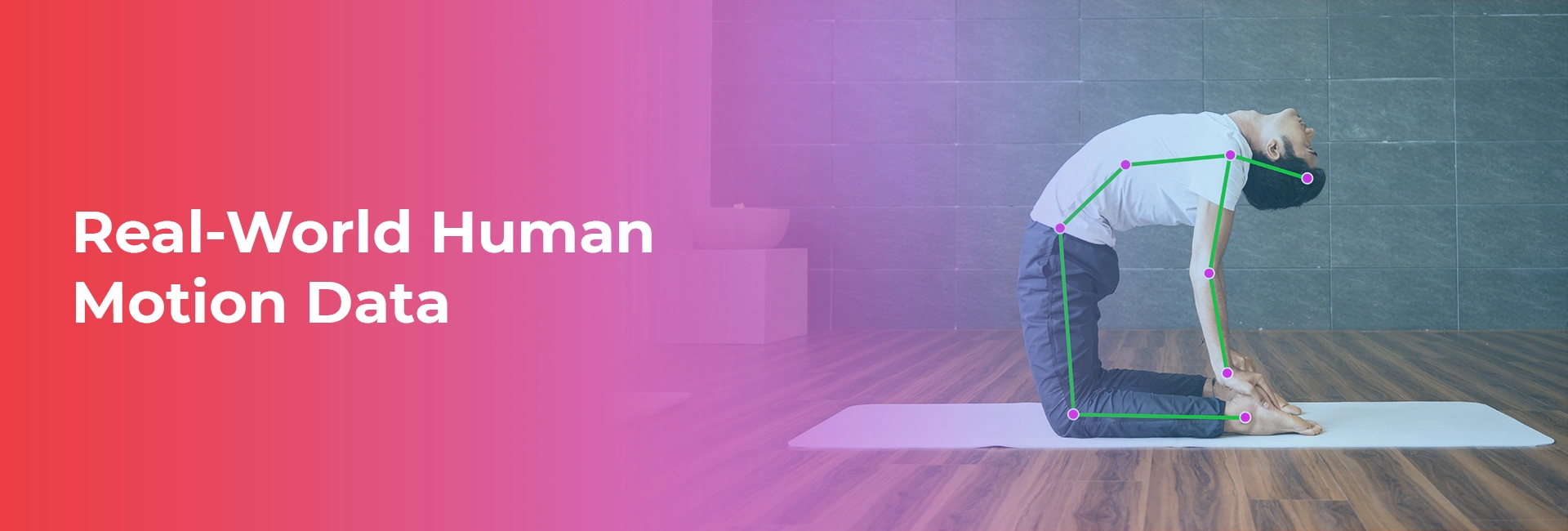
Why Human Motion Matters in Robot Learning
Robots increasingly learn by imitation, a process known as Learning from Demonstration (LfD). Instead of hardcoding every joint movement, engineers show the robot how a human performs a task. To do this effectively, systems must capture fine-grained motion, such as subtle hand-object interactions, body posture shifts, and underlying human intent.
The applications for this technology are vast. In industrial robotics, machines learn to assemble complex parts by watching human technicians. In healthcare, assistive robots analyze patient movements to provide better physical support. Meanwhile, autonomous systems rely on motion tracking to predict pedestrian behavior. Despite these advancements, a noticeable gap remains between human dexterity and robotic execution, driving the need for better training data.
What is Multimodal Data in Robotics?
Multimodal datasets combine different types of sensory information to create a complete picture of an environment or action. Relying on a single data source often leads to failure in real-world scenarios. For instance, a standard camera might struggle in low light, or a sensor might be blocked by an object.
Key modalities in robotics include:
- RGB video: Standard visual feeds that provide color, shape, and context.
- Depth sensing: Scanners that measure the distance between the camera and objects, providing crucial 3D spatial awareness.
- IMU (motion sensors): Wearables that track acceleration and rotation, capturing movement even when out of the camera’s line of sight.
- Audio and tactile signals: Sound and touch feedback that help robots understand interactions, like the click of a latch or the weight of an object.
Sensor fusion combines these diverse streams, dramatically improving model robustness and allowing robots to “see” and “feel” more like humans.
The Role of Real-World Human Motion Data
There is a stark contrast between synthetic data generated in a simulation and real-world human motion data. Simulated environments are neat and predictable. The real world is messy.
Collecting data in the wild presents unique challenges. Cameras face occlusions when people walk behind objects. Lighting variability ruins visual tracking, and complex environments introduce unpredictable background noise. However, overcoming these hurdles yields immense benefits. Models trained on real-world human motion data show greatly improved generalization, meaning they adapt better to new, unseen tasks. They also model realistic behavior much more accurately.
Examples of this data in action include tracking warehouse operators to automate inventory management, monitoring daily human activities to train domestic robots, and analyzing complex navigation and manipulation tasks for industrial automation.
3D Body Pose Estimation from Egocentric View
An egocentric perspective means viewing the world from a first-person perspective, typically via a head-mounted or chest-mounted camera. This viewpoint is critical for embodied AI, as it teaches robots how to interact with the world exactly as a human does.
However, extracting reliable data from this viewpoint is difficult. Technical challenges include partial visibility of the user’s own body, severe motion blur during fast movements, and erratic camera shaking. Recent advances in 3D body pose estimation from egocentric view have started to overcome these hurdles. By utilizing sensor fusion—combining wearable IMUs with outward-facing cameras—and advanced deep learning algorithms, engineers can accurately reconstruct the wearer’s full-body pose. Use cases for this technology are rapidly expanding across AR/VR environments, human-robot collaboration on assembly lines, and advanced skill learning.
Importance of High-Quality Pose Estimation Datasets
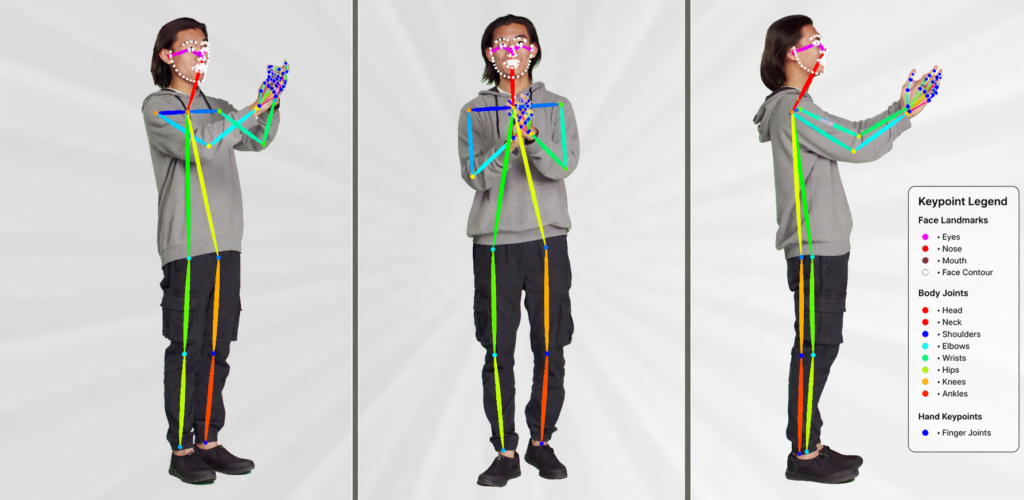
Training these sophisticated models requires highly accurate pose estimation datasets. These datasets serve as the ground truth that algorithms use to learn the mechanics of the human skeleton.
Key characteristics of high-quality datasets include broad diversity across demographics and environments, ensuring the AI does not become biased. They also require high annotation accuracy, usually mapping specific 2D and 3D keypoints on the human body. Temporal consistency is equally critical so the AI understands fluid motion over time rather than just static frames. Creating these datasets involves complex joint tracking and managing multi-person interactions, highlighting the growing need for professional, scalable data annotation services.
Data Collection and Annotation Pipeline
Building these foundational datasets requires a rigorous end-to-end pipeline. The process begins with data collection using a mix of wearables, high-speed cameras, and environmental sensors. Once the raw data is captured, engineers must precisely synchronize the multimodal streams so the audio, video, and depth data align perfectly down to the millisecond.
Next comes annotation. Specialists label poses, categorize actions, and tag human intent. The final step is rigorous quality validation to ensure the labels are flawless. This process utilizes advanced tools like optical motion capture systems and AI-assisted annotation platforms. Given the scale required, outsourcing to specialized partners is essential. Companies like Macgence enable the creation of high-quality, large-scale datasets, allowing robotics companies to focus on algorithm development rather than data wrangling.
Key Challenges in Multimodal Human Motion Data
Despite its value, gathering this data is not without friction. Data privacy and consent remain top concerns, especially when recording people in their natural environments. Additionally, the high cost of collection and the sheer complexity of annotating multimodal streams pose significant barriers. Hardware issues, such as sensor calibration drift, can corrupt entire datasets if not monitored closely. Finally, the industry still lacks standardized benchmarks for multimodal human motion, making it difficult to compare different AI models objectively.
Future Trends in Human Motion-Based Robot Learning
Looking forward, the rise of embodied AI and humanoid robots will drive an even greater need for high-fidelity motion data. We will see tighter integration with large foundation models, allowing robots to understand broader contexts about their environments. Self-supervised learning from motion data will reduce the reliance on manual labeling. Furthermore, the expansion of egocentric datasets will pave the way for real-time adaptive robotics, where machines learn and adjust their behavior on the fly alongside their human counterparts.
Shaping the Future of Intelligent Robotics
Bridging the gap between human motion and robotics is one of the most exciting frontiers in modern technology. Multimodal data serves as the foundational layer for this progress, providing machines with the rich, contextual inputs they need to navigate our world safely. As the industry pushes toward fully autonomous systems, the demand for high-quality, real-world datasets will only grow. Organizations must prioritize accurate, scalable data collection to stay competitive. By partnering with experts like Macgence, businesses can secure the high-fidelity data needed to drive the next generation of intelligent robots.
Frequently Asked Questions
It refers to movement data collected from humans performing tasks in natural, everyday environments, as opposed to simulated or lab-controlled settings. It helps robots learn realistic and adaptable behaviors.
Multimodal data combines different sensor inputs, like video, depth, and motion trackers. This prevents system failures when one sensor type is compromised, ensuring robots can operate reliably in complex environments.
It is the process of reconstructing a person’s full 3D body posture using a first-person camera (like smart glasses), allowing AI to understand how a human interacts with the space immediately around them.
They are used to train machine learning models to identify and track human joints and movements, which is essential for applications in robotics, sports analytics, and augmented reality.
Primary challenges include privacy concerns, high costs, complex synchronization of different sensors, handling occlusions, and the time-consuming nature of accurate data annotation.
By studying human motion, robots can learn complex physical tasks through imitation, improving their dexterity, adaptability, and safety when working alongside people.
Yes. Specialized data providers like Macgence offer end-to-end data collection and annotation services, allowing robotics developers to quickly scale their AI training pipelines with high-quality datasets.
 Previous Blog


You Might Like

October 12, 2026
DataRobot Training for Enterprises: How High-Quality AI Training Data Improves Model Performance
DataRobot Training refers to the data preparation process, followed by machine learning model creation and evaluation on the DataRobot platform. It requires AI training data to be reliable in terms of labels and datasets as well as consistency of records – otherwise, there will be no valid predictions. As businesses transition AI from pilot to […]

October 5, 2026
Data Annotation Company for AI Training: From Healthcare Data Labeling to Robotics & Multimodal Datasets
AI is transitioning from pilot to production, and models do not fail due to their architecture but due to the quality of the data which was used to train them. With the scaling of projects in computer vision, NLP, healthcare, robotics, companies need a data annotation company that will provide domain-specific labeling of all kinds […]

September 28, 2026
Annotation Provider for AI Training: Computer Vision, NLP, Healthcare and Robotics Annotation
All effective AI models, from robots to clinical NLP engines, require one crucial layer: annotation. As enterprises race to deploy computer vision, NLP, healthcare, and robotics solutions, the quality of an annotation provider now makes all the difference between the success or failure of a model outside of lab conditions. Generic labeling cannot meet the […]