


- What is Multi-Modal Egocentric Data?
- Why Egocentric Video Datasets Alone Are Not Enough
- Key Components of Multi-Modal Egocentric Data
- Why Multi-Modal Egocentric Data is Critical for Robot Learning
- Real-World Applications
- Challenges in Building Multi-Modal Egocentric Datasets
- Best Practices for High-Quality Dataset Creation
- The Role of Multi-Modal Data in Closing the Sim-to-Real Gap
- Future Trends in Egocentric Robotics Data
- The Next Wave of Embodied AI
- FAQs
How Multi-Modal Egocentric Data is Transforming Robot Learning
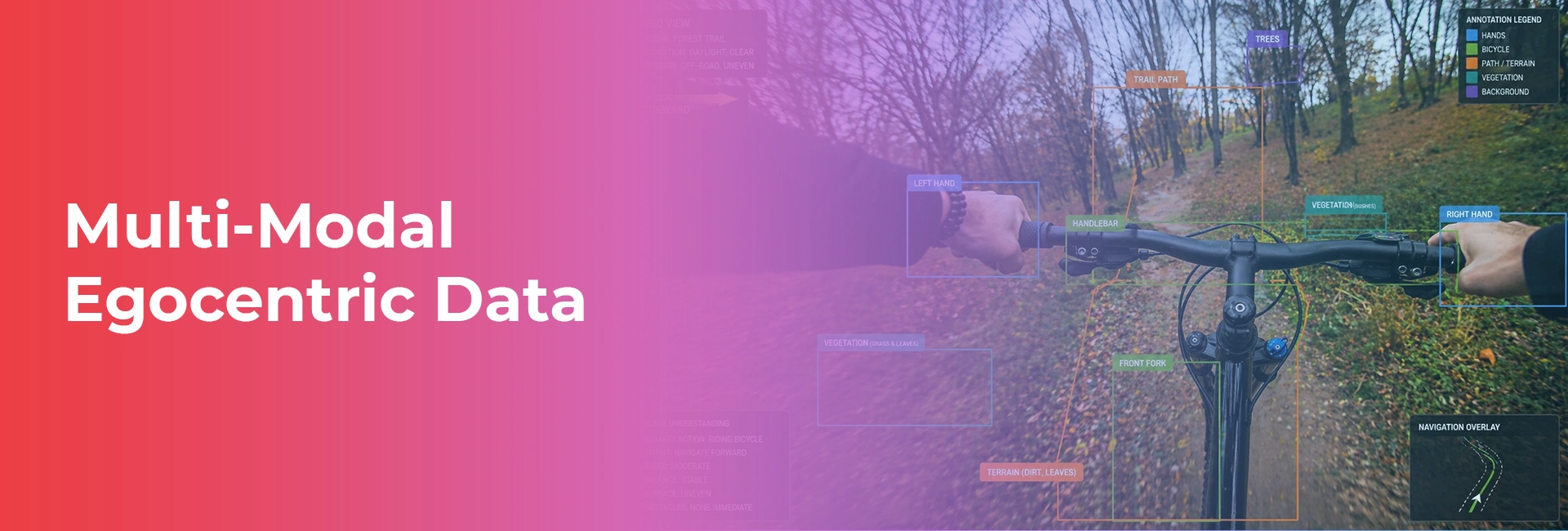
Robots are no longer trained exclusively on static, third-person imagery. Instead, they are learning to view and interact with the world from a human perspective. This shift is driven by Multi-Modal Egocentric Data, a game-changing approach that teaches machines to perform complex tasks by mimicking human actions.
Combining vision, motion, audio, and physical sensor feedback creates a rich environment for real-world learning. When developers fuse these different data types, robots gain a deep understanding of their surroundings. While early models relied heavily on basic egocentric video datasets, the modern landscape requires much more nuance.
This post explores the mechanics of Multi-Modal Egocentric Data. You will learn why this comprehensive data collection method is vital for the future of robotics, embodied artificial intelligence, and seamless real-world deployment.
What is Multi-Modal Egocentric Data?
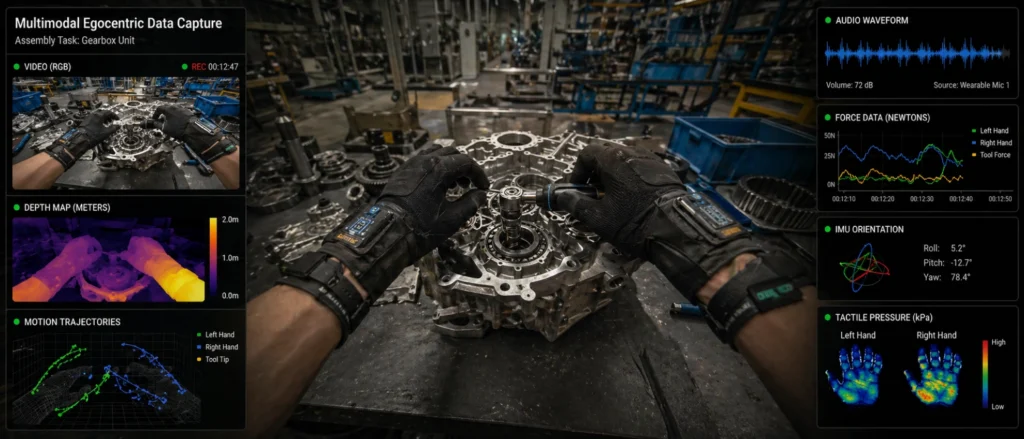
To understand this concept, you have to break it down into two parts. First, “egocentric” refers to first-person, point-of-view (POV) data captured directly from a human perspective. Second, “multi-modal” means combining several different types of information streams. These streams typically include standard video (RGB), depth mapping, motion trajectories, audio, and physical sensor data.
Consider a human worker assembling a complicated piece of machinery. To capture this action for a robot, the worker might wear a head-mounted camera along with tactile gloves and motion trackers. The resulting dataset records exactly what the worker sees, the force they apply to the tools, the sounds of the factory, and the specific angles of their joints.
This context-rich learning approach is vastly different from traditional third-person datasets. Typical CCTV-style footage only shows a robot what a task looks like from a distance. Egocentric, multi-modal data shows the robot exactly how to perform the task itself.
Why Egocentric Video Datasets Alone Are Not Enough
Standard egocentric video datasets are incredibly useful for providing basic visual context. They give robots a clear view of hand-object interactions and spatial layouts. However, visual information alone has significant limitations when teaching a machine to interact with physical objects.
A video cannot tell a robot how hard to grip a fragile glass. It lacks force feedback. Furthermore, video struggles to capture the exact micro-movements of human fingers, resulting in missing motion precision. Standard cameras also fail to provide a true, mathematical understanding of depth.
To bridge this gap, roboticists must move beyond simple video. They need to fuse visual input with physical and spatial data streams.
Key Components of Multi-Modal Egocentric Data
True human-like perception requires a combination of several data signals. Here are the core components that make up a comprehensive multi-modal dataset.
Visual Data (RGB Egocentric Video)
This acts as the core perception layer. High-quality video allows the robotic system to recognize specific objects, understand the general scene, and track visual changes as tasks are completed.
Depth and 3D Data
Using depth maps and LiDAR, robots gain crucial spatial awareness. This data layer allows the machine to estimate distances accurately and map the three-dimensional shapes of the objects in front of them.
Motion and Trajectory Data
Sensors track hand movements, joint positions, and skeletal structures. This specific trajectory data is critical for imitation learning, as it provides the exact mathematical coordinates needed for a robot arm to replicate a human gesture.
Audio Signals
Sound provides vital contextual cues. The audio layer can capture spoken human instructions, the click of a properly connected seatbelt, or the hum of an active machine.
Sensor and Tactile Data
This includes force, pressure, and interaction feedback from tools like Inertial Measurement Units (IMUs) and tactile gloves. This layer prevents a robotic gripper from crushing a delicate object or dropping a heavy one.
Why Multi-Modal Egocentric Data is Critical for Robot Learning
Fusing these diverse data streams unlocks several key benefits for modern robotics. Primarily, it vastly improves Imitation Learning, also known as Learning from Demonstration (LfD). When a machine has access to vision, depth, and touch simultaneously, it develops much better hand-eye coordination.
This comprehensive data also builds rich context awareness. The robot understands not just what to do, but how to adapt if the environment slightly changes. Consequently, this enables fine-grained manipulation tasks that were previously impossible for machines to manage safely.
These advancements open the door to exciting new use cases. Cooking robots can chop vegetables without damaging the cutting board. Warehouse picking systems can handle awkwardly shaped packages. Home assistant robots can fold laundry, and industrial cobots can safely work directly alongside human counterparts.
Real-World Applications
The impact of this technology spans across multiple major industries. Here is how context-rich training data is currently being deployed.
Household Robotics
Domestic robots use multi-modal data to navigate cluttered living rooms, clean delicate surfaces, and organize items. The combination of visual and tactile data ensures they do not break household goods.
Warehouse and Logistics Automation
Logistics centers rely on robotic arms for picking, sorting, and packing orders. By incorporating depth and motion data alongside standard egocentric video datasets, these systems can rapidly identify and grasp items of varying weights and sizes.
Healthcare and Assistive Robotics
In medical settings, robots assist with patient care and physical rehabilitation. High-precision sensor data is absolutely crucial here to ensure all human-robot physical interactions are perfectly safe and gentle.
Retail and Workplace Activity Recognition
Automated systems use first-person data to track employee behavior and automate repetitive tasks. This helps streamline inventory management and improves workplace safety protocols.
Challenges in Building Multi-Modal Egocentric Datasets
While the benefits are clear, capturing and processing this data is incredibly difficult. Data synchronization is a primary hurdle. Aligning high-speed video frames with millisecond-precise motion and sensor streams requires heavy computational lifting.
Annotation complexity is another major issue. Teams must perform multi-layer labeling, simultaneously tagging objects, actions, and specific trajectory points. Because real-world data collection is expensive and time-consuming, scalability issues frequently slow down development.
Furthermore, capturing first-person data raises valid privacy concerns, as cameras inevitably record bystanders and sensitive environments. Finally, hardware constraints persist. Calibrating wearable sensors for human actors can be clumsy, and the equipment is often fragile.
Best Practices for High-Quality Dataset Creation
To build effective training models, developers must prioritize data quality. It is essential to capture data in real-world environments rather than relying exclusively on sterile computer simulations.
Teams must ensure rigorous multi-sensor calibration before any recording begins. They should also actively collect diverse scenarios and edge cases so the robot learns to handle unexpected situations. Maintaining high annotation accuracy across all data layers is non-negotiable.
Applying strict data enrichment and validation pipelines ensures the final dataset is flawless. Working with experienced data partners, such as Macgence, can help organizations build highly accurate, properly annotated datasets that meet the rigorous demands of modern AI models.
The Role of Multi-Modal Data in Closing the Sim-to-Real Gap
Historically, developers trained robots in computer simulations before deploying them in the physical world. However, simulations lack real-world noise, friction, and unpredictability. This creates a “sim-to-real gap,” where a robot fails when exposed to physical reality.
Multi-modal egocentric data solves this problem by adding intense realism to the training process. By learning from actual human physical feedback, robots significantly improve their generalization capabilities. They become far more adaptable to unstructured environments and the natural variability of human behavior.
Future Trends in Egocentric Robotics Data
The methods for collecting and utilizing robot training data will rapidly evolve over the next few years. We will see a massive growth of lightweight, wearable data collection systems that make gathering first-person data much easier.
Additionally, the rise of foundation models trained on multi-modal inputs will accelerate development. These massive AI models will integrate seamlessly with Vision-Language-Action (VLA) architectures, allowing robots to understand spoken commands and execute physical tasks fluidly. As these technologies mature, the demand for highly customized robotics datasets will continue to surge.
The Next Wave of Embodied AI
Multi-Modal Egocentric Data represents the next big leap in robotics. By moving machines past simple visual perception and into a realm of deep physical understanding, developers are unlocking entirely new capabilities for automated action.
Companies investing in high-quality, multi-layered datasets today will undoubtedly lead the next wave of embodied AI. Those who prioritize human-perspective data collection will build the safest, most efficient, and most adaptable robotic systems of tomorrow.
FAQs
Ans: – It is training data captured from a first-person (human) perspective that combines multiple information streams, including video, audio, depth, motion tracking, and physical sensor feedback.
Ans: – They provide the foundational visual context. Robots use this video footage to understand spatial layouts, recognize objects, and observe how human hands interact with physical items.
Ans: – Visual data alone cannot teach a robot how much force to apply or exactly how to move its joints. Multi-modal data provides the depth, trajectory, and tactile feedback necessary for precise physical interactions.
Ans: – Major challenges include synchronizing different data streams, navigating complex multi-layer annotation, managing the high costs of data collection, and handling privacy concerns.
Ans: – Key industries include logistics and warehousing, healthcare and rehabilitation, domestic consumer robotics, and industrial manufacturing.
Ans: – It introduces real-world noise, physics, and unpredictability into the training process. This helps robots trained in simulation function accurately when deployed in physical environments.
 Previous Blog


You Might Like

October 12, 2026
DataRobot Training for Enterprises: How High-Quality AI Training Data Improves Model Performance
DataRobot Training refers to the data preparation process, followed by machine learning model creation and evaluation on the DataRobot platform. It requires AI training data to be reliable in terms of labels and datasets as well as consistency of records – otherwise, there will be no valid predictions. As businesses transition AI from pilot to […]

October 5, 2026
Data Annotation Company for AI Training: From Healthcare Data Labeling to Robotics & Multimodal Datasets
AI is transitioning from pilot to production, and models do not fail due to their architecture but due to the quality of the data which was used to train them. With the scaling of projects in computer vision, NLP, healthcare, robotics, companies need a data annotation company that will provide domain-specific labeling of all kinds […]

September 28, 2026
Annotation Provider for AI Training: Computer Vision, NLP, Healthcare and Robotics Annotation
All effective AI models, from robots to clinical NLP engines, require one crucial layer: annotation. As enterprises race to deploy computer vision, NLP, healthcare, and robotics solutions, the quality of an annotation provider now makes all the difference between the success or failure of a model outside of lab conditions. Generic labeling cannot meet the […]