


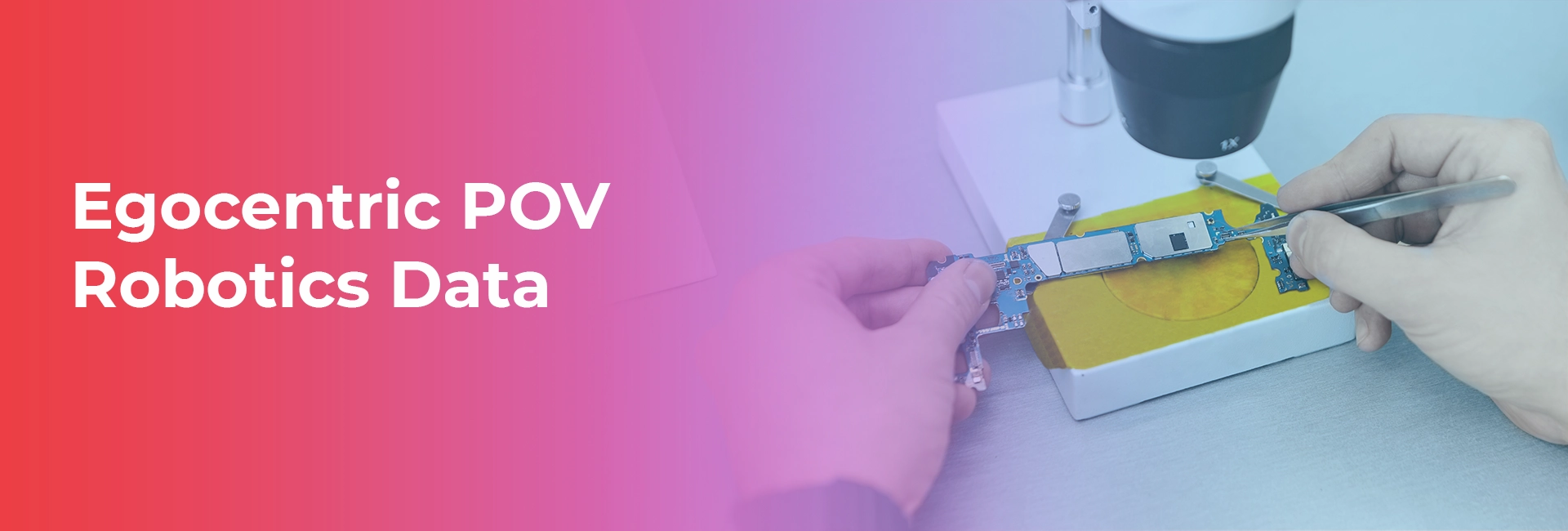
- What is Egocentric POV Robotics Data?
- Core Architecture of Egocentric Data Pipelines
- Egocentric Gesture Recognition Labeling: Challenges & Solutions
- Action Anticipation in 1PP: The Next Frontier
- Multimodal Fusion in Egocentric Robotics Data
- Building Scalable Egocentric Data Pipelines
- Use Cases of Egocentric Robotics Data
- Future of Egocentric Data in Embodied AI
- Empowering the Next Generation of Robots
- FAQs
Egocentric Data Pipelines for Robot Learning: A Deep Dive
Traditional robot datasets have long relied on third-person or static camera viewpoints. While these perspectives offer a broad view of an environment, they lack the nuanced, task-specific focus required for advanced automation. Modern embodied AI systems now require a first-person understanding of their surroundings. This shift is reshaping how we train machines.
Egocentric POV robotics data captures the world exactly as the agent experiences it. By recording human intention, fine-grained hand-object interactions, and context-aware spatial reasoning, this data bridges the gap between perception and action.
Because of this shift, robots are moving away from being pre-programmed executors. They are becoming adaptive learners capable of navigating complex, dynamic environments. To support this transition, developers need high-quality robotics data pipelines, multimodal annotation capabilities, and scalable dataset generation. This is exactly where Macgence excels, providing the foundational data infrastructure for the next generation of embodied AI.
What is Egocentric POV Robotics Data?
Egocentric POV robotics data refers to datasets captured from a first-person perspective. Data sources typically include wearable cameras (like GoPro-style headsets), robot-mounted cameras, and smart glasses.
Unlike static data, this perspective features a dynamic viewpoint that moves constantly with the agent. It also presents high occlusion variability, as hands or tools frequently block objects from view. Furthermore, it provides a rich temporal context through continuous action streams.
The data modalities included in these datasets are highly diverse. They often consist of RGB video streams, depth data from RGB-D sensors, IMU data for motion tracking, and even eye-tracking in advanced setups.
This type of data is critical because it mimics how robots should “see” the world. By aligning the machine’s perspective with human-like viewpoints, it enables highly effective human-like task learning.
Core Architecture of Egocentric Data Pipelines
Building a robust pipeline requires a technical backbone capable of processing complex, multimodal streams. Here is a breakdown of the core layers.
Data Collection Layer
The journey begins with gathering the raw information. Sources include human teleoperation sessions, demonstration captures using wearable cameras, and robot self-exploration data collection. During this phase, engineers face several challenges, including motion blur, lighting inconsistencies, and high variability in unstructured environments.
Data Synchronization Layer
Multimodal learning relies entirely on accurate timing. The data synchronization layer aligns video frames, sensor signals, and action logs. Techniques used here include timestamp normalization, frame interpolation, and sensor fusion alignment. This ensures that a visual cue perfectly matches the corresponding motion or telemetry data.
Preprocessing Layer
Raw data is rarely ready for training. The preprocessing layer filters out unusable or corrupted frames. It also handles the stabilization of egocentric motion and manages initial object segmentation preprocessing, setting the stage for accurate labeling.
Annotation Layer
This layer transforms raw footage into usable training material, and it is a core value offering for Macgence. A major focus here is egocentric gesture recognition labeling. Annotators label hand movements in a first-person view, identifying specific gestures like grasping, pointing, pushing, and rotating objects.
Action labeling is also applied to atomic actions (such as pick, place, open, close) and composite tasks (like making coffee or assembling parts). Macgence utilizes human-in-the-loop annotation systems, AI-assisted pre-labeling, and precise frame-level and segment-level labeling tools to achieve high accuracy.
Dataset Structuring Layer
Finally, the pipeline outputs the data in structured formats. These formats include episode-based structures for task sequences, frame-level annotations, and temporal action graphs.
Egocentric Gesture Recognition Labeling: Challenges & Solutions
Accurately labeling first-person gestures is notoriously difficult. Hand-object occlusion is a constant issue, as fingers frequently block the items being manipulated. Additionally, annotators must differentiate between similar-looking gestures across entirely different tasks. Rapid motion transitions and context dependency further complicate the process.
To overcome these hurdles, pipelines employ multi-view augmentation when additional camera angles are available. Temporal smoothing of labels helps maintain consistency across rapid movements. Hierarchical labeling breaks complex tasks down from gesture, to action, to overall task. Finally, synthetic data augmentation using simulation engines helps fill in the gaps where real-world data falls short.
Action Anticipation in 1PP: The Next Frontier

Action anticipation in 1PP (first-person perspective) refers to predicting what action a human or robot will perform next, based on partial observations in an egocentric view.
This capability is critical for collaborative robotics. It enables proactive robot behavior and significantly reduces latency in human-robot interaction. If a robot can anticipate that a human is reaching for a screwdriver, it can adjust its own movements accordingly.
Engineers use advanced techniques to achieve this, including Transformer-based sequence modeling, baseline LSTM/GRU temporal encoders, and Vision-language-action (VLA) models. These models process visual cues, hand trajectory patterns, and environmental context to accurately predict future actions.
Multimodal Fusion in Egocentric Robotics Data
Modern embodied AI systems rarely rely on a single data source. They combine various modalities, such as vision (RGB and Depth), language (task instructions), action signals, and sensor telemetry.
Fusion strategies dictate how this data is combined. Early fusion blends the data at the input level, while late fusion combines insights at the decision level. Cross-attention transformers are increasingly preferred, especially in VLA models, as they dynamically weigh the importance of different inputs. This multimodal fusion greatly improves a robot’s ability to generalize tasks across unseen environments.
Building Scalable Egocentric Data Pipelines
Scaling these pipelines introduces significant hurdles. High annotation costs, massive data storage requirements, and the need for quality consistency across diverse datasets are constant challenges.
Macgence addresses these bottlenecks through distributed annotation workflows and scalable cloud-based labeling platforms. By implementing active learning loops, the model itself helps improve dataset selection, minimizing unnecessary labeling. Automated QA checks further ensure that the final training data remains flawless.
Use Cases of Egocentric Robotics Data
Industrial Robotics
First-person data allows robots to learn intricate assembly line tasks and perform accurate tool usage recognition on the factory floor.
Humanoid Robots
Egocentric data is essential for teaching humanoids household tasks and modeling complex social interactions in domestic environments.
Autonomous Systems
Vehicles and drones use this perspective for navigation in dynamic environments, enabling human-aware decision-making in crowded spaces.
AR/VR Training Systems
Virtual reality platforms leverage egocentric data to simulate real-world manipulation tasks for training humans and algorithms alike.
Future of Egocentric Data in Embodied AI
The robotics industry is experiencing a massive shift toward foundation models. The rise of Vision-Language-Action (VLA) systems means that robots will increasingly learn from a human perspective rather than relying strictly on engineered, robot-only datasets. Furthermore, synthetic egocentric dataset generation via simulation engines will accelerate self-supervised robot learning at an unprecedented scale.
Empowering the Next Generation of Robots
Egocentric POV robotics data is becoming the foundational building block for embodied AI. To succeed, modern data pipelines must flawlessly handle multimodal, temporal, and noisy inputs. Annotation quality, particularly concerning egocentric gesture recognition labeling, remains a critical success factor. Meanwhile, capabilities like action anticipation in 1PP are paving the way for truly predictive robotics intelligence.
As robots step out of controlled factories and into our daily lives, the data they learn from must reflect the complexities of the real world. Macgence provides unmatched expertise in robotics data pipelines and scalable annotation infrastructure, supporting the comprehensive multimodal dataset creation required for tomorrow’s embodied AI.
FAQs
It is data captured from a first-person perspective, typically using wearable or robot-mounted cameras, reflecting exactly what the agent sees and experiences.
It bridges the gap between perception and action by showing exactly how tasks are performed from the viewpoint of the person or machine executing them.
It is the precise annotation of hand movements and object interactions within first-person video feeds to train robots on how to manipulate items.
Action anticipation in 1PP helps robots predict a human’s next move based on partial visual cues, enabling safer and more fluid collaboration.
Primary challenges include managing massive data storage, resolving hand-object occlusion during annotation, and maintaining consistent quality at scale.
By fusing vision, language, and sensor telemetry, multimodal data gives robots a richer, more context-aware understanding of their environment.
Yes, it is highly effective for teaching humanoid robots how to perform household tasks and interact naturally in human environments.
 Previous Blog


You Might Like

October 12, 2026
DataRobot Training for Enterprises: How High-Quality AI Training Data Improves Model Performance
DataRobot Training refers to the data preparation process, followed by machine learning model creation and evaluation on the DataRobot platform. It requires AI training data to be reliable in terms of labels and datasets as well as consistency of records – otherwise, there will be no valid predictions. As businesses transition AI from pilot to […]

October 5, 2026
Data Annotation Company for AI Training: From Healthcare Data Labeling to Robotics & Multimodal Datasets
AI is transitioning from pilot to production, and models do not fail due to their architecture but due to the quality of the data which was used to train them. With the scaling of projects in computer vision, NLP, healthcare, robotics, companies need a data annotation company that will provide domain-specific labeling of all kinds […]

September 28, 2026
Annotation Provider for AI Training: Computer Vision, NLP, Healthcare and Robotics Annotation
All effective AI models, from robots to clinical NLP engines, require one crucial layer: annotation. As enterprises race to deploy computer vision, NLP, healthcare, and robotics solutions, the quality of an annotation provider now makes all the difference between the success or failure of a model outside of lab conditions. Generic labeling cannot meet the […]