


AI: Revolutionizing Medical Healthcare for Everyone
In the dynamic world of healthcare, there’s a remarkable tool called Artificial Intelligence (AI) that’s transforming the way we care for patients.
Medical Healthcare AI refers to the application of artificial intelligence (AI) technology in the healthcare sector. It involves the use of algorithms and machine learning techniques to analyze vast amounts of medical data. Ranging from patient records to diagnostic images, in order to assist healthcare professionals in various aspects of patient care.
Medical healthcare AI is a smart tool that doctors use to improve patient care. It’s like having a really clever assistant who can quickly analyze lots of medical information. This helps doctors make better decisions about diagnosing and treating patients. It also helps with tasks like scheduling appointments and organizing medical records. Basically, it’s a high-tech way to make healthcare smoother and more effective.
How Does Medical Healthcare AI Work?
Medical Healthcare AI works by using really smart computer programs to understand medical information. These programs are trained on big sets of data that include things like patient details, medical history, symptoms, and how treatments have worked in the past. By looking at all this information, AI systems can spot trends, make predictions, and give doctors helpful insights to diagnose illnesses, plan treatments, and make decisions about patient care.
Key Components of Medical Healthcare AI

Several key components contribute to the functionality of Medical Healthcare AI systems:
- Data Collection: Medical Healthcare AI needs lots of different types of information, like electronic health records, pictures of inside the body, and data from medical research studies.
- Machine Learning Algorithms: These are like the brains of AI systems in healthcare. They learn from lots of data, spot trends, and predict things.
- Natural Language Processing (NLP): This helps AI understand and study messy data, like doctors’ notes and medical articles.
- Computer Vision: Like eyes for AI, this tech helps it understand and analyze medical images like X-rays and MRIs as well as a human can.
- Decision Support Systems: These are tools in healthcare AI that give suggestions to doctors based on patient info and medical rules.
By understanding these components, we can gain insights into how Medical Healthcare AI functions and its potential applications in healthcare delivery.
Let’s explore how AI is reshaping healthcare in simpler terms:
- Speeding Up Diagnosis
AI helps doctors pinpoint health issues faster and more accurately. It’s like having an extra set of incredibly sharp eyes that can analyze medical images like X-rays and scans in a snap. This means patients get the right treatment sooner.
- Tailoring Treatment Plans
Every individual is different, and AI understands that. It collects information about your health, such as your genes and medical background, to create treatment plans customized just for you. This means doctors can personalize treatments to suit your specific needs and what’s most effective for your health.
- Preventing Problems
AI can predict when someone might get sick. By looking at a bunch of information about a person’s health, it can spot warning signs early. This helps doctors step in before anything bad happens and keep people healthy.
- Making Things Easier
AI doesn’t just help doctors; it streamlines tasks for everyone in healthcare. It can quickly understand lots of information, which means it can assist with scheduling appointments and answering questions from patients, making everything run smoother.
- Looking Ahead
Artificial Intelligence (AI) is making significant strides in healthcare, and its potential for improvement is promising. As AI technology advances, it will play an increasingly vital role in keeping people healthy and ensuring access to proper care for everyone. However, it’s essential for us to approach its use with responsibility and caution.
So, when considering AI in healthcare, view it as a highly skilled ally dedicated to enhancing healthcare outcomes for individuals and society as a whole. It represents a thrilling advancement in healthcare that benefits us all.
Learn more about medical healthcare AI with Macgence:
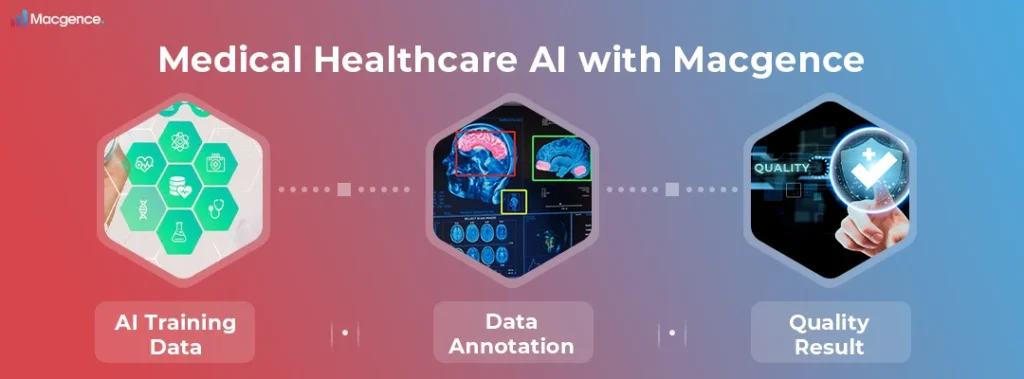
Macgence plays a pivotal role in advancing understanding and implementation of Medical Healthcare AI. Leveraging its expertise in AI training data, Macgence provides invaluable support to healthcare organizations seeking to harness the full potential of AI technology. Through meticulously curated datasets and advanced data annotation techniques. Macgence empowers healthcare professionals to develop and refine AI models tailored to their specific needs.
Whether it’s improving diagnostic accuracy through medical imaging analysis or enhancing patient outcomes through predictive analytics. Macgence’s AI training data solutions serve as a cornerstone for driving innovation and transformation in the field of medical healthcare AI. With Macgence as a trusted partner, healthcare organizations can unlock new insights, streamline operations, and ultimately deliver superior care to patients.
FAQs
Ans: – Yes, Medical Healthcare AI can look at a person’s health information and notice if anything looks different or unusual. By watching this data over time, AI can warn doctors if there might be a problem coming up. This helps doctors take action early to stop serious health issues and make sure patients stay healthy.
Ans: – Macgence provides special data to help doctors use AI to understand medical images better and predict what might happen to patients. By giving doctors accurate information and helping them understand medical data. Macgence helps them make better decisions about how to treat patients, leading to better outcomes for patients.
Ans: – AI computers in hospitals act like super-efficient assistants. They can handle tasks that used to be time-consuming for humans. Such as scheduling appointments, organizing patient files, and managing billing. By completing these tasks swiftly, AI computers allow hospital staff to dedicate more attention to providing excellent care for patients.
 Previous Blog


You Might Like

February 18, 2026
Prebuilt vs Custom AI Training Datasets: Which One Should You Choose?
Data is the fuel that powers artificial intelligence. But just like premium fuel vs. regular unleaded makes a difference in a high-performance engine, the type of data you feed your AI model dictates how well it runs. The global market for AI training datasets is booming, with companies offering everything from generic image libraries to […]

February 17, 2026
Building an AI Dataset? Here’s the Real Timeline Breakdown
We often hear that data is the new oil, but raw data is actually more like crude oil. It’s valuable, but you can’t put it directly into the engine. It needs to be refined. In the world of artificial intelligence, that refinement process is the creation of high-quality datasets. AI models are only as good […]

February 16, 2026
The Hidden Cost of Poorly Labeled Data in Production AI Systems
When an AI system fails in production, the immediate instinct is to blame the model architecture. Teams scramble to tweak hyperparameters, add layers, or switch algorithms entirely. But more often than not, the culprit isn’t the code—it’s the data used to teach it. While companies pour resources into hiring top-tier data scientists and acquiring expensive […]