


- Why Your AI Data Vendor Matters More Than You Think
- Key Signs It’s Time to Switch Your AI Data Vendor
- Risks of Staying with the Wrong Vendor
- How to Evaluate Before You Switch
- Best Practices for Switching Data Annotation Provider
- Why Choosing the Right AI Data Vendor Gives You a Competitive Edge
- The Next Step for Your AI Project
- FAQs
When Is It Time to Switch Your AI Data Vendor?
Building a high-performing artificial intelligence model requires massive amounts of accurate, high-quality data. A reliable AI data vendor is the backbone of this process, ensuring your algorithms learn from the best possible inputs. However, partnering with the wrong vendor can bring your AI projects to a grinding halt. Poor data quality leads to increased costs, reduced model accuracy, and frustrating delays.
So, when is the right time to switch your AI data vendor? Recognizing that a partnership is no longer serving your goals is crucial for long-term success. Moving to a new provider is not a sign of failure. It is a strategic decision that can save your project, protect your budget, and ultimately get your product to market faster.
Why Your AI Data Vendor Matters More Than You Think
The quality of your data directly dictates the accuracy and performance of your AI models. If an annotation team feeds your algorithm poorly labeled images or text, the model will output flawed predictions. Your vendor plays a massive role in the scalability and speed of your AI deployment. When you need to scale up operations rapidly, a capable partner ensures you do not sacrifice quality for speed.
There are also hidden costs associated with poor-quality annotation. When data is labeled incorrectly, your internal team has to spend valuable engineering hours fixing those mistakes. Conducting a thorough AI vendor comparison is a necessary evaluation step to ensure you are not bleeding resources on a provider that cannot meet your standards.
Key Signs It’s Time to Switch Your AI Data Vendor
Identifying the red flags early can save your organization significant time and money. Here are the main indicators that you need to reevaluate your current partnership.
Declining Data Quality
High-quality data is non-negotiable. If you start noticing inconsistent annotations and high error rates, your model outputs will suffer. A reliable partner will have strict quality assurance processes in place to catch mistakes before the data reaches your engineers. A lack of these QA processes is a major warning sign.
Missed Deadlines and Poor Turnaround Time
AI development moves quickly, and delays directly impact your product timelines. If your vendor consistently misses deadlines or takes too long to return labeled batches, your entire roadmap gets pushed back. Furthermore, an inability to scale workforce size alongside your project demands shows that the vendor cannot support your long-term growth.
Lack of Domain Expertise
Generic annotation teams often struggle with industry-specific datasets. If you are building models for healthcare, automotive, or finance, your annotators need specialized knowledge. A vendor that treats medical image labeling the same as basic bounding boxes will inevitably produce unusable data.
Poor Communication and Transparency
A successful partnership requires open lines of communication. You should never have to guess about the status of your data. Limited updates, unclear workflows, and a lack of visibility into progress or QA metrics indicate a vendor that does not value your business or respect your operational needs.
High Costs Without ROI
You should see a clear return on your investment. If the pricing is not aligned with the quality you receive, you are overpaying. Hidden fees and unexpected costs that inflate your monthly bills are clear signals that it is time to look elsewhere.
Limited Technology and Tools
AI workflows are becoming increasingly complex. If your vendor uses outdated annotation tools, they will struggle to keep up. A lack of support for advanced requirements, such as large language models (LLMs) or multimodal data, means you will eventually outgrow their capabilities.
Risks of Staying with the Wrong Vendor
Ignoring these warning signs carries significant business risks. Model inaccuracies caused by bad data can lead to product failures and financial losses. The longer you wait to fix the problem, the slower your time-to-market becomes. Your internal teams will face increased rework, leading to severe cost overruns and burnout. Ultimately, sticking with an underperforming vendor puts you at a severe competitive disadvantage in a fast-moving market.
How to Evaluate Before You Switch
Before making a move, you need an AI vendor comparison framework to ensure your next partner is the right fit.
Quality Assurance Process
Look for vendors that employ multi-level QA. Ask them about their specific accuracy benchmarks and how they handle edge cases.
Scalability and Turnaround Time
Your new provider must have the ability to handle large datasets efficiently. A flexible workforce that can scale up or down based on your project needs is essential.
Domain Expertise
Always check for industry-specific experience. Ask for relevant case studies or references from clients in your exact field.
Technology Stack
Evaluate their annotation tools and automation capabilities. They should offer seamless integration capabilities with your existing data pipelines.
Pricing Transparency
You need a clear cost structure from day one. Look for an ROI-driven approach where you understand exactly what you are paying for.
Best Practices for Switching Data Annotation Provider
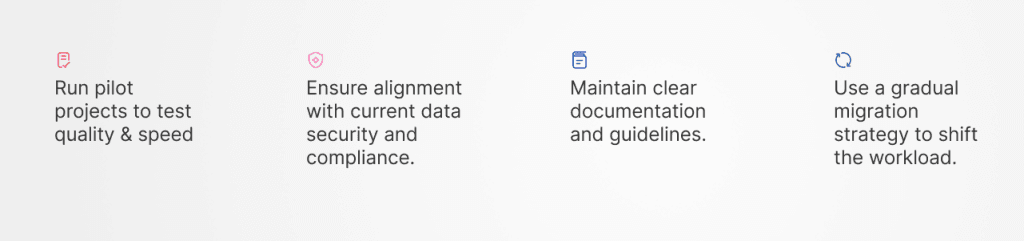
When you decide to switch data annotation providers, you must manage the transition carefully. Avoid abrupt transitions that leave your engineering team without data for weeks. Instead, run pilot projects with the new vendor to test their quality and speed before committing fully. Ensure they comply with all your data security and compliance requirements. Maintain clear documentation and guidelines to make the onboarding process smooth, and use a gradual migration strategy to shift the workload securely.
Why Choosing the Right AI Data Vendor Gives You a Competitive Edge
A strong data partnership translates directly into business success. With high-quality, reliable data, you benefit from faster model deployment. Higher accuracy leads to better product outcomes, which translates to happier end-users. In the long run, working with a competent vendor provides incredible cost efficiency. By treating your choice of vendor as a strategic advantage rather than an administrative checklist item, you set your entire AI initiative up to win.
The Next Step for Your AI Project
Knowing when to switch your AI data vendor comes down to monitoring quality, communication, and cost. If your current provider is missing deadlines, delivering inaccurate annotations, or lacking transparency, your project is at risk. Switching is sometimes a necessary step for the growth and success of your models.
Looking to switch your AI data vendor? Partner with experts who prioritize quality, scalability, and transparency to ensure your AI models perform at their best.
FAQs
Ans: – You should consider switching if you experience consistently poor data quality, missed deadlines, hidden costs, or a lack of transparent communication from your current provider.
Ans: – Evaluate vendors based on their quality assurance processes, domain expertise, technological capabilities, scalability, and transparent pricing structures. Always request case studies and run pilot projects.
Ans: – There is a slight operational risk, but staying with a bad vendor is much riskier. You can mitigate transition risks by running a pilot project and using a gradual migration strategy.
Ans: – The main challenges include transferring institutional knowledge, onboarding the new vendor to your specific guidelines, and avoiding workflow interruptions during the transition.
Ans: – The timeline varies depending on project complexity, but a well-planned transition involving a pilot phase and gradual workload migration typically takes a few weeks to a couple of months.
Ans: – Absolutely. A new vendor with better quality assurance, domain expertise, and superior annotation tools will provide higher-quality training data, directly improving your model’s accuracy.
 Previous Blog


You Might Like

April 13, 2026
Building Better Humanoids: The Power of Custom Multimodal Robotics Datasets
Humanoid robots are rapidly moving out of research labs and into real-world applications. We are seeing these complex machines take on roles in logistics, healthcare, retail, and home assistance. However, creating a robot that can safely and effectively navigate human spaces is an immense challenge. Humanoids require a highly contextual, multimodal understanding of their surroundings […]

April 13, 2026
How Scene Understanding Data Powers Autonomous Driving
Autonomous vehicles and robots are no longer just experimental concepts. They are actively entering real-world environments. However, a major challenge remains for engineers. Machines must accurately interpret complex, dynamic scenes in real time. This is where Autonomous Driving Scene Understanding becomes a critical capability. It allows machines to comprehend their surroundings rather than just passively […]

April 11, 2026
From Smart Homes to Warehouses: Data Use Cases in Robotics
Robotics technology is rapidly expanding across a wide variety of environments. We now see intelligent machines operating seamlessly in homes, warehouses, retail spaces, and corporate offices. This widespread adoption relies heavily on one crucial element: high-quality data. Data serves as the foundation of real-world robot intelligence. However, a single, universal dataset cannot train a robot […]