


- Why Companies Are Outsourcing Data Annotation
- Key Challenges in AI Data Annotation Outsourcing
- What to Look For in a Data Annotation Service Provider
- The Benefits of Getting This Decision Right
- When Does Outsourcing Data Annotation Make Sense?
- Make Your Annotation Strategy Work for Your AI Goals
- FAQs
Outsourcing Data Annotation: How to Choose the Right Partner
High-quality labeled data is the backbone of any successful AI model. Without it, even the most sophisticated algorithms fall flat. As AI adoption accelerates across industries, the demand for accurately annotated datasets has never been higher—and building an in-house team capable of meeting that demand is expensive, slow, and operationally complex.
That’s where outsourcing data annotation comes in. For startups racing to ship their first model and enterprises scaling to production, partnering with a specialized data annotation service provider offers a faster, more cost-effective path forward. But here’s the catch: not every vendor delivers the same level of quality, security, or domain expertise. The partner you choose can make or break your AI project. This guide breaks down what to look for before signing on the dotted line.
Why Companies Are Outsourcing Data Annotation
The shift toward AI data outsourcing isn’t driven by a single factor—it’s a combination of pressures that make in-house annotation increasingly impractical.
Cost Efficiency
Maintaining an internal annotation team means hiring, training, managing, and retaining staff—plus building the infrastructure to support them. Outsourcing eliminates much of this overhead. Companies pay for what they need, when they need it, without carrying the fixed costs of a full-time workforce.
Access to Skilled Annotators
Not all data is created equal. Medical imaging, financial documents, and autonomous driving datasets require annotators with genuine domain knowledge. Specialized outsourcing partners employ experts across verticals—healthcare, legal, retail, NLP, and more—who understand the nuances of the data they’re labeling.
Faster AI Development
Speed matters in AI. Large, distributed annotation teams can process datasets far faster than an internal team ramping up from scratch. Faster annotation means faster training cycles, and faster training cycles mean shorter time-to-deployment.
Scalability
AI projects rarely stay small. A proof-of-concept that starts with thousands of data points can quickly require millions. Outsourcing partners are built to scale—up or down—without the friction of constant hiring.
Key Challenges in AI Data Annotation Outsourcing
Outsourcing is not without risk. Companies that rush the vendor selection process often run into problems that set their projects back significantly.
Common pain points include:
- Poor annotation quality that introduces noise into training data
- Lack of domain expertise, leading to mislabeled or misunderstood data points
- Data security gaps, particularly with sensitive datasets in regulated industries
- Inconsistent labeling guidelines that produce unreliable outputs
- Limited scalability when project demands outpace vendor capacity
These aren’t minor inconveniences—they can corrupt an entire dataset and force costly rework. To avoid them, companies need to rigorously evaluate potential data annotation service providers before entering any partnership.
What to Look For in a Data Annotation Service Provider
This is where due diligence pays off. Here are the six criteria that matter most.
1. Annotation Quality & Accuracy
Quality is non-negotiable. Ask any prospective partner how they manage quality control—a vague answer should be a red flag. Look for vendors with structured, multi-layer QA workflows that include independent review, consensus-based labeling (where multiple annotators label the same item and results are compared), and clear accuracy benchmarks.
A reliable provider will be transparent about their inter-annotator agreement rates and will offer sample work or pilot projects so you can evaluate quality before committing.
2. Domain Expertise
General-purpose annotation teams struggle with specialized datasets. A provider with experience in your specific industry—whether that’s radiology, autonomous vehicle perception, or financial document processing—will produce more accurate labels and require far less handholding.
When evaluating vendors, ask for case studies or references from projects in your domain. The ability to understand context, not just follow instructions, is what separates a competent annotator from a great one.
3. Data Security & Compliance
Sharing proprietary datasets with a third party introduces real security risks. Any credible data annotation service provider should offer:
- GDPR compliance (and alignment with other applicable regional regulations)
- ISO certifications (such as ISO 27001 for information security)
- Secure, encrypted data pipelines
- NDA and confidentiality protocols as standard practice
If a vendor can’t clearly articulate their security posture, that’s a serious concern—especially for companies operating in healthcare, finance, or other regulated sectors.
4. Scalability & Workforce Capacity
Your annotation needs today may look very different in six months. A strong outsourcing partner can scale their workforce to match your project’s demands—whether you need 10,000 labels or 10 million. Global annotation teams also offer the advantage of round-the-clock operations, which can significantly compress project timelines.
Ask vendors directly: what’s their current capacity? How do they handle sudden volume increases? What’s their process for maintaining quality as they scale?
5. Technology & Annotation Tools
The tools a vendor uses directly impact efficiency and consistency. Advanced annotation platforms support features like automation-assisted labeling (which uses AI to pre-label data for human review), workflow management dashboards, and version control. These capabilities reduce errors, speed up delivery, and make it easier to maintain labeling consistency across large teams.
Equally important is whether the vendor’s tooling integrates cleanly with your existing ML pipeline. Smooth data handoff reduces friction and keeps your development cycle moving.
6. Turnaround Time & SLAs
Even the highest-quality annotations are only valuable if they arrive on time. Evaluate vendors on their project management capabilities and ask for clearly defined service level agreements (SLAs) that specify delivery timelines. The best providers build efficiency into their workflows without cutting corners on quality—and they’re upfront about realistic timelines from the start.
The Benefits of Getting This Decision Right
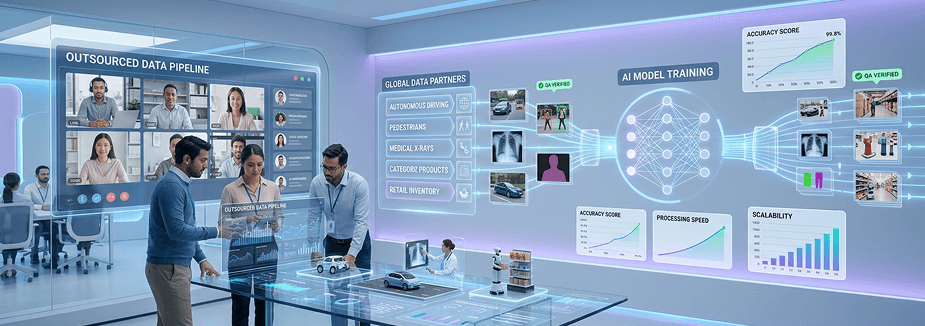
Choosing the right AI data outsourcing partner compounds quickly. The immediate benefits are obvious: faster model training, lower operational complexity, and higher-quality datasets. But the longer-term advantages run deeper.
Access to specialized annotators improves model accuracy in ways that are difficult to replicate internally. Scalable partnerships mean you can grow your AI capabilities without rebuilding your annotation infrastructure from scratch at each milestone. And a trusted partner—one that understands your data, your domain, and your timelines—becomes a genuine asset to your AI development process.
Companies like Macgence demonstrate how dedicated outsourcing partners can support organizations in delivering high-quality annotated datasets for enterprise AI applications across healthcare, autonomous driving, retail, and beyond.
When Does Outsourcing Data Annotation Make Sense?
Outsourcing is the right call in several common scenarios:
- You’re under pressure to ship an AI product quickly
- Your dataset requirements exceed what an internal team can realistically handle
- Your team lacks annotation expertise in the relevant domain
- The data requires specialized knowledge (e.g., medical terminology, legal language)
- You’re working against a tight ML deployment deadline
If one or more of these apply, the case for outsourcing is strong.
Make Your Annotation Strategy Work for Your AI Goals
AI models are only as good as the data they’re trained on. Outsourcing data annotation can accelerate development, lower costs, and give your team access to expertise that’s difficult to build internally—but only if you choose the right partner.
Evaluate vendors on the criteria that matter: annotation quality, domain expertise, data security, scalability, tooling, and turnaround time. The companies that treat vendor selection as a strategic decision—not just a procurement exercise—are the ones that build better models, faster.
FAQs
Outsourcing data annotation involves hiring a third-party service provider to label, tag, or classify data for use in training AI and machine learning models, rather than building an in-house annotation team.
The primary reasons are cost efficiency, access to specialized annotators, faster dataset creation, and the ability to scale annotation capacity without significant infrastructure investment.
Evaluate providers based on their quality control processes, domain expertise, data security certifications, scalability, annotation tools, and ability to meet defined turnaround SLAs. Requesting a pilot project before full engagement is also strongly recommended.
Most providers support a wide range of data types, including images, video, audio, text, LiDAR point clouds, and medical imaging. The availability of domain-specific expertise will vary by vendor.
It can be, provided you choose a vendor with robust security protocols in place. Look for GDPR compliance, ISO 27001 certification, encrypted data pipelines, and standard NDA agreements before sharing any proprietary datasets.
 Previous Blog


You Might Like
April 8, 2026
Why Data is the Real Bottleneck in Embodied AI Training
AI is moving off our screens and into the physical world. For years, artificial intelligence lived exclusively on servers and smartphones. Now, it is driving autonomous systems, powering delivery robots, and animating humanoids. This transition from software-only models to physical agents represents a massive shift in how machines interact with human environments. While there is […]
April 7, 2026
Why Synthetic Speech Data Isn’t Enough for Production AI
The voice AI market is experiencing explosive growth. From virtual assistants and call automation systems to interactive voice bots, companies are racing to build intelligent audio tools. To meet the demand for training information, developers are increasingly turning to synthetic speech data as a fast, highly scalable solution. Because of this rapid adoption, a common […]
April 6, 2026
Where to Buy High-Quality Speech Datasets for AI Training?
The demand for intelligent voice assistants, call analytics software, and multilingual AI models is growing rapidly. Developers are rushing to build smarter tools that understand human nuances. But the biggest challenge engineers face isn’t writing better algorithms. The main hurdle is finding reliable, scalable, and high-quality audio collections to train their models effectively. Training a […]