


- What Are Speech Datasets for AI?
- Why Buying High-Quality Speech Data Matters
- Key Factors to Consider Before You Buy Speech Data
- Where to Buy Speech Datasets for AI
- Why Choose a Dedicated Speech Dataset Provider Like Macgence
- Cost of Speech Datasets: What to Expect
- How to Choose the Right Speech Dataset Provider
- Securing Your AI's Future
- FAQs
Where to Buy High-Quality Speech Datasets for AI Training?
The demand for intelligent voice assistants, call analytics software, and multilingual AI models is growing rapidly. Developers are rushing to build smarter tools that understand human nuances. But the biggest challenge engineers face isn’t writing better algorithms. The main hurdle is finding reliable, scalable, and high-quality audio collections to train their models effectively.
Training a machine learning model on low-quality audio carries serious risks. Poorly sourced data often creates biased models that fail to recognize diverse accents. It causes terrible transcription accuracy and can even trigger severe legal compliance issues if the audio was collected without proper consent. Building a robust AI system requires exceptionally clean, accurate inputs.
This guide outlines exactly where to buy speech data to ensure your project succeeds. We will explore the different types of audio collections available, explain what to look for in a reliable speech dataset provider, and highlight why investing in premium data quality yields a massive return on investment.
What Are Speech Datasets for AI?
Speech datasets for AI are structured collections of audio recordings paired with accurate text transcriptions and metadata. Machine learning engineers use these assets to train Automatic Speech Recognition (ASR), Natural Language Processing (NLP), and conversational AI systems to understand spoken language.
There are several types of audio datasets available, depending on your project’s specific needs:
- Conversational datasets: These capture back-and-forth dialogue, such as call center recordings and customer support interactions.
- Multilingual speech datasets: Collections featuring various languages and regional dialects.
- Noisy environment datasets: Audio recorded in crowded spaces or busy streets to teach AI how to filter background noise.
- Annotated vs. raw audio datasets: Annotated data includes detailed labeling for speaker identity, emotion, or timestamps, while raw audio requires processing before use.
Companies rely on these datasets for numerous applications. They power virtual assistants similar to Alexa or Siri. They act as the foundation for modern speech-to-text engines. Businesses also use them for call center analytics, as well as specialized voice applications in the healthcare and fintech sectors.
Why Buying High-Quality Speech Data Matters
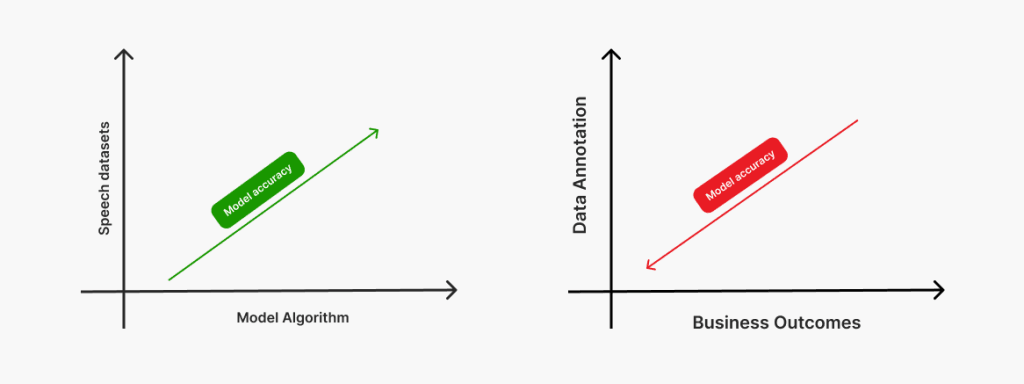
The information you feed your algorithm directly dictates its performance. High-quality speech datasets for AI dramatically improve model accuracy. When your system processes clean annotations, it learns to recognize words with incredible precision.
You must prioritize diverse accents and languages. A model trained on a single demographic will fail when exposed to the general public. Exposing your AI to real-world scenarios, including background noise and natural interruptions, prepares it for actual user interactions.
Compliance and privacy are equally critical. Using consent-based data ensures your company adheres to strict regulations like GDPR. The cost of bad data is incredibly high, often resulting in failed product launches and legal penalties. Conversely, premium datasets deliver a substantial return on investment through superior AI performance and reduced troubleshooting time.
Key Factors to Consider Before You Buy Speech Data
Selecting the perfect data requires careful evaluation. Keep these crucial factors in mind when assessing your options.
Data Quality and Annotation Accuracy
Machine learning models require exceptional precision. Look for vendors that use human-in-the-loop validation to ensure transcriptions perfectly match the spoken audio. High transcription accuracy benchmarks guarantee that your AI learns from the best possible examples.
Dataset Diversity
Your end-users come from all walks of life, and your training data should reflect that reality. Ensure the collection includes various languages, regional accents, and demographic profiles. Industry-specific data is also vital. A medical dictation tool requires vastly different vocabulary than a retail customer service bot.
Scalability
As your AI model grows, your data needs will expand. You need a partner capable of delivering large volumes of audio quickly. The ability to request custom dataset creation ensures you never hit a development bottleneck due to a lack of training materials.
Compliance and Ethical Sourcing
Never compromise on legal and ethical standards. Verify that your vendor uses consent-driven data collection methods. Proper data anonymization protects user privacy and shields your organization from regulatory fines.
Customization Capabilities
Off-the-shelf options rarely solve complex engineering problems. You often need tailored datasets designed for specific AI use cases. Advanced metadata tagging and domain-specific vocabulary allow you to fine-tune your algorithm for highly specialized tasks.
Where to Buy Speech Datasets for AI
When you are ready to buy speech data, you generally have three primary avenues to explore.
Option 1: AI Data Marketplaces
Data marketplaces offer a broad marketplace of pre-packaged audio files.
- Pros: They provide quick access to a wide variety of datasets, allowing you to start training immediately.
- Cons: You face limited customization options. Quality varies wildly between different sellers, requiring extensive manual review on your end.
Option 2: Open Source Platforms
Platforms like Common Voice and LibriSpeech offer public access to audio recordings.
- Pros: These collections are completely free or very low-cost.
- Cons: They suffer from limited scalability. The audio is typically generic, making it completely unsuitable for industry-specific applications like banking or healthcare.
Option 3: Specialized Speech Dataset Providers
Partnering with a dedicated data company is the most reliable approach for commercial AI development. These vendors offer end-to-end data solutions, including custom data collection and precise annotation. They guarantee rigorous quality assurance and strict regulatory compliance.
If you want production-ready audio, Macgence is a premier speech dataset provider. They offer fully managed AI data solutions, industry-specific datasets for finance and healthcare, and extensive multilingual capabilities ranging from Dutch to Hindi.
Why Choose a Dedicated Speech Dataset Provider Like Macgence
A specialized partner eliminates the guesswork from AI development. Dedicated providers supply high-quality, production-ready datasets that you can deploy immediately. They build custom data collection pipelines tailored to your exact specifications.
Firms like Macgence bring deep domain-specific expertise across BFSI, healthcare, and retail sectors. They possess scalable infrastructure and enforce strong QA processes to catch transcription errors before they reach your engineering team. This level of professional support guarantees a faster turnaround time for your projects.
Cost of Speech Datasets: What to Expect
Budgeting for AI training requires understanding the primary pricing factors. The total dataset size, measured in hours of audio, heavily influences the cost. Annotation complexity also drives up prices; tagging overlapping speakers costs more than basic transcription. Rare languages and high customization levels will naturally command a premium.
Vendors typically use a few standard pricing models. You might pay per hour of audio, per individual annotation task, or via a subscription for bulk pricing access. Remember that you should not simply choose the cheapest option. Choose the data that provides the best ROI through accurate, bias-free model performance.
How to Choose the Right Speech Dataset Provider
Selecting a vendor requires a systematic approach. Use this checklist to evaluate potential partners:
- Look for a proven track record of successful enterprise deployments.
- Ask for sample dataset availability to test their quality firsthand.
- Demand transparent pricing structures.
- Verify their internal QA processes.
- Confirm their ability to scale data collection as your needs grow.
Watch out for clear red flags. Walk away immediately if a vendor lacks compliance clarity or cannot explain their sourcing methods. A lack of customization options or poor documentation usually indicates a low-quality operation.
Securing Your AI’s Future
Quality speech data directly equals better AI performance. Choosing the right provider is a critical business decision that separates successful tech launches from costly failures.
To build an accurate, unbiased, and highly effective voice model, you need a partner you can trust. Explore diverse, ethically sourced audio collections designed for enterprise scalability.
Browse high-quality speech datasets at data.macgence.com or request a custom dataset tailored to your AI needs.
FAQs
Ans: – You can purchase them from AI data marketplaces, access basic versions on open-source platforms, or buy premium, custom collections from dedicated speech dataset providers like Macgence.
Ans: – Costs vary based on the hours of audio, annotation complexity, language rarity, and the level of customization required. Providers usually charge per hour of audio or per specific annotation task.
Ans: – The best provider offers high transcription accuracy, ethical data sourcing, and domain-specific expertise. Macgence is a leading choice due to its scalable infrastructure and robust QA processes.
Ans: – Free datasets are helpful for basic research or early prototyping. However, commercial applications require premium, domain-specific data to ensure accuracy and legal compliance.
Ans: – Major sectors include healthcare (medical dictation), BFSI (customer service chatbots), retail, automotive (in-car voice assistants), and telecommunications.
Ans: – A standard package includes the raw audio files, highly accurate text transcriptions, and metadata detailing speaker demographics, language, and recording environment.
Ans: – Yes. Dedicated providers can build custom data collection pipelines to source and annotate audio that meets your exact industry and language specifications.
 Previous Blog


You Might Like
April 8, 2026
Why Data is the Real Bottleneck in Embodied AI Training
AI is moving off our screens and into the physical world. For years, artificial intelligence lived exclusively on servers and smartphones. Now, it is driving autonomous systems, powering delivery robots, and animating humanoids. This transition from software-only models to physical agents represents a massive shift in how machines interact with human environments. While there is […]
April 7, 2026
Why Synthetic Speech Data Isn’t Enough for Production AI
The voice AI market is experiencing explosive growth. From virtual assistants and call automation systems to interactive voice bots, companies are racing to build intelligent audio tools. To meet the demand for training information, developers are increasingly turning to synthetic speech data as a fast, highly scalable solution. Because of this rapid adoption, a common […]

April 1, 2026
How High-Quality Medical Datasets Improve Diagnostic AI
Artificial intelligence is rapidly transforming the healthcare landscape. From analyzing complex radiology scans to predicting patient outcomes through advanced analytics, diagnostic tools are becoming increasingly sophisticated. Hospitals and clinics rely on these systems to process information faster and assist medical professionals in making critical decisions. However, even the most advanced algorithms can fail if they […]