


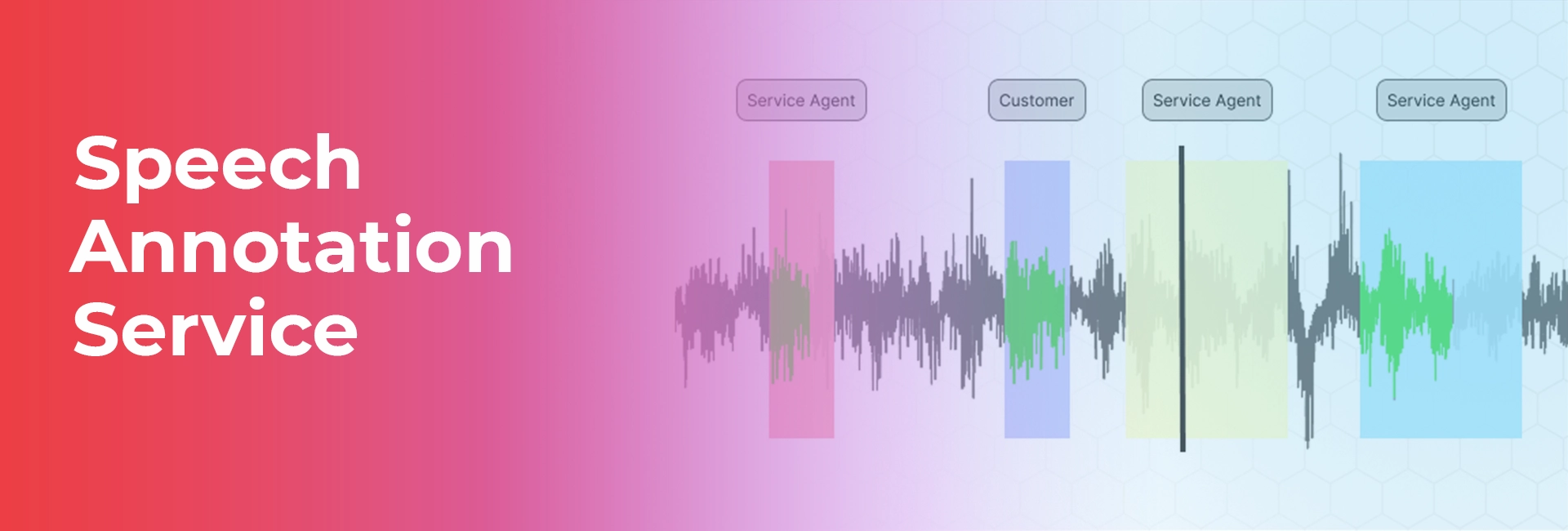
- What Is Speech Annotation?
- What Is Conversational Dataset Creation?
- Core Differences: Speech Annotation Services vs Conversational Dataset Creation
- Use Cases and Industry Applications
- When Do You Need Speech Annotation vs Conversational Dataset Creation?
- Can You Combine Both? (Hybrid Approach)
- Data Quality Challenges in Both Approaches
- How Macgence Supports Speech and Conversational AI Training
- Choosing the Right Data Strategy Defines Your AI's Success
Speech Annotation vs Conversational Dataset Creation: Which Does Your AI Need?
Voice-based AI is no longer a novelty—it’s everywhere. From virtual assistants managing our schedules to chatbots resolving customer queries, speech-driven systems are reshaping how businesses interact with users. According to recent estimates, the conversational AI market is projected to grow exponentially, driven by demand for smarter customer support, hands-free interfaces, and real-time analytics.
But behind every intelligent voice interaction lies a critical decision: What kind of data does your AI actually need?
Two terms dominate this conversation: speech annotation services and conversational dataset creation. While they sound similar, they serve distinct purposes in AI development. Misunderstanding the difference can lead to wasted resources, underperforming models, and missed opportunities.
This guide breaks down both approaches—what they are, where they’re used, and how to choose the right one for your project. Whether you’re building a voice assistant, training an ASR model, or deploying a customer service chatbot, you’ll walk away knowing exactly which data strategy fits your needs.
What Is Speech Annotation?
Speech annotation is the process of labeling audio data with transcriptions, metadata, and context to train AI models that understand spoken language. It’s the foundation of systems that convert sound into meaning—whether that’s transcribing a voice memo, identifying who’s speaking in a conference call, or detecting frustration in a customer’s tone.
Key Types of Speech Data Labeling
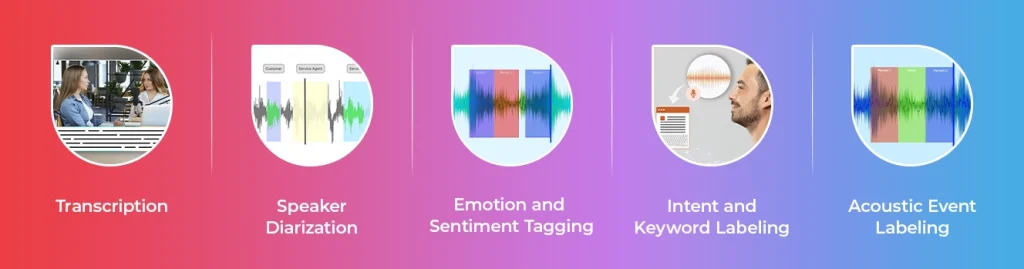
Speech annotation isn’t one-size-fits-all. Different AI applications require different types of labels:
- Transcription: Converting spoken words into text. This can be verbatim (every filler word included), clean (edited for readability), or phonetic (capturing pronunciation).
- Speaker Diarization: Identifying and separating different speakers in a recording—essential for meeting transcription tools.
- Emotion and Sentiment Tagging: Labeling audio with emotional cues like anger, joy, or neutrality to improve empathy in voice bots.
- Intent and Keyword Labeling: Highlighting specific phrases or commands that trigger actions in voice-controlled systems.
- Acoustic Event Labeling: Marking non-speech sounds like background noise, silence, or interruptions that affect audio quality.
Role in AI Model Training
Speech annotation powers some of the most critical AI systems used today. It improves:
- ASR (Automatic Speech Recognition): Models that transcribe spoken language into text with high accuracy.
- Voice Biometrics: Systems that authenticate users based on unique vocal characteristics.
- Speech-to-Text Engines: Applications ranging from medical dictation software to real-time captioning tools.
Without high-quality speech data labeling, these systems struggle with accents, background noise, and context—leading to poor user experiences and lost trust.
What Is Conversational Dataset Creation?
While speech annotation focuses on audio understanding, conversational dataset creation is all about dialogue. These datasets are structured collections of back-and-forth exchanges—whether between humans, bots, or a combination of both.
Components of Conversational Datasets
A well-built conversational dataset includes:
- Utterances and Responses: The core dialogue pairs that teach AI how to respond naturally.
- Intents and Entities: Labels that identify what the user wants (intent) and the key details needed to fulfill that request (entities).
- Context Tracking: Information that helps AI remember what was said earlier in the conversation.
- Turn-Taking Structure: Patterns that capture how conversations flow—pauses, interruptions, and transitions.
- Multilingual or Domain-Specific Content: Tailored dialogues for specific industries (like banking or healthcare) or languages.
Where Conversational Datasets Are Used
These datasets are the backbone of:
- Chatbots and Virtual Assistants: From customer support bots to enterprise AI agents.
- Customer Support Automation: Systems that handle FAQs, troubleshooting, and escalations.
- LLM Fine-Tuning: Training large language models to generate more accurate, context-aware responses.
- Voice Bots and IVR Systems: Interactive voice response platforms that guide callers through menu options or resolve issues.
Conversational datasets teach AI not just to understand words, but to manage the nuances of human dialogue—sarcasm, ambiguity, and shifting topics.
Core Differences: Speech Annotation Services vs Conversational Dataset Creation
The table below highlights the key distinctions:
| Factor | Speech Annotation Services | Conversational Dataset Creation |
| Data Type | Raw audio files | Dialogue scripts or real chat logs |
| Primary Goal | Improve speech recognition | Improve dialogue understanding |
| Focus | Accuracy of sound-to-text conversion | Natural language flow and context |
| Output | Labeled audio with transcriptions and metadata | Structured conversation logs with intents |
| Used For | ASR, voice recognition, call analytics | Chatbots, LLMs, conversational AI |
Here’s the key takeaway: Speech annotation focuses on audio understanding, helping machines hear and transcribe accurately. Conversational datasets focus on language and intent understanding, teaching machines how to respond appropriately in dialogue.
Use Cases and Industry Applications
Speech annotation powers AI systems that need to process and understand spoken language:
- Voice Assistants: Platforms like Alexa or Google Assistant rely on annotated speech data to recognize commands across accents and environments.
- Call Center Analytics: Tools that analyze agent-customer interactions for quality assurance and sentiment tracking.
- Speech-to-Text Engines: Applications that transcribe podcasts, lectures, or legal proceedings.
- Medical Dictation Systems: Software that converts doctor-patient conversations into structured clinical notes.
Use Cases for Conversational Datasets
Conversational datasets drive AI that needs to manage dialogue:
- Customer Service Chatbots: Bots that handle inquiries, complaints, and product recommendations.
- Banking Virtual Agents: AI assistants that help users check balances, transfer funds, or report fraud.
- Healthcare Symptom Checkers: Conversational tools that triage patient concerns before booking appointments.
- E-Commerce Support Bots: Systems that assist with order tracking, returns, and product searches.
Both approaches improve accuracy, enable automation, and enhance user experiences—but they do so in fundamentally different ways.
When Do You Need Speech Annotation vs Conversational Dataset Creation?
Choose Speech Annotation Services If:
- You already have raw audio recordings that need transcription or labeling.
- Your AI system must accurately recognize speech across accents, languages, or noisy environments.
- You’re training ASR models, voice biometrics, or speech-to-text engines.
- You need speaker identification, emotion detection, or acoustic event tagging.
Choose Conversational Dataset Creation If:
- You’re building a chatbot, virtual assistant, or LLM-powered agent.
- Your AI needs intent-response pairs to handle user queries naturally.
- You require multilingual or domain-specific dialogues (e.g., healthcare, finance).
- You want to simulate or collect real-user conversations to improve response quality.
Still unsure? Consider this: If your AI listens first, you need speech annotation. If your AI talks back, you need conversational datasets.
Can You Combine Both? (Hybrid Approach)
Modern AI systems increasingly require both capabilities. Voice bots, for example, must:
- Process audio inputs using speech annotation to transcribe and understand spoken words.
- Manage dialogue flow using conversational datasets to generate appropriate responses.
This hybrid approach delivers:
- Better NLP Accuracy: Combining audio understanding with contextual dialogue handling.
- Improved Real-Time Responses: Faster, more natural interactions in voice-based applications.
- Smarter Voice AI Systems: Solutions that adapt to accents, background noise, and conversational nuances.
For instance, a banking voice bot needs annotated audio to transcribe “I’d like to check my balance” and conversational datasets to respond with “Sure! Your current balance is $1,250. Would you like to hear recent transactions?”
Data Quality Challenges in Both Approaches
Building high-performing AI isn’t just about quantity—it’s about quality. Common challenges include:
- Noise and Accents: Speech data labeling must account for regional accents, background noise, and audio distortions.
- Bias in Conversational Datasets: Dialogue collections can reflect cultural or demographic biases that skew AI responses.
- Context Loss: Conversations often rely on implicit context that’s difficult to capture in static datasets.
- Scalability and Consistency: Maintaining annotation quality across thousands of hours of audio or millions of dialogue turns requires robust processes.
The solution? A human-in-the-loop quality assurance pipeline combined with:
- Domain-specific expertise
- Multilingual annotators
- Continuous validation and auditing
These measures ensure your AI performs reliably in real-world conditions.
How Macgence Supports Speech and Conversational AI Training
At Macgence, we understand that high-quality data is the backbone of every successful AI project. That’s why we offer comprehensive solutions for both speech annotation services and conversational dataset creation:
End-to-End Speech Annotation Services
- Accurate transcription (verbatim, clean, phonetic)
- Intent labeling and keyword tagging
- Speaker diarization and emotion detection
- Multi-language support with native annotators
Custom Conversational Dataset Creation
- Domain-specific dialogues tailored to your industry (BFSI, healthcare, retail, AI startups)
- Multilingual datasets spanning 200+ languages
- LLM-ready formats optimized for fine-tuning
- Real-world and synthetic conversation generation
Key Strengths
- Human + AI-Assisted Annotation: Combining automation with expert review for maximum accuracy.
- Scalable Workforce: Access to a global network of skilled annotators and subject matter experts.
- Industry-Specific Expertise: Deep experience across sectors requiring precise, compliant data solutions.
Whether you need speech data labeling to power your ASR engine or conversational datasets to train your next-generation chatbot, Macgence helps you build high-quality training data that drives results.
Choosing the Right Data Strategy Defines Your AI’s Success
Here’s the bottom line:
Speech annotation services transform raw audio into structured insights—essential for systems that need to hear and understand spoken language accurately.
Conversational dataset creation structures dialogue into training material—critical for AI that needs to manage back-and-forth exchanges naturally.
Both are essential for modern voice-based AI. The choice depends on your model’s goals:
- Are you building speech recognition capabilities? Start with speech annotation.
- Are you developing dialogue intelligence? Focus on conversational datasets.
- Are you creating a complete voice assistant? You’ll need both.
Evaluate your AI pipeline carefully. Choosing the right data approach can define your AI’s success—or its failure. With the right partner and the right data strategy, you’re not just building AI. You’re building AI that truly understands and responds to human communication.
 Previous Blog


You Might Like

April 13, 2026
Building Better Humanoids: The Power of Custom Multimodal Robotics Datasets
Humanoid robots are rapidly moving out of research labs and into real-world applications. We are seeing these complex machines take on roles in logistics, healthcare, retail, and home assistance. However, creating a robot that can safely and effectively navigate human spaces is an immense challenge. Humanoids require a highly contextual, multimodal understanding of their surroundings […]

April 13, 2026
How Scene Understanding Data Powers Autonomous Driving
Autonomous vehicles and robots are no longer just experimental concepts. They are actively entering real-world environments. However, a major challenge remains for engineers. Machines must accurately interpret complex, dynamic scenes in real time. This is where Autonomous Driving Scene Understanding becomes a critical capability. It allows machines to comprehend their surroundings rather than just passively […]

April 11, 2026
From Smart Homes to Warehouses: Data Use Cases in Robotics
Robotics technology is rapidly expanding across a wide variety of environments. We now see intelligent machines operating seamlessly in homes, warehouses, retail spaces, and corporate offices. This widespread adoption relies heavily on one crucial element: high-quality data. Data serves as the foundation of real-world robot intelligence. However, a single, universal dataset cannot train a robot […]