


- What Is a Custom AI Dataset?
- Why Time Estimation Matters in AI Projects
- High-Level Overview: AI Dataset Development Timeline
- Stage-by-Stage Breakdown of Custom Dataset Creation Time
- Key Factors That Affect Custom Dataset Creation Time
- Typical Timelines by Use Case
- How to Reduce AI Dataset Development Timeline
- In-House vs. Outsourced Custom Dataset Creation
- Cost vs. Time Trade-Off
- Common Mistakes That Delay Dataset Creation
- How to Plan Your Custom Dataset Project
- Final Summary
- Need help building a high-quality custom AI dataset faster?
Building an AI Dataset? Here’s the Real Timeline Breakdown
We often hear that data is the new oil, but raw data is actually more like crude oil. It’s valuable, but you can’t put it directly into the engine. It needs to be refined. In the world of artificial intelligence, that refinement process is the creation of high-quality datasets.
AI models are only as good as the data they are fed. If you feed a model messy, inconsistent, or biased data, the output will be equally flawed. This is why custom dataset creation is often the most critical phase of any machine learning project. However, it is also the phase that businesses most frequently underestimate.
Executives and project managers often look at a project roadmap and assume the data part will take a few weeks. Then, reality hits. Delays in data collection, bottlenecks in annotation, and rigorous quality assurance loops push the timeline out by months. This leads to the inevitable questions: “Why is this taking so long?” and “Can we speed it up?”
This guide breaks down the reality of the AI dataset development timeline. We will explore exactly where the time goes, what factors cause delays, and how you can realistically estimate the time required to build a dataset that actually works.
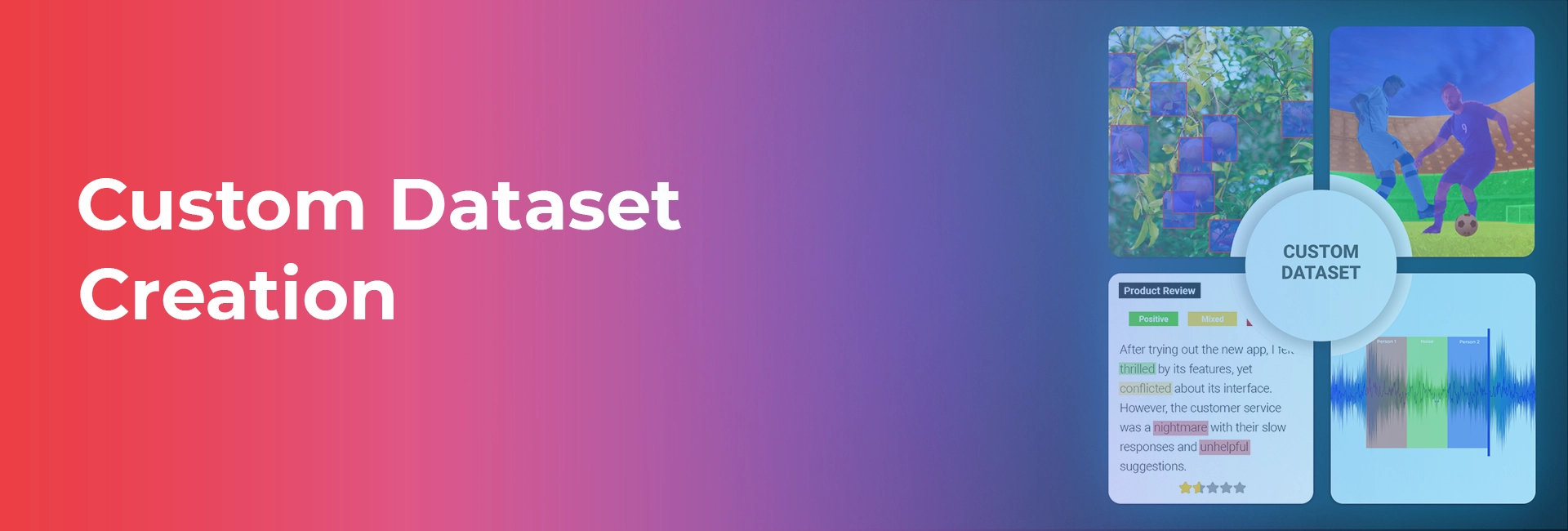
What Is a Custom AI Dataset?
Before dissecting the timeline, we must define what we are building. A custom AI dataset is a collection of data points—images, text, audio, or video—that has been specifically gathered, cleaned, and labeled to train a machine learning model for a unique purpose.
Unlike generic datasets, a custom dataset is tailored to your specific domain. It includes the exact edge cases, lighting conditions, acoustic environments, or industry jargon that your model will encounter in the real world.
Custom vs. Off-the-Shelf Datasets
Many companies start by asking if they can just use an off-the-shelf dataset. There are massive, open-source repositories available, such as COCO (Common Objects in Context) for object detection, ImageNet for classification, or Common Crawl for text.
These are excellent for benchmarking or pre-training base models, but they rarely suffice for commercial applications. If you are building a medical diagnostic tool, a generic database of “natural images” won’t help you detect fractures in X-rays. If you are building a legal contract review bot, a dataset of Reddit comments won’t teach it to identify indemnity clauses.
Businesses choose custom dataset creation because it offers higher accuracy, better domain relevance, and a significant competitive advantage. Your competitors can access public data; they cannot access your proprietary custom data.
Why Time Estimation Matters in AI Projects
Getting the timeline wrong on your dataset isn’t just a scheduling inconvenience; it’s a business risk. The dataset is the prerequisite for model training. If the data isn’t ready, your data scientists and ML engineers are effectively stalled.
Poor estimation often leads to:
- Budget Overruns: Extended timelines mean higher costs for tooling and workforce.
- Missed Deadlines: Product launches are pushed back, potentially missing market windows.
- Incomplete Labeling: Rushing to meet a deadline often results in cutting corners on Quality Assurance (QA), leading to a model that fails in production.
Industry experts often cite that data preparation—collection, cleaning, and labeling—accounts for 70% to 80% of the total effort in an AI project. If you underestimate this chunk of the work, you are underestimating the entire project.
High-Level Overview: AI Dataset Development Timeline
Creating a dataset is a pipeline process. While some stages can overlap, you generally cannot move to step C without finishing step B.
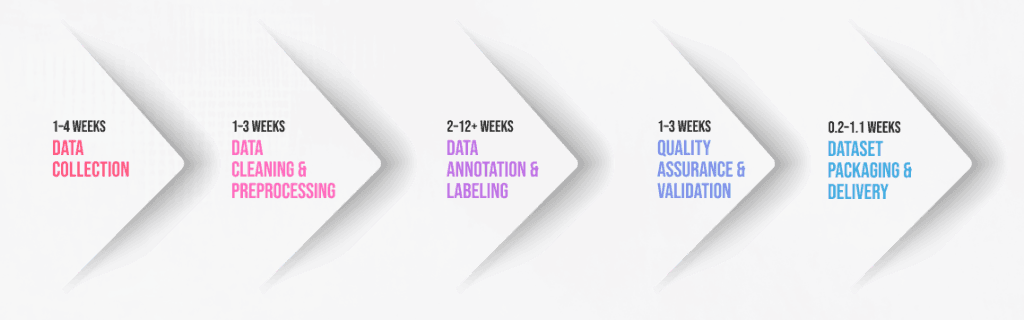
The standard AI dataset development timeline looks like this:
- Data Collection: Gathering the raw materials.
- Data Cleaning & Preprocessing: Making the raw data usable.
- Annotation & Labeling: Teaching the machine what the data represents.
- Quality Control: Verifying the teaching.
- Dataset Validation & Delivery: Packaging it for the model.
Depending on the complexity and volume of the data, this total timeline can range from as little as three weeks for a simple proof-of-concept to six months or more for a production-grade autonomous driving dataset.
Stage-by-Stage Breakdown of Custom Dataset Creation Time
To give you a realistic estimate, we need to look at the specific friction points in each stage.
5.1 Data Collection (Time: 1–4 Weeks)
This is where it all begins. The time required here depends heavily on where the data is coming from.
- Sources: You might be pulling data from internal company databases, scraping the web, using APIs, or physically deploying sensors and cameras to capture new footage.
- Bottlenecks: If you have the data sitting in an SQL database, this takes days. If you need to photograph 10,000 specific retail items on store shelves, it takes weeks. If you need to negotiate legal permissions to access third-party data, it can take months.
- Examples: Collecting 50,000 tweets via an API might take 48 hours. Collecting 500 MRI scans with patient consent forms signed might take 4 weeks.
5.2 Data Cleaning & Preprocessing (Time: 1–3 Weeks)
Raw data is rarely clean. It is often full of duplicates, corrupt files, and irrelevant samples.
- The Task: This stage involves file format standardization (converting everything to .jpg or .wav), resolution normalization, and deduplication. For text data, this involves OCR (Optical Character Recognition) cleanup and tokenization.
- Why it matters: This is the “Garbage in, garbage out” filter. If you send bad data to the annotators, you waste money labeling garbage. This stage requires scripting and manual spot-checking, which eats into the timeline.
5.3 Data Annotation & Labeling (Time: 2–12+ Weeks)
This is usually the longest phase of the project. Data annotation time is dictated by the complexity of the task and the volume of data.
a) Image Annotation
- Bounding Boxes: Drawing a box around a car is fast (30–90 seconds per image).
- Segmentation: Drawing a pixel-perfect outline around a tumor or a tree is slow (5–15 minutes per image).
- Keypoints: Marking joints on a human body for pose estimation falls somewhere in between.
b) Text Annotation
- Sentiment Analysis: Categorizing a review as “positive” or “negative” is quick.
- Entity Extraction: Highlighting specific drug names, dosages, and frequencies in a medical report takes significantly longer (1–5 minutes per sample) and requires focus.
c) Audio Annotation
- Transcription: Writing out what is said.
- Speaker Diarization: Identifying who said it.
- Emotion Detection: Labeling the tone of voice.
d) Video Annotation
- This is the most time-intensive. It involves frame-by-frame labeling, tracking objects as they move behind obstacles (occlusion), and maintaining consistent IDs for objects across thousands of frames.
Factors like manual labeling versus AI-assisted labeling (where a model takes a first guess and a human corrects it) play a massive role here. However, complex logic requiring human intuition cannot be rushed.
5.4 Quality Assurance & Validation (Time: 1–3 Weeks)
You cannot simply trust that the annotation is correct. You need a validation loop.
- The Process: This involves multi-pass reviews where senior annotators check the work of junior annotators. It includes calculating “Inter-Annotator Agreement” (do two humans agree on the same label?).
- The Loop: If the error rate is too high, batches of data must be sent back for re-labeling. This recursive loop is the most common cause of timeline slippage.
5.5 Dataset Packaging & Delivery (Time: 2–7 Days)
Once the data is labeled and checked, it must be exported into a format the model can ingest (JSON, COCO, YOLO, CSV, TFRecord). This stage also involves documenting the dataset schema and creating version control, so you know exactly which data was used to train which model version.
Key Factors That Affect Custom Dataset Creation Time

Timelines are not fixed; they are elastic based on several variables.
6.1 Dataset Size
It is obvious, but often overlooked: 100,000 images take ten times longer than 10,000 images, unless you scale your workforce by ten times (which introduces management overhead).
6.2 Annotation Complexity
A binary classification task (Is this a cat? Yes/No) is instant. Semantic segmentation (Color every pixel that belongs to the cat) is laborious. The more granular the detail required, the longer the timeline.
6.3 Domain Expertise Needed
Who is doing the labeling? If you need to identify stop signs, anyone can do it. If you need to identify legal clauses in M&A contracts or anomalies in a CT scan, you need subject matter experts (SMEs). SMEs are expensive, harder to find, and have limited availability, which stretches the timeline.
6.4 Automation Level
Are you doing everything manually? Or are you using “Active Learning” where the model learns as you go, and pre-labels the second half of the dataset for you? AI-assisted annotation can cut data annotation time by 30-50%.
6.5 Quality Standards
Do you need 90% accuracy or 99.5% accuracy? The final 5% of quality often takes 50% of the effort. Reaching “Ground Truth” perfection requires multiple review rounds.
6.6 Compliance & Security
If you are handling PII (Personally Identifiable Information), you need to factor in GDPR, HIPAA, or SOC-2 compliance. Redacting faces or blurring license plates adds an extra processing step.
Typical Timelines by Use Case
To make this concrete, here are estimated timelines for common AI projects, assuming a standard team size.
| Use Case | Estimated Time | Why? |
| Chatbot Intent Dataset (5k rows) | 2–3 Weeks | Text is fast to process; often requires minimal preprocessing. |
| E-commerce Product Tagging | 3–5 Weeks | Bounding boxes are standard; data is usually clean. |
| Medical Imaging Dataset | 2–4 Months | Requires specialized doctors to label; high privacy/security friction. |
| Autonomous Driving Dataset | 3–6 Months | Video data is heavy; frame-by-frame labeling is intense; extremely high quality required. |
| Legal Document Annotation | 1–3 Months | Reading lengthy documents takes time; requires legal professionals. |
How to Reduce AI Dataset Development Timeline
If the timelines above look daunting, there are strategies to accelerate the process without sacrificing quality.
- Use Pre-Labeled Datasets: Start with an open-source dataset to train a baseline model, then use custom dataset creation only for the edge cases the baseline misses.
- Active Learning: Use your model to label the data. As the model gets smarter, the humans only have to verify the model’s guesses rather than drawing labels from scratch.
- Smart Sampling: Don’t label everything. Use algorithms to select only the most “informative” data points that will actually improve the model.
- Clear Guidelines: Invest time upfront in writing a foolproof “Annotation Guidebook.” Ambiguity causes errors, and errors cause rework.
- Parallel Teams: Split the dataset into batches and run multiple annotation teams in parallel.
- Synthetic Data: Generate artificial data to fill gaps in your dataset. This is instant and perfectly labeled, though it should be used to augment, not replace, real data.
Strategies like these can compress the AI dataset development timeline significantly.
In-House vs. Outsourced Custom Dataset Creation
The decision of who builds the dataset is often a trade-off between control and speed.
In-House:
Building an internal team gives you maximum control over security and domain knowledge. However, it has a slow “cold start.” You have to hire people, license tools, and build workflows. It is rarely the fastest option.
Outsourced:
Outsourcing to managed data service providers offers a scalable workforce that is ready to go immediately. They have proven QA processes and tooling in place. While you sacrifice some direct oversight, the turnaround time is usually much faster because they operate as a dedicated factory for data.
Cost vs. Time Trade-Off
There is always a lever to pull. If you need the dataset fast, it will cost more. You will need to pay for expedited delivery, more annotators, and advanced automation tools.
Conversely, if you have a tight budget, you can extend the timeline and use a smaller team. The key is to understand the ROI of speed. If getting your model to market two months early generates $1M in revenue, paying an extra $50k for expedited data annotation time is a smart investment.
Common Mistakes That Delay Dataset Creation
Even with a perfect plan, projects get derailed. Watch out for these pitfalls:
- Poor Labeling Guidelines: If annotators are unsure what to do with an edge case, they will guess. This leads to inconsistent data that has to be redone.
- Scope Creep: Changing the label taxonomy halfway through (e.g., deciding to split “Car” into “Sedan” and “SUV”) requires restarting the labeling process.
- No QA Pipeline: Waiting until the end to check quality is a disaster. QA must happen in real-time.
- Over-Collecting Data: Do you really need 1 million images? Or will 50,000 high-quality ones do?
- Underestimating Annotation Time: Humans get tired. They don’t annotate at peak speed for 8 hours a day.
How to Plan Your Custom Dataset Project
To ensure your project lands on time, follow this planning hierarchy:
- Define Model Objective: What exactly does the model need to output?
- Choose Data Type: Image, text, audio?
- Estimate Volume: How many samples are needed for statistical significance?
- Pick Annotation Method: Bounding box? Segmentation?
- Set Quality Benchmark: Define what “good” looks like.
- Build a Buffer: Take your estimated timeline and add 20% for unforeseen data cleaning issues.
Final Summary
Custom dataset creation is not an instant process. It is a rigorous engineering discipline that requires planning, patience, and expertise. While the timeline varies wildly based on complexity—from a few weeks for simple text to half a year for complex video—the single biggest factor is data annotation time.
By understanding the AI dataset development timeline and the levers you can pull to speed it up, you can move from a vague roadmap to a concrete delivery schedule.
Need help building a high-quality custom AI dataset faster?
Don’t let data delays stall your AI innovation. Talk to our data experts at Macgence to estimate your dataset timeline and discover how we can accelerate your project.
[Get Dataset Timeline Estimate]
 Previous Blog


You Might Like

August 26, 2026
Physical AI Data Providers: From Robotics Data Collection to Physical AI Annotation
Physical AI is moving AI beyond screens and into the physical world, where it will fuel robots, autonomous vehicles, and other kinds of intelligent machines that need to make sense of the environment and act accordingly. This development is expected to increase the demand for specialized data providers capable of generating multimodal Physical AI data. […]

August 17, 2026
Video Narration Annotation for Robotics Egocentric Data: Building AI Datasets for the Robotics Industry
Robotics has progressed beyond controlled lab settings and into Physical AI systems that can perceive, comprehend, and interact in the real world. In light of the rapid progress being made towards this technology, AI datasets that will feed the future needs of the robotics sector will no longer suffice without the context, structure, and multimodal […]

August 10, 2026
Annotation for Robotics: How High-Quality Data Improves Robot Intelligence
Robots today must be able to maneuver through complex surroundings, identify objects, perceive human intent, and make smart decisions. All of this can only be achieved with the use of robotics annotation and high-quality annotation for robotics, which convert unstructured sensory inputs into high-quality AI robotics training datasets. In all industries, ranging from manufacturing and […]