


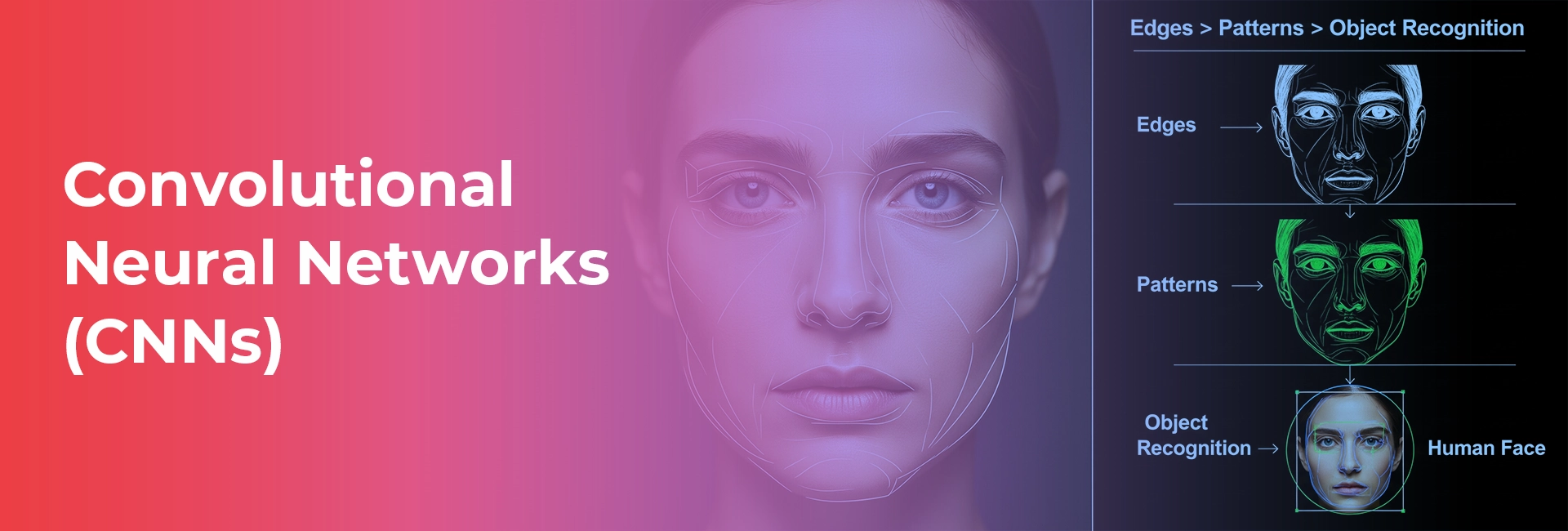
How Convolutional Neural Networks (CNNs) Power Image Recognition and Computer Vision
Artificial intelligence has made enormous strides in recent years, but when it comes to teaching machines to “see,” one technology stands out: Convolutional Neural Networks (CNNs). They are the backbone of modern computer vision systems, enabling applications ranging from facial recognition and autonomous vehicles to medical imaging and industrial inspection.

Convolutional Neural Net are designed to mimic the way the human brain processes visual information, breaking down images into smaller parts, identifying patterns, and learning how these pieces fit together. Let’s explore how CNNs work, why they are so powerful, and where they are transforming industries today.
Convolutional Neural Network Meaning
At their core, CNNs are a class of deep learning models specifically built for processing visual data. Unlike traditional neural networks that treat images as flat vectors, CNN Neural Net leverages the spatial structure of images. This means they can understand that pixels close to each other are related and form meaningful patterns.
A CNN is made up of multiple layers:
- Convolutional layers: Extract local features (edges, textures, shapes).
- Pooling layers: Reduce dimensionality while retaining important features.
- Fully connected layers: Combine features to make final predictions.
This hierarchical approach allows Conv Neural Net to progress from detecting simple lines or curves to recognizing complex objects such as a cat, a car, or even a tumor in an X-ray.

Why CNN Neural excel at Image Recognition
The strength of CNNs lies in their ability to automatically learn features from raw image data. In older machine learning methods, researchers had to manually define which features were important. CNNs remove that limitation by letting the model discover patterns on its own.
Here’s why CNNs are especially effective:
- Translation invariance: A cat is still a cat whether it appears in the top-left or bottom-right corner of an image.
- Parameter efficiency: Instead of learning separate weights for each pixel, CNNs reuse filters, making them computationally efficient.
- Hierarchical feature learning: Lower layers capture basic shapes, while deeper layers capture high-level concepts.
This combination allows CNNs to achieve near-human or even superhuman performance on image classification tasks.
Real-World Applications of Convolutional Neural Net
CNNs are no longer confined to research labs. They are embedded in daily life and business processes. Below is a snapshot of how industries are leveraging them:
| Industry | Use Case | Impact |
|---|---|---|
| Healthcare | Detecting diseases from X-rays, MRIs, CT scans | Up to 94% accuracy in cancer detection |
| Automotive | Object detection in autonomous vehicles | Reduces accidents by 40% in pilot programs |
| Retail & E-commerce | Visual product search and personalized recommendations | Boosts conversions by 30% |
| Security | Facial recognition for surveillance and access | Used in 80+ countries worldwide |
| Manufacturing | Automated defect detection in assembly lines | Cuts inspection time by 60% |
Key Statistics on CNN Adoption
- The global computer vision market is projected to reach $21.3 billion by 2030, driven largely by CNN-powered applications.
- CNN-based systems now achieve over 99% accuracy on popular image classification benchmarks like ImageNet.
- In healthcare, AI imaging solutions using CNNs are expected to save $150 billion annually for the U.S. healthcare system by 2026.
- 95% of autonomous vehicle companies rely on CNNs for object detection and scene understanding.
The Challenge: Data Quality and Training
While CNNs are powerful, they are only as good as the data used to train them. High-quality, annotated datasets are essential for teaching these models how to distinguish between objects.
For example, a CNN trained on blurry or biased images may fail in real-world scenarios. Similarly, a self-driving car system trained on sunny weather data may struggle in fog or snow. This highlights the importance of collecting diverse, accurate, and well-labeled training data.
Creating such datasets is often the most resource-intensive part of building computer vision systems. Companies need thousands—or even millions—of images annotated with bounding boxes, labels, or pixel-level segmentation to train effective CNNs.
How Macgence AI Can Help
This is where Macgence steps in. As a trusted AI training data company, Macgence specializes in delivering high-quality, domain-specific datasets that CNNs require to succeed. Whether it’s image annotation, data collection, or building custom datasets for unique computer vision applications, Macgence ensures that the data foundation is rock solid.
By working with Macgence, organizations can:
- Access expertly annotated images tailored to their industry.
- Save time and resources on dataset preparation.
- Ensure diversity and accuracy in data, reducing model bias.
- Accelerate the deployment of CNN-powered applications in healthcare, automotive, retail, and more.
Final Thoughts
Convolutional Neural Networks are the engines behind modern image recognition and computer vision. Their ability to automatically extract features and learn visual patterns has unlocked applications that were once science fiction. But without high-quality data, even the most sophisticated CNN cannot perform well.
Macgence AI bridges this gap by providing the essential training datasets that make CNNs truly effective. If your organization is building or scaling computer vision systems, partnering with Macgence ensures that your models don’t just work—they excel in real-world conditions.
FAQ’s
CNNs preserve the spatial structure of images, automatically learning features like edges, textures, and shapes. Traditional neural networks treat images as flat data, which loses critical context.
Industries such as healthcare, automotive, retail, manufacturing, and security see the biggest impact, using CNN network for diagnostics, autonomous driving, defect detection, and facial recognition.
The amount varies depending on complexity, but large-scale CNNs often require millions of annotated images to achieve high accuracy.
Macgence provides high-quality, annotated datasets tailored to specific industries, helping organizations train CNNs more effectively and reduce model bias.
 Previous Blog


You Might Like

October 12, 2026
DataRobot Training for Enterprises: How High-Quality AI Training Data Improves Model Performance
DataRobot Training refers to the data preparation process, followed by machine learning model creation and evaluation on the DataRobot platform. It requires AI training data to be reliable in terms of labels and datasets as well as consistency of records – otherwise, there will be no valid predictions. As businesses transition AI from pilot to […]

October 5, 2026
Data Annotation Company for AI Training: From Healthcare Data Labeling to Robotics & Multimodal Datasets
AI is transitioning from pilot to production, and models do not fail due to their architecture but due to the quality of the data which was used to train them. With the scaling of projects in computer vision, NLP, healthcare, robotics, companies need a data annotation company that will provide domain-specific labeling of all kinds […]

September 28, 2026
Annotation Provider for AI Training: Computer Vision, NLP, Healthcare and Robotics Annotation
All effective AI models, from robots to clinical NLP engines, require one crucial layer: annotation. As enterprises race to deploy computer vision, NLP, healthcare, and robotics solutions, the quality of an annotation provider now makes all the difference between the success or failure of a model outside of lab conditions. Generic labeling cannot meet the […]