


- Understanding VLA Models in Embodied AI
- What Exactly is VLA Training Data?
- Moving from Traditional to Multimodal VLA Datasets
- Why VLA Training Data is Critical for Embodied AI
- Key Challenges in Building High-Quality VLA Training Data
- How VLA Training Data is Collected in Practice
- Applications of VLA Training Data in Modern Robotics
- The Role of Multimodal Robotics Datasets in Scaling
- Future Trends in VLA Training Data
- Business Impact: Invest in VLA Training Data Now
- The Data Layer Will Define the Future of Embodied AI
- FAQs
Why VLA Training Data is the Backbone of Next-Gen Embodied AI
Artificial intelligence is undergoing a massive shift. We are moving away from systems that simply perceive their environment to intelligent agents that can see, reason, and act within the physical world. This leap forward is driven by Embodied AI, a field that aims to give machines physical forms and real-world capabilities.
At the heart of this transformation are Vision-Language-Action (VLA) models. These models allow robots to understand verbal instructions, process visual inputs from their surroundings, and execute complex physical tasks. However, these advanced models require a new kind of fuel. VLA Training Data is rapidly becoming the critical resource for developing robots that possess genuine real-world intelligence.
By shifting from traditional, single-modality data to rich, multimodal robotics datasets, developers can finally bridge the gap between digital reasoning and physical execution.
Understanding VLA Models in Embodied AI
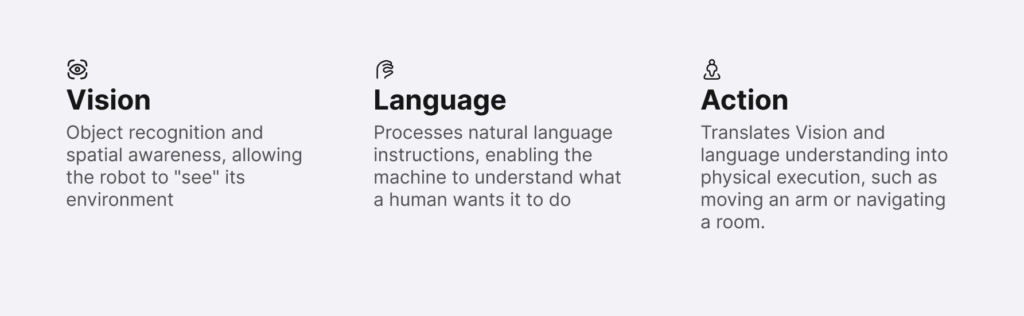
VLA models integrate three core components: vision, language, and action. Unlike traditional AI models that might only process text or classify images, VLA systems combine these modalities to function in the real world.
First, the vision component handles object recognition and spatial awareness, allowing the robot to “see” its environment. Second, the language module processes natural language instructions, enabling the machine to understand what a human wants it to do. Finally, the action component translates this understanding into physical execution, such as moving an arm or navigating a room.
These models are already powering humanoid robots, warehouse automation systems, and autonomous manipulation robots. To function reliably, these systems rely heavily on high-quality VLA model training data.
What Exactly is VLA Training Data?
In the context of Embodied AI, VLA Training Data refers to synchronized datasets that map visual inputs and language instructions to specific action sequences.
The structure of these datasets typically includes:
- Visual inputs like images, videos, and depth data.
- Language instructions, usually natural language commands given by humans.
- Action sequences, which consist of robot motion logs and control signals.
The biggest challenge in creating this data is alignment. The visual data, the spoken command, and the physical action must be perfectly synchronized so the model learns exactly how a specific request translates into a physical movement.
Moving from Traditional to Multimodal VLA Datasets
Historically, robotics relied on isolated datasets. Researchers used image recognition datasets like COCO or ImageNet to teach robots how to see, while using separate robot motion datasets to teach them how to move.
These earlier datasets had severe limitations. They lacked language grounding, meaning robots could not easily understand verbal commands, and they offered poor real-world adaptability. The rise of multimodal robotics datasets has changed this. By combining perception, instruction, and execution into a single training pipeline, developers are enabling general-purpose robotics intelligence that can adapt to new, unseen tasks.
Why VLA Training Data is Critical for Embodied AI
High-quality VLA Training Data is essential for several reasons. It enables robots to understand nuanced human intent rather than relying on rigid, hard-coded instructions. It also improves generalization, allowing robots to operate in diverse environments like homes, factories, and hospitals.
Furthermore, this data helps bridge the simulation-to-real-world gap (often called Sim2Real). By learning from accurate human demonstrations, robots become much more adaptable in unstructured, unpredictable environments.
Key Challenges in Building High-Quality VLA Training Data
Creating VLA model training data is not a simple task. It requires overcoming several technical and logistical hurdles.
Data Collection Complexity
Real-world robotics data is expensive and slow to collect. Capturing data across diverse environments requires significant hardware investments and time.
Annotation Difficulties
Aligning language instructions with physical actions requires precise temporal synchronization. Annotators must accurately label when an action begins and ends in relation to a verbal command.
Edge Case Coverage
Robots will inevitably encounter unexpected obstacles and failures. Building robust systems requires long-tail data that covers these rare, unpredictable scenarios.
Multi-sensor Integration
Modern robots use multiple sensors, including cameras, LiDAR, and depth sensors. Fusing this data into a cohesive dataset is computationally demanding.
How VLA Training Data is Collected in Practice
To build these complex datasets, developers use a variety of collection methods. Teleoperation is a common approach, where humans manually control robots to record baseline action sequences.
Simulation environments like Unity, Gazebo, and NVIDIA Isaac Sim are also heavily utilized to generate massive amounts of data quickly. Additionally, real-world robotic trials and human demonstration recordings provide the authentic physics and visual noise needed for reliable training. Many companies are now turning to specialized outsourced robotics data collection services to manage sensor fusion pipelines and scale their multimodal capture efforts.
Applications of VLA Training Data in Modern Robotics
As multimodal robotics datasets grow, they are enabling breakthroughs across several industries.
Humanoid Robots
VLA data helps humanoid robots perform household assistance tasks and understand human-like interactions, making them safer and more helpful in domestic settings.
Industrial Automation
In manufacturing, these models power adaptive warehouse robotics. Robots can now handle dynamic picking, sorting, and assembly tasks without needing reprogrammed instructions for every new object.
Autonomous Navigation Robots
Robots that navigate public spaces use VLA model training data to make dynamic decisions and manipulate objects in real-time.
Service Robotics
From healthcare assistants to retail customer service bots, Embodied AI relies on multimodal data to interact naturally with the public.
The Role of Multimodal Robotics Datasets in Scaling
To scale VLA models, developers need massive, diverse datasets. Just as Large Language Models required the entire internet to learn text, Embodied AI requires vast amounts of physical interaction data to build foundation models for robotics.
There is an ongoing debate about dataset quality versus dataset quantity. While massive datasets help with generalization across unseen scenarios, high-quality, perfectly synchronized data is often more effective for teaching precise physical tasks. Continuous dataset updates remain crucial for keeping these models relevant.
Future Trends in VLA Training Data
The landscape of Embodied AI is evolving rapidly. Several key trends are shaping the future of data collection and model training:
- Synthetic and Real Hybrid Datasets: Combining simulation data with real-world logs to maximize scale while maintaining physical accuracy.
- Self-Supervised Learning: Allowing robots to learn by interacting with their environment without explicitly labeled data.
- Foundation Models for Robotics: Building generalized GPT-like models specifically for embodied physical intelligence.
- Continuous Learning Systems: Creating robots that update their knowledge and refine their actions in real time.
- Standardization: Developing industry-wide benchmarks and dataset standards for VLA models.
Business Impact: Invest in VLA Training Data Now
For startups and enterprise robotics teams, investing in VLA Training Data now offers a massive competitive advantage. Access to high-quality data accelerates model deployment cycles and significantly reduces long-term R&D costs. Companies that prioritize robust, multimodal datasets will achieve better performance in real-world deployments and capture market share in the rapidly expanding Embodied AI sector.
The Data Layer Will Define the Future of Embodied AI
VLA Training Data is the foundation upon which the next generation of robotics is being built. As the industry shifts toward multimodal intelligence, robots will increasingly act as context-aware agents capable of executing complex instructions in messy, real-world environments.
Ultimately, the hardware will become commoditized, and the algorithms will become open-source. The true differentiator for future AI capabilities will be the quality, diversity, and scale of the data layer.
FAQs
Ans: – VLA Training Data consists of synchronized datasets that combine visual inputs, natural language instructions, and physical action sequences to train robots how to interact with the real world.
Ans: – Traditional datasets usually focus on a single modality, like image recognition or motor control. VLA data is multimodal, linking what a robot sees and hears directly to how it should move.
Ans: – They are used to train advanced AI models that can generalize across different tasks, environments, and physical forms, enabling general-purpose robotics.
Ans: – It provides the vital link between digital reasoning and physical execution, allowing robots to understand human intent and navigate unpredictable physical spaces safely.
Ans: – The main challenges include the high cost of real-world data collection, the difficulty of synchronizing multi-sensor data with language, and the need to capture rare edge cases.
Ans: – Yes. Synthetic data generated in simulation environments is widely used, though it is usually combined with real-world data to bridge the gap between simulation physics and real-world dynamics.
 Previous Blog


You Might Like

October 12, 2026
DataRobot Training for Enterprises: How High-Quality AI Training Data Improves Model Performance
DataRobot Training refers to the data preparation process, followed by machine learning model creation and evaluation on the DataRobot platform. It requires AI training data to be reliable in terms of labels and datasets as well as consistency of records – otherwise, there will be no valid predictions. As businesses transition AI from pilot to […]

October 5, 2026
Data Annotation Company for AI Training: From Healthcare Data Labeling to Robotics & Multimodal Datasets
AI is transitioning from pilot to production, and models do not fail due to their architecture but due to the quality of the data which was used to train them. With the scaling of projects in computer vision, NLP, healthcare, robotics, companies need a data annotation company that will provide domain-specific labeling of all kinds […]

September 28, 2026
Annotation Provider for AI Training: Computer Vision, NLP, Healthcare and Robotics Annotation
All effective AI models, from robots to clinical NLP engines, require one crucial layer: annotation. As enterprises race to deploy computer vision, NLP, healthcare, and robotics solutions, the quality of an annotation provider now makes all the difference between the success or failure of a model outside of lab conditions. Generic labeling cannot meet the […]