


- Understanding the Sim-to-Real Gap
- The Limitations of Simulation
- The Importance of Real-World Robot Training Data
- Data-Centric Strategies for Sim-to-Real Gap Reduction
- Cross-Embodiment Transfer Data
- Challenges in Building High-Quality Robotics Datasets
- Best Practices for Enterprise Deployment
- Future Trends in Sim-to-Real Learning
- Building Resilient AI for the Physical World
- FAQs
How to Solve the Sim-to-Real Gap in Robotics AI
Building a robot that performs flawlessly in a computer simulation is an impressive feat. Getting that same robot to operate safely and reliably in the physical world is entirely different. When machine learning models trained in virtual environments fail upon real-world deployment, engineers face a frustrating roadblock. This discrepancy is a primary reason why autonomous robots and industrial automation systems frequently experience high failure rates during initial testing.
For safety-critical applications, these failures are unacceptable. A robotic arm dropping a delicate component or an autonomous vehicle misjudging a physical obstacle can cause severe damage. Many developers mistakenly treat this issue as a modeling flaw, continuously tweaking algorithms in hopes of better physical performance. However, the root of the problem is fundamentally a data issue.
Achieving meaningful Sim-to-Real Gap Reduction requires a shift in focus. The physics engines powering simulations simply cannot replicate the infinite complexities of the physical world. To truly bridge this divide, developers must prioritize high-quality real-world robot training data and leverage advanced concepts like cross-embodiment transfer data.
Understanding the Sim-to-Real Gap
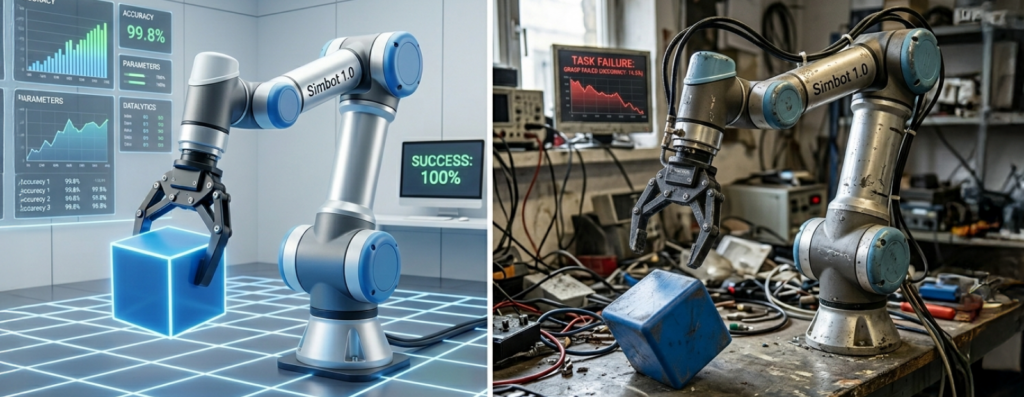
The Sim-to-Real Gap refers to the performance discrepancy between a model’s execution in a simulated training environment and its behavior in the physical world. A model might achieve near-perfect accuracy virtually, only to struggle with basic tasks once deployed on actual hardware.
Several factors cause this mismatch. Physics engines often struggle to simulate complex friction dynamics, varied lighting conditions, and unpredictable sensor noise. Simulated environments also lack the chaotic diversity of physical spaces, leading models to overfit to clean, synthetic distributions. For instance, a robotic arm trained exclusively in a simulation might perfectly grasp standardized virtual cubes but fail to pick up objects with slight real-world variations in texture, weight, or shape.
The Limitations of Simulation
Simulation remains a vital tool in robotics development. It offers incredible scalability, allowing developers to run millions of training iterations overnight without risking expensive hardware. It is highly cost-efficient and provides a perfectly safe space for early-stage experimentation.
Despite these advantages, simulation alone is never enough. Virtual environments often fail to generate realistic edge cases and miss the unpredictable long-tail scenarios that robots encounter daily. Furthermore, simulations provide clean data that lacks the poor fidelity and noise typical of actual physical sensors.
Because simulation creates these inherently biased datasets, relying on it exclusively leaves AI models fundamentally ungrounded. Real-world data is absolutely required to anchor these models to the messy realities of physical operation.
The Importance of Real-World Robot Training Data
Real-world robot training data encompasses the actual sensor inputs a robot records while operating in physical spaces. This includes RGB video feeds, depth maps, LiDAR point clouds, and physical motion trajectories, often gathered through human demonstrations.
Integrating this data is crucial because it accurately captures the noise, uncertainty, and environmental variability that simulations miss. Training models on physical data dramatically improves robustness and helps the AI generalize its behaviors across different environments. Using egocentric video datasets, multi-modal sensor inputs, and task-specific human demonstrations gives the AI the context it desperately needs.
Consider warehouse automation. Robots trained entirely in simulation often freeze or miscalculate paths when encountering unexpected clutter on a facility floor. In contrast, robots trained using real-world robot training data that includes physical clutter scenarios easily outperform their sim-trained counterparts.
Data-Centric Strategies for Sim-to-Real Gap Reduction
To effectively narrow the performance gap, engineering teams must adopt data-centric training strategies.
Domain Randomization
Domain randomization involves intentionally varying textures, lighting conditions, camera angles, and physics parameters within the simulation. By exposing the model to extreme visual and physical variations, the AI learns to ignore irrelevant details and focus on the core task, helping it generalize better upon deployment.
Sim and Real Hybrid Training
Instead of treating simulation and real-world training as isolated steps, hybrid training combines synthetic and physical datasets. Developers pre-train the model in simulation to learn basic mechanics, then fine-tune the system using real-world samples to adapt to physical nuances.
Data Augmentation
Data augmentation techniques artificially introduce real-world imperfections into clean training data. Injecting synthetic noise, simulating sensor distortion, and dropping data frames forces the model to learn how to operate under sub-optimal physical conditions.
Active Data Collection
Active data collection is a continuous process where engineers deploy robots into physical spaces specifically to log failure cases. The system iteratively collects data precisely where the model struggles, feeding those physical edge cases back into the training pipeline for continuous improvement.
Human-in-the-Loop Annotation
Even the best data requires accurate labeling. Human-in-the-loop annotation involves expert reviewers correcting complex edge cases and ensuring labels are highly accurate, which is especially important for 3D and temporal datasets.
Cross-Embodiment Transfer Data
Cross-embodiment transfer data represents a massive leap forward for scalable robotics AI. This concept involves training models to generalize skills across entirely different types of robot hardware. For example, an AI might learn basic grasping techniques on a stationary robotic arm and subsequently transfer that knowledge to a mobile humanoid robot.
This matters because it drastically reduces the need to collect massive amounts of real-world robot training data for every new hardware iteration. By utilizing shared manipulation datasets and multi-robot learning frameworks, developers encourage the AI to learn broad, task-level abstractions rather than memorizing hardware-specific joint movements. Ultimately, cross-embodiment datasets accelerate the scalability of robotics AI across entire industries.
Challenges in Building High-Quality Robotics Datasets
Gathering the data required for Sim-to-Real Gap Reduction is not easy. Physical data collection is inherently expensive and time-consuming, often requiring fleets of robots and human operators.
Furthermore, annotating robotics data is highly complex. Annotators must deal with 3D spatial information, temporal video sequences, and multimodal sensor inputs simultaneously. Hardware diversity also creates massive data standardization challenges, as different robots use varying camera placements, sensor types, and kinematic structures.
Best Practices for Enterprise Deployment
Enterprises looking to deploy reliable robotics AI must build robust, multimodal data pipelines from day one. Organizations should focus on combining scalable simulation with targeted real-world data collection, prioritizing the capture of physical edge cases.
Establishing scalable annotation workflows is also critical. Because labeling 3D and temporal data is highly specialized, many successful enterprises partner with expert data providers—like Macgence—to ensure their datasets are accurate, diverse, and properly formatted for machine learning models.
Future Trends in Sim-to-Real Learning
The field of robotics AI is evolving rapidly. We are seeing a strong push toward self-supervised learning, where robots learn from unstructured physical environments without relying on massive amounts of manually labeled data.
Foundation models for robotics are also emerging, promising to act as general-purpose brains that can be fine-tuned for specific physical tasks. Additionally, developers are using generative AI to better align synthetic data with physical reality, creating highly realistic training environments. Across all these trends, the industry is recognizing that data quality ultimately matters far more than model complexity.
Building Resilient AI for the Physical World
The Sim-to-Real Gap is primarily a data challenge, not a software flaw. While simulations provide a necessary foundation, they cannot replicate the chaos of physical environments.
Achieving true Sim-to-Real Gap Reduction requires an aggressive commitment to gathering high-quality real-world robot training data and utilizing cross-embodiment transfer data to scale capabilities efficiently. Companies that prioritize data-centric AI strategies will overcome deployment hurdles faster and ultimately lead the next wave of robotics innovation.
FAQs
Ans: – It is the process of minimizing the performance drop that occurs when an AI model trained in a virtual simulation is deployed onto a physical robot in the real world.
Ans: – The gap occurs because simulations cannot perfectly replicate real-world physics, lighting, friction, and sensor noise. Models often overfit to the clean, predictable nature of simulated environments.
Ans: – Physical data captures the unpredictable noise and variability of real environments. By incorporating this data, models learn to handle physical uncertainties, improving their overall robustness.
Ans: – This refers to training data that allows an AI model to learn skills on one type of robot (like an industrial arm) and transfer those skills to a differently designed robot (like a humanoid).
Ans: – No. While simulation is excellent for safe, scalable pre-training, it lacks the fidelity and edge-case diversity required to finalize a model for safe physical deployment.
Ans: – Industries relying on physical automation see the most benefit. This includes manufacturing, warehouse logistics, autonomous vehicles, agriculture, and healthcare robotics.
Ans: – Top strategies include domain randomization, hybrid training (combining sim and real data), injecting synthetic noise (data augmentation), and actively collecting physical failure cases to continuously update the model.
 Previous Blog


You Might Like

August 26, 2026
Physical AI Data Providers: From Robotics Data Collection to Physical AI Annotation
Physical AI is moving AI beyond screens and into the physical world, where it will fuel robots, autonomous vehicles, and other kinds of intelligent machines that need to make sense of the environment and act accordingly. This development is expected to increase the demand for specialized data providers capable of generating multimodal Physical AI data. […]

August 17, 2026
Video Narration Annotation for Robotics Egocentric Data: Building AI Datasets for the Robotics Industry
Robotics has progressed beyond controlled lab settings and into Physical AI systems that can perceive, comprehend, and interact in the real world. In light of the rapid progress being made towards this technology, AI datasets that will feed the future needs of the robotics sector will no longer suffice without the context, structure, and multimodal […]

August 10, 2026
Annotation for Robotics: How High-Quality Data Improves Robot Intelligence
Robots today must be able to maneuver through complex surroundings, identify objects, perceive human intent, and make smart decisions. All of this can only be achieved with the use of robotics annotation and high-quality annotation for robotics, which convert unstructured sensory inputs into high-quality AI robotics training datasets. In all industries, ranging from manufacturing and […]