


- What Are Multilingual Speech Datasets?
- Why Sourcing Multilingual Speech Data Is Challenging
- Key Factors to Consider Before Sourcing Multilingual Speech Datasets
- Main Ways to Source Multilingual Speech Datasets
- Best Practices for Building High-Quality Multilingual Speech Datasets
- Common Mistakes to Avoid
- When to Choose a Custom Multilingual Speech Dataset Strategy
- How Enterprises Typically Source Multilingual Speech Datasets at Scale
- Building Global Voice AI Starts With the Right Data
How to Source Multilingual Speech Datasets That Actually Work
Voice AI has moved from novelty to necessity. Businesses across industries are deploying chatbots, interactive voice response systems, virtual assistants, and transcription services to meet customer expectations. But there’s a catch: most voice AI models are trained on English-only datasets, which limits their real-world utility in diverse, multilingual markets.
If you’re building voice technology for global audiences, sourcing high-quality multilingual speech datasets is no longer optional. It’s a strategic requirement that directly impacts model accuracy, user trust, and market reach.
But sourcing multilingual speech data is harder than it sounds. Language diversity, speaker variability, annotation consistency, and compliance standards all complicate the process. This guide walks you through what multilingual speech datasets are, why sourcing them is challenging, and how to approach it strategically—whether you’re starting from scratch or scaling an existing voice AI product.
What Are Multilingual Speech Datasets?
Multilingual speech datasets are curated collections of spoken audio samples across multiple languages, paired with accurate transcriptions and metadata. These datasets enable machine learning models to understand, transcribe, and respond to speech in different languages and accents.
A well-structured dataset typically includes:
- Raw audio files in various formats (WAV, MP3, FLAC)
- Transcriptions aligned to the audio
- Speaker demographics (age, gender, region)
- Language tags and dialect labels
- Environmental metadata (noise levels, recording conditions)
These datasets power use cases like:
- Automatic Speech Recognition (ASR)
- Voice assistants and smart speakers
- Call center analytics and quality monitoring
- Real-time speech translation
- Voice biometrics and authentication
The quality and diversity of your multilingual speech datasets determine how well your models perform across different languages, regions, and user groups.
Why Sourcing Multilingual Speech Data Is Challenging

Collecting speech data in one language is already complex. Expanding that effort across multiple languages introduces new layers of difficulty:
Language diversity: Languages come with accents, dialects, regional variations, and code-switching. A Spanish ASR model trained on Mexican Spanish may struggle with Argentinian or Castilian Spanish.
Speaker diversity: Models need to generalize across age groups, genders, and geographic regions. Skewed representation leads to biased or inaccurate predictions.
Data consistency: Recording conditions vary widely across regions. Inconsistent audio quality makes it harder to train robust models.
Privacy and consent: Different countries have different data protection laws. GDPR in Europe, DPDP in India, and other regional regulations require explicit consent and data anonymization.
Annotation complexity: Multilingual transcription demands native-language annotators who understand context, slang, and nuance. Poor annotation quality undermines model performance.
Scalability: Training production-grade ASR models requires thousands of hours per language. Sourcing that volume while maintaining quality is resource-intensive.
The business impact is clear: poor sourcing leads to biased models, limited language coverage, and restricted market reach. Getting it right from the start saves time, money, and reputation.
Key Factors to Consider Before Sourcing Multilingual Speech Datasets
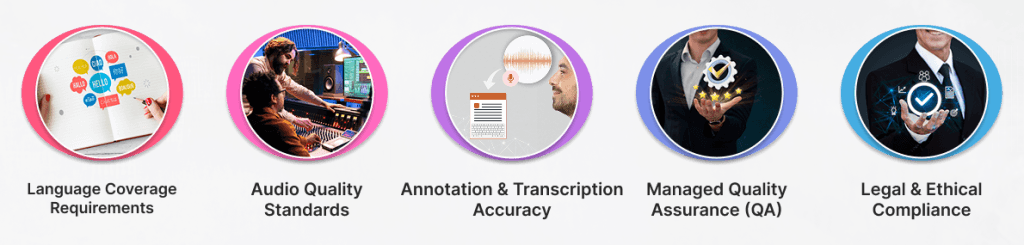
Before you begin sourcing, define your requirements clearly. This ensures you collect the right data for your use case.
Language Coverage Requirements
Determine which languages you need and how deeply you need to cover them. High-resource languages like English, Mandarin, and Spanish have abundant datasets. Low-resource languages like Swahili, Tamil, or Icelandic require custom collection efforts.
Also consider whether you need regional accents or standard language. A voice assistant for Indian English users should account for the diversity of Indian accents, not just neutral American or British English.
Audio Quality Standards
Establish clear audio quality benchmarks:
- Sample rate: 16 kHz is standard for ASR; higher rates may be needed for certain applications
- Noise levels: Background noise affects transcription accuracy
- Recording environments: Studio recordings differ from field recordings or call center audio
Consistency across languages is critical. If your English dataset is studio-quality but your Hindi dataset is noisy, your model will perform unevenly.
Annotation & Transcription Accuracy
Transcription quality directly impacts model performance. Native-language annotators are essential for capturing nuances, slang, and context. Maintain consistency across languages by using standardized annotation guidelines and quality assurance processes.
Legal & Ethical Compliance
Ensure all speakers provide informed consent. Anonymize personally identifiable information (PII) and comply with regional data protection laws like GDPR, CCPA, and DPDP. Non-compliance can result in legal penalties and reputational damage.
Main Ways to Source Multilingual Speech Datasets
There are several sourcing strategies, each with trade-offs. Your choice depends on budget, timeline, and quality requirements.
Open-Source Speech Datasets
Platforms like Mozilla’s Common Voice and OpenSLR offer free, publicly available datasets in multiple languages. These are useful for prototyping and research.
Pros:
- Low cost
- Fast access
- Community-driven
Cons:
- Limited language coverage
- Inconsistent quality across languages
- Licensing restrictions
- Not domain-specific (e.g., call center, healthcare)
Open-source datasets work well for proof-of-concept projects but often fall short for production-grade systems.
In-House Data Collection
Recording your own speakers gives you full control over data quality, metadata, and compliance. You can tailor datasets to specific domains, accents, and use cases.
Pros:
- Full control over quality
- Custom requirements
- Domain-specific data
Cons:
- High operational cost
- Long timelines
- Recruitment and logistics challenges
- Compliance complexity across regions
In-house collection makes sense for organizations with dedicated resources and specific needs that off-the-shelf datasets can’t meet.
Data Marketplaces
Marketplaces sell pre-collected datasets across various languages. These offer faster access than in-house collection but less customization.
Pros:
- Faster than in-house
- Lower upfront cost
- Some variety in languages
Cons:
- Generic data
- Limited customization
- Inconsistent metadata
- Quality varies by provider
Marketplaces are a middle-ground option for teams that need speed but can tolerate some lack of specificity.
Managed Data Service Providers
Enterprises building large-scale voice AI systems often partner with managed data service providers. These providers handle end-to-end data collection, transcription, and quality assurance across multiple languages and regions.
Pros:
- Custom data collection tailored to your use case
- Language-specific sourcing with native speakers
- Domain adaptation (call center, healthcare, automotive)
- Built-in quality assurance pipelines
- Compliance handling across jurisdictions
Cons:
- Higher cost than open-source or marketplaces
- Requires clear communication of requirements
This approach suits organizations that need scalable, high-quality multilingual speech datasets and prefer to focus on model development rather than data operations.
Best Practices for Building High-Quality Multilingual Speech Datasets
Following these practices will help you build datasets that generalize well across languages and use cases:
- Use native speakers for both data capture and transcription to ensure linguistic accuracy
- Balance languages and accents intentionally to avoid bias
- Standardize recording environments across regions to maintain consistency
- Implement multi-stage quality validation with checks for audio quality, transcription accuracy, and metadata completeness
- Track metadata for each language, including speaker demographics, dialect, and recording conditions
- Continuously update datasets with new accents, slang, and language variations
- Test dataset performance in real ASR pipelines to validate usability
High-quality multilingual speech datasets aren’t built once and forgotten. They require ongoing refinement as languages evolve and new use cases emerge.
Common Mistakes to Avoid
Even experienced teams make avoidable errors when sourcing multilingual speech data:
- Over-relying on English-heavy datasets and assuming they’ll generalize to other languages
- Ignoring dialect and accent variation within a single language
- Mixing inconsistent annotation standards across languages
- Neglecting speaker diversity in age, gender, and geography
- Using datasets without clear consent documentation, risking legal issues
- Choosing volume over quality, which leads to poor model performance
Avoiding these pitfalls saves time and resources in the long run.
When to Choose a Custom Multilingual Speech Dataset Strategy
Custom sourcing is the right choice when:
- You’re launching voice products in multiple countries with diverse languages
- You need domain-specific ASR models (e.g., medical terminology, financial services)
- You’re supporting low-resource languages with limited public datasets
- You must meet strict regulatory requirements for data privacy and consent
- You need scalable, long-term datasets that evolve with your product
Custom datasets require more upfront investment but deliver better model performance and market differentiation.
How Enterprises Typically Source Multilingual Speech Datasets at Scale
Most enterprises follow a structured process when sourcing multilingual speech data:
- Requirement analysis: Define languages, target hours, domain, and use case
- Speaker recruitment: Source native speakers across target regions
- Data collection pipelines: Record audio under controlled conditions
- Transcription and validation: Use native-language annotators with quality checks
- Dataset delivery: Provide structured formats (JSON, CSV, audio files) with complete metadata
This workflow ensures consistency, compliance, and scalability across languages. Organizations often partner with data service providers to handle the operational complexity while retaining control over quality standards.
Building Global Voice AI Starts With the Right Data
Multilingual speech datasets are the foundation of accurate, fair, and scalable voice AI systems. The sourcing strategy you choose directly affects model performance, user experience, and market reach.
As voice AI expands globally, multilingual data becomes a competitive advantage. Thoughtful planning, quality standards, and the right sourcing approach will set your voice products apart in an increasingly multilingual world.
Organizations building global voice systems increasingly rely on structured multilingual speech datasets to ensure accuracy, fairness, and scalability.
 Previous Blog


You Might Like

April 13, 2026
Building Better Humanoids: The Power of Custom Multimodal Robotics Datasets
Humanoid robots are rapidly moving out of research labs and into real-world applications. We are seeing these complex machines take on roles in logistics, healthcare, retail, and home assistance. However, creating a robot that can safely and effectively navigate human spaces is an immense challenge. Humanoids require a highly contextual, multimodal understanding of their surroundings […]

April 13, 2026
How Scene Understanding Data Powers Autonomous Driving
Autonomous vehicles and robots are no longer just experimental concepts. They are actively entering real-world environments. However, a major challenge remains for engineers. Machines must accurately interpret complex, dynamic scenes in real time. This is where Autonomous Driving Scene Understanding becomes a critical capability. It allows machines to comprehend their surroundings rather than just passively […]

April 11, 2026
From Smart Homes to Warehouses: Data Use Cases in Robotics
Robotics technology is rapidly expanding across a wide variety of environments. We now see intelligent machines operating seamlessly in homes, warehouses, retail spaces, and corporate offices. This widespread adoption relies heavily on one crucial element: high-quality data. Data serves as the foundation of real-world robot intelligence. However, a single, universal dataset cannot train a robot […]