


Building a High-Quality Robot Perception Dataset

Robot perception serves as the backbone of embodied AI. Without the ability to accurately see, hear, and feel their surroundings, machines cannot interact safely with the physical environment. A robot perception dataset provides the essential sensory inputs—like vision, depth, and tactile feedback—that train these systems to understand the world around them. When developers rely on […]
Advanced Robotics Data Types: From Trajectories to 3D Hand Meshes
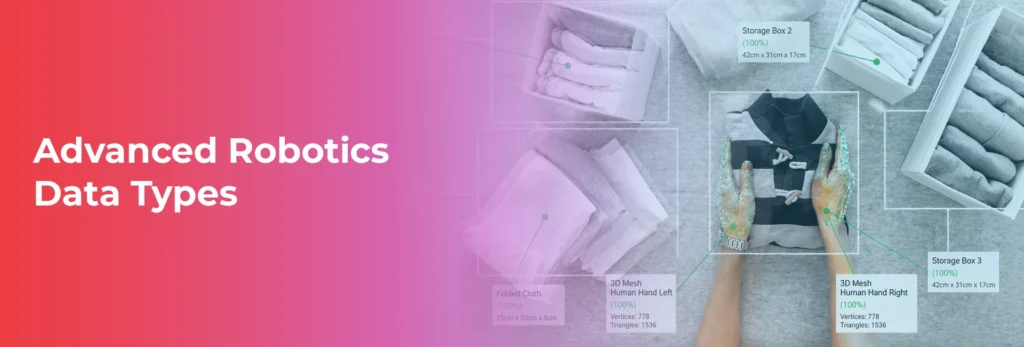
The field of artificial intelligence is experiencing a massive shift. We are moving away from simple labeled datasets toward complex, multimodal robotics data. Early AI models relied heavily on static images and text, but embodied AI and modern robot learning require something much more robust. To interact with the physical world, robots need high-fidelity data […]
Decoding Robot Imitation Learning Data Challenges and Opportunities

Getting a robot to perform a complex task used to require thousands of lines of hard-coded rules. Even with modern reinforcement learning, machines often spend countless hours in simulation trial-and-error just to grasp basic movements. Robot imitation learning offers a smarter alternative. By observing human or expert demonstrations, robots can learn behaviors much more naturally. […]
Bridging Human Motion and Robot Learning with Data

Robotics has experienced a massive shift in recent years, moving away from rigid, rule-based programming toward dynamic, data-driven learning. For intelligent systems to operate seamlessly alongside humans, they need to understand and replicate human actions. Capturing human motion is essential for training these modern AI systems. Historically, developers relied heavily on synthetic data or lab-controlled […]
Why VLA Training Data is the Backbone of Next-Gen Embodied AI

Artificial intelligence is undergoing a massive shift. We are moving away from systems that simply perceive their environment to intelligent agents that can see, reason, and act within the physical world. This leap forward is driven by Embodied AI, a field that aims to give machines physical forms and real-world capabilities. At the heart of […]
Egocentric Data Pipelines for Robot Learning: A Deep Dive

Traditional robot datasets have long relied on third-person or static camera viewpoints. While these perspectives offer a broad view of an environment, they lack the nuanced, task-specific focus required for advanced automation. Modern embodied AI systems now require a first-person understanding of their surroundings. This shift is reshaping how we train machines. Egocentric POV robotics […]
Fast Track AI: Outsource Robotics Data Collection
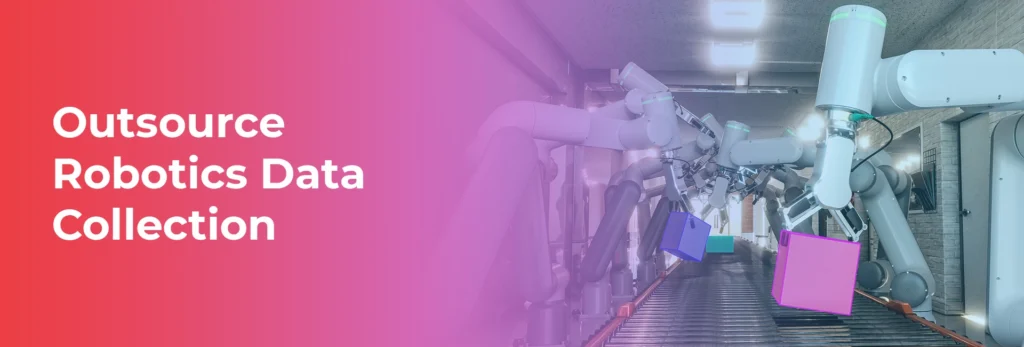
The demand for faster robotics AI deployment is surging across industries like logistics, manufacturing, and autonomous systems. Companies are racing to build smarter, more capable robots. However, a major hurdle often slows down these ambitious timelines. Data collection is frequently the biggest bottleneck in robotics AI pipelines. Gathering the massive amounts of high-quality data required […]
How Edge Case Data Boosted Robotics AI Performance by 35%

Robotics AI failures rarely happen under normal, predictable conditions. Instead, they occur in rare, unpredictable scenarios that standard testing environments simply fail to replicate. A warehouse robot might flawlessly navigate clear aisles but completely misidentify a heavily shadowed pallet in a poorly lit corner. This is where edge case data for robotics AI becomes essential. […]
How Quality Ground Truth Data Improves Robot Vision

Artificial intelligence is transforming how machines interact with their environments. Autonomous robots, warehouse logistics, smart manufacturing lines, and domestic assistants all rely heavily on advanced robot vision systems to function. These systems allow machines to “see” and interpret the world around them, making real-time decisions that drive productivity and efficiency. However, building a reliable robot […]
How to Scale Robotics Data Annotation Services for Warehouses

Warehouse automation is growing at an incredible rate. Facilities are adopting Amazon-style fulfillment models to keep up with consumer demand. Autonomous mobile robots (AMRs) and robotic picking arms now handle tasks that were previously entirely manual, powered by robotics data annotation. These AI-driven machines rely heavily on high-quality annotated data to function properly. A robot […]