


- What Is an Enterprise AI Data Pipeline?
- Challenges of Building AI Data Pipelines In-House
- What Is Enterprise AI Data Pipeline Outsourcing?
- Key Benefits of Enterprise AI Data Pipeline Outsourcing
- Which Enterprise Use Cases Benefit Most from Outsourcing?
- In-House vs Outsourced AI Data Pipelines
- How to Choose the Right Enterprise AI Data Pipeline Outsourcing Partner
- Best Practices for Successful AI Data Pipeline Outsourcing
- Common Risks and How to Mitigate Them
- Why Enterprises Are Moving Toward Managed Data Pipeline Services
- How Macgence Supports Enterprise AI Data Pipeline Outsourcing
- Turn Data into a Strategic Advantage
Enterprise AI Data Pipeline Outsourcing: A Strategic Guide
Building enterprise-grade AI models isn’t just about algorithms and computers. It’s about data—specifically, how you collect, clean, label, and deliver it at scale. For most organizations, the complexity of managing an AI data pipeline becomes a bottleneck before the model ever sees production.
That’s where enterprise AI data pipeline outsourcing comes in. Rather than treating it as a cost-cutting measure, forward-thinking companies view outsourcing as a strategic decision that accelerates time-to-market, improves data quality, and frees internal teams to focus on innovation.
This guide breaks down what enterprise AI data pipeline outsourcing is, why it matters, and how to do it right.
What Is an Enterprise AI Data Pipeline?
An AI data pipeline is the infrastructure that moves raw data through a series of transformations until it’s ready for model training. Think of it as the assembly line that turns messy, unstructured inputs into structured, high-quality datasets.
Key Stages of an AI Data Pipeline
Most pipelines follow a similar flow:
Data sourcing: Collecting text, images, video, speech, or sensor data from multiple channels.
Data preprocessing & normalization: Cleaning, formatting, and standardizing inputs so they’re usable.
Annotation & labeling: Adding ground truth labels—bounding boxes, sentiment tags, entity recognition, transcription.
Quality assurance: Reviewing and validating labeled data to catch errors and inconsistencies.
Secure delivery: Sending finalized datasets to ML teams via secure cloud environments or on-premise systems.
Why Enterprise Pipelines Are More Complex
Enterprise AI projects aren’t small-scale experiments. They involve:
- Multi-source data: Pulling from APIs, databases, third-party vendors, and user-generated content.
- Large-scale volumes: Millions of records, not thousands.
- Strict security requirements: Compliance with GDPR, HIPAA, and internal governance policies.
- Multiple AI use cases: Natural language processing (NLP), computer vision (CV), automatic speech recognition (ASR), and large language models (LLMs) all require different pipelines.
The result? Building and maintaining these pipelines in-house becomes resource-intensive fast.
Challenges of Building AI Data Pipelines In-House
Many enterprises start by handling data pipelines internally. It makes sense on paper—you control the process, own the infrastructure, and keep everything under one roof. But as projects scale, cracks start to show.
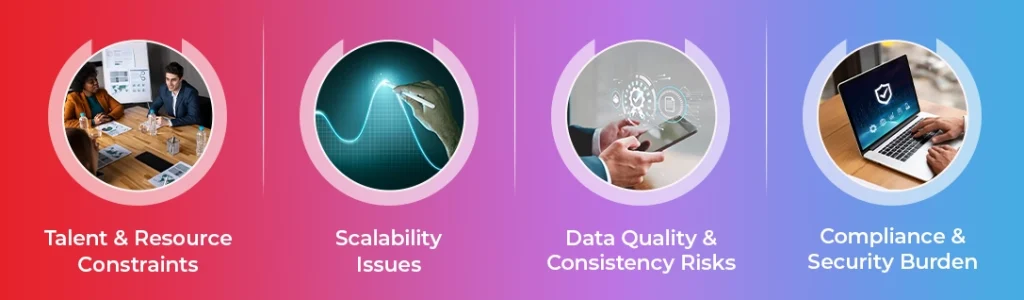
Talent and Resource Constraints
Data pipelines require specialized roles: data engineers, annotators, QA analysts, and workflow managers. Hiring and training these teams takes time and money. Keeping them fully utilized across fluctuating project demands? Even harder.
Scalability Issues
AI projects rarely follow predictable timelines. Sudden spikes in data volume—whether from a product launch, new market entry, or regulatory change—can overwhelm internal teams. Global deployment adds another layer of complexity, requiring multilingual support and region-specific workflows.
Data Quality & Consistency Risks
Inconsistent labeling is one of the fastest ways to sabotage model performance. When annotation standards aren’t clearly defined or enforced, you end up with noisy datasets that require expensive rework. Bias creeps in. Edge cases get missed. Quality drifts over time.
Compliance & Security Burden
Enterprises operating in healthcare, finance, or retail face strict regulatory requirements. Managing GDPR compliance, HIPAA audits, and SOC 2 certifications internally means dedicating legal, security, and ops resources to data handling processes—resources that could be better spent elsewhere.
What Is Enterprise AI Data Pipeline Outsourcing?
Enterprise AI data pipeline outsourcing means partnering with a specialized vendor to manage part or all of your AI data lifecycle. Instead of building everything in-house, you leverage external expertise, infrastructure, and workforce to accelerate delivery.
Outsourcing Models
Not all outsourcing looks the same. Common models include:
Fully managed pipeline: The vendor handles everything from data collection to final delivery.
Hybrid model: Internal teams manage strategy and oversight while the vendor executes annotation, QA, and delivery.
Task-based outsourcing: You outsource specific tasks—annotation, enrichment, validation—while keeping preprocessing and delivery in-house.
The right model depends on your internal capabilities, security requirements, and project scope.
Key Benefits of Enterprise AI Data Pipeline Outsourcing
Faster Time to Model Training
Outsourcing partners bring ready-to-deploy teams, prebuilt workflows, and automation tools. What might take months to set up internally can be operational in weeks. Faster data delivery means faster model iteration.
Improved Data Quality
Specialized vendors have multi-layer QA processes, domain-trained annotators, and bias mitigation frameworks. They’ve seen thousands of annotation projects and know where quality issues tend to emerge. Their infrastructure is built to catch errors before they reach your ML team.
Cost Optimization
Building an internal annotation team means fixed overhead: salaries, benefits, training, software licenses, and infrastructure. Outsourcing shifts this to a variable cost model. You pay for what you need, when you need it—no idle resources during downtime.
Built-in Security & Compliance
Reputable vendors operate ISO-certified processes, maintain NDA-controlled workforces, and provide secure cloud environments. Many are already GDPR-compliant and offer HIPAA-ready infrastructure for healthcare clients. Instead of building compliance from scratch, you inherit it.
Scalability on Demand
Need to label 10,000 images this month and 100,000 next month? Outsourcing partners can scale up or down without the hiring delays. They handle multilingual projects, support multiple domains, and operate across time zones for 24/7 delivery.
Which Enterprise Use Cases Benefit Most from Outsourcing?
Certain industries and AI applications see outsized benefits from pipeline outsourcing:
Autonomous vehicles: LiDAR point cloud annotation, video object tracking, sensor fusion labeling.
Healthcare AI: Medical imaging annotation, clinical text extraction, EHR data structuring.
Retail & eCommerce: Product tagging, search relevance tuning, visual search datasets.
Financial services: Fraud detection, document AI, transaction categorization.
Conversational AI: Speech transcription, intent labeling, dialogue dataset creation.
LLM training and fine-tuning: Instruction datasets, RLHF feedback, prompt engineering support.
If your use case involves high data volumes, complex labeling, or strict compliance requirements, outsourcing becomes less of a nice-to-have and more of a necessity.
In-House vs Outsourced AI Data Pipelines
| Factor | In-House Pipeline | Outsourced Pipeline |
| Setup time | High | Low |
| Cost | Fixed + overhead | Variable & scalable |
| Data quality | Depends on team | SLA-based |
| Compliance | Internal burden | Vendor-managed |
| Speed | Limited by resources | Rapid scaling |
The table makes the trade-offs clear. In-house pipelines give you control. Outsourced pipelines give you speed, flexibility, and expertise.
How to Choose the Right Enterprise AI Data Pipeline Outsourcing Partner
Not all vendors are created equal. Choosing the wrong partner can lead to quality issues, security breaches, and project delays. Here’s what to look for:
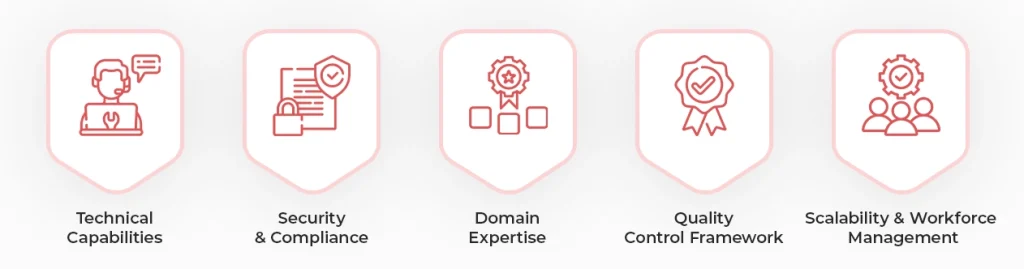
Technical Capabilities
Does the vendor offer robust annotation tools? Can they automate repetitive tasks? Do they support dataset versioning and integration with MLOps platforms?
Security & Compliance
Look for ISO 27001 certification, GDPR compliance, and HIPAA support (for healthcare projects). Ask about private cloud or on-premise deployment options if your data can’t leave your infrastructure.
Domain Expertise
Generic annotation shops struggle with specialized use cases. If you’re building healthcare AI, work with a vendor who understands medical terminology. Automotive AI? Find someone with experience in LiDAR and sensor data.
Quality Control Framework
Ask about their QA process. Do they use multi-pass review? Gold standard datasets? Performance metrics? How do they handle edge cases and inter-annotator disagreement?
Scalability & Workforce Management
Can they scale to meet your demand? Do they have multilingual teams? Can they operate around the clock if needed?
Best Practices for Successful AI Data Pipeline Outsourcing
Outsourcing isn’t plug-and-play. Follow these practices to maximize success:
Define data standards upfront: Be explicit about format, schema, and quality expectations.
Share annotation guidelines: Provide clear, detailed instructions with examples.
Start with pilot projects: Test the vendor on a small batch before committing to full-scale work.
Set quality SLAs: Define acceptable error rates, turnaround times, and review cycles.
Integrate with MLOps workflows: Ensure the vendor’s output format aligns with your model training pipeline.
Use continuous feedback loops: Regular check-ins catch quality drift early.
Common Risks and How to Mitigate Them
Outsourcing comes with risks. Here’s how to address them:
Vendor lock-in: Use modular contracts that allow you to switch providers if needed.
Data leakage: Ensure the vendor uses encrypted environments and restricts data access.
Quality drift: Conduct frequent audits and spot-check deliverables.
Miscommunication: Maintain centralized documentation and regular status updates.
Why Enterprises Are Moving Toward Managed Data Pipeline Services
The AI landscape is shifting fast. Unstructured data is exploding. Multimodal AI models are becoming the norm. Deployment timelines are shrinking. Enterprises can’t afford to spend months building data infrastructure—they need to move from concept to production quickly.
Outsourcing data pipelines isn’t just about saving money. It’s about reallocating resources toward what actually drives competitive advantage: building smarter models, launching new products, and delivering business outcomes.
How Macgence Supports Enterprise AI Data Pipeline Outsourcing
Macgence offers end-to-end data pipeline management designed for enterprise AI teams. From data collection to final delivery, Macgence handles the complexity so your team can focus on building models.
Key capabilities include:
- Secure, enterprise-grade infrastructure with ISO and GDPR compliance
- Custom annotation workflows tailored to your use case
- Human + automation hybrid model for speed and accuracy
- Multi-domain expertise across healthcare, automotive, retail, and finance
- Flexible engagement models—fully managed, hybrid, or task-based
Whether you’re training an LLM, building computer vision models, or deploying conversational AI, Macgence provides the data foundation you need to succeed.
Turn Data into a Strategic Advantage
Enterprise AI data pipeline outsourcing isn’t about offloading work. It’s about accelerating delivery, improving quality, and scaling intelligently. The organizations that win with AI aren’t the ones with the biggest internal teams—they’re the ones that know when to build, when to buy, and when to partner.
If your data pipeline is slowing down your AI ambitions, it’s time to rethink your approach. Outsourcing gives you speed, quality, and scalability without the overhead. More importantly, it frees your team to focus on what matters: turning AI into real business impact.
 Previous Blog


You Might Like

September 14, 2026
Teleoperations Robotics Data for Physical AI: Building Better AI Robotics Training Datasets
Physical AI only earns trust when it acts correctly in the real world, not just when it recognizes patterns on a screen. Robots performing tasks in warehouses, manufacturing facilities, hospitals, and urban environments need to translate their perceptions into safe and accurate physical action, which static training datasets alone cannot fully capture. Here, teleoperations robotics […]

September 8, 2026
Multimodal Datasets: The Complete Guide to AI Training Data for Modern AI Models
AI models do not perceive the world through just one sense, and neither should their training datasets. A self-driving car does not just “see”; it senses distance and tracks movements. In the same vein, conversational AI agents do not just analyze text; they hear, interpret tones, and process visual information. This is the very essence […]

August 31, 2026
Robotics Data Partner for Physical AI: Building the Data Pipeline Behind Intelligent Robots
Physical AI is revolutionizing the way robots sense, understand, and respond to the world. Unlike typical AI, intelligent robots need to understand dynamic environments, people, spatial relationships, motion, and changes in real-time. What data does Physical AI require? It requires diverse real-world inputs, including images, video, LiDAR, depth, sensor data, and human-object interaction data. For […]