


What is Model-in-the-Loop (MITL) and Why Does it Matter?
There has never been a greater need for reliable and effective testing frameworks more essential than ever. However, due to the growing complexity of embedded systems, which power everything from self-driving cars to intelligent medical gadgets, testing frameworks has become very crucial everyday. When it comes to detecting design defects early in the development cycle, standard testing approaches frequently fall short in a world where precision, dependability, and real-time performance are non-negotiable. The result? increasing expenses, sluggish schedules, and weakened product quality.
Here, Model-in-the-Loop (MITL) testing becomes a game-changing approach. MITL bridges the gap between design and deployment by facilitating early-stage validation using simulation, providing a more intelligent and proactive approach to embedded system testing.
In this blog, we’ll examine the reasons for MITL’s rise to prominence in contemporary system development. Gaining knowledge of its fundamental ideas, main benefits, setup needs, and industry best practices will enable you to put more flexible and economical testing techniques into reality.
What is Model-in-the-Loop (MITL)?
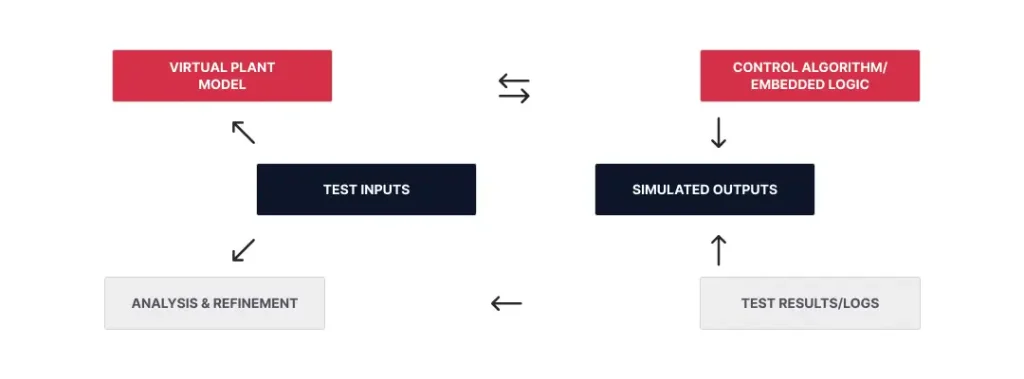
A simulation-based testing technique called Model-in-the-Loop (MITL) uses virtual models to simulate actual hardware as it is being developed. Before any physical components are constructed, consider it a digital sandbox for testing your system.
Why is it important? Teams may improve designs more quickly, find flaws early, and prevent costly rework later on with the aid of MITL. It all comes down to faster, safer, and more intelligent development.
Where it is utilized:
- Automotive: Advanced Driver Assistance System (ADAS) simulation
- Aerospace: Testing flight control systems in the aerospace industry without entering a cockpit
- Robotics and MedTech: Verifying control logic prior to practical implementation
Benefits of Model-in-the-Loop
Early Identification of Errors
- Early in the development cycle, developers can find system faults and design issues thanks to MITL’s ability to facilitate testing in a controlled, virtual environment.
- Early detection lowers the chance of late-stage problems and the requirement for significant redesigns.
Example – Research in the automobile sector has demonstrated that detecting problems at the modeling phase may save corrective expenses by as much as 90% as compared to addressing them after the prototype.
Cutting Expenses
- The necessity for a lot of physical prototypes, which are quite costly and time-consuming to create, is greatly decreased by the method of simulation-based testing.
- This makes the entire development process more and more economical and efficient by preventing delays and even every minor, major production-level problems.
For instance, employing MITL to model and improve control systems before construction has resulted in significant cost reductions for aerospace companies.
Improved System Reliability
- By enabling developers to model a variety of real-world situations and edge cases, MITL improves testing accuracy.
- As a result, system logic and behavior are better validated, guaranteeing that the embedded system operates dependably in a variety of scenarios.
- In safety-critical fields such as medical devices, robots, or Internet of Things networks, this degree of accuracy reduces the possibility of unanticipated field failures.
How to Set Up a Model-in-the-Loop Environment
Software Requirements
The foundation of any MITL setup lies in robust modeling and simulation tools. Key software includes:
- MATLAB/Simulink – Widely used for modeling dynamic systems and running simulations.
- LabVIEW, Modelica, or SCADE – Alternatives depending on the industry and project complexity.
- Testing frameworks – Tools like Simulink Test or Jenkins for automating test cases and managing simulation workflows.
These tools allow developers to create detailed system models, run test scenarios, and visualize outputs without needing physical hardware.
Hardware Requirements
While MITL focuses on virtual testing, hardware-in-the-loop (HIL) emulators can complement the workflow in advanced stages:
- Microcontroller or processor boards for co-simulation (if needed)
- Communication interfaces (e.g., CAN, UART) for signal emulation
Though not always necessary, adding hardware elements can help very efficiently validate the interaction between software models and real-world interfaces early in the design, which is a total plus.
Integration Tips
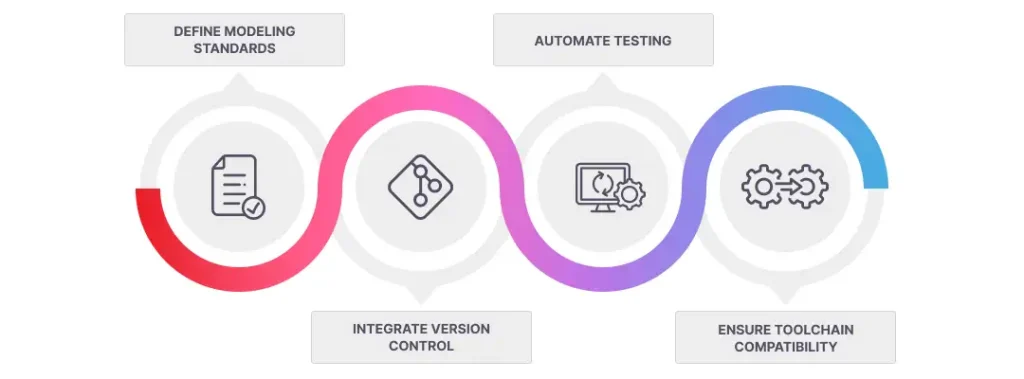
To incorporate MITL into your development pipeline effectively:
- Define modeling standards early to maintain consistency across teams.
- Integrate version control (e.g., Git) to manage model iterations.
- Automate testing using scripting and CI tools for efficient regression testing.
- Ensure toolchain compatibility, especially when importing models across platforms.
Challenges to watch for
- Tool incompatibility: Choose tools that support standard data formats (like FMI/FMU) to ease integration.
- Simulator speed vs. model accuracy: When feasible, simplify without sacrificing accuracy.
- Team training: To prevent workflow bottlenecks, make sure all stakeholders are conversant with the procedures and tools.
Best Practices for Implementing MITL
Version Control and Configuration Management
Consistent model versioning is crucial to avoid mismatches between different components or simulation environments.
Establish a structured naming convention and use configuration management tools to track dependencies, inputs, and parameters.
Recommended tools:
- Git for version control of models and scripts
- Simulink Project or Git LFS for handling large model files
- Model configuration snapshots to document settings used during simulation runs
This ensures traceability and helps teams revert or compare different model versions confidently.
Testing and Continuous Integration
Automated model testing following each code or design modification is made possible by integrating MITL into a Continuous Integration (CI) workflow. In the long run, this increases model dependability and guarantees prompt feedback.
How to apply it:
- Set up automated simulation runs with tools like Jenkins, GitLab CI, or Azure DevOps
- Run regression tests to catch unintended effects of changes
- Use dashboards to monitor test results and performance metrics
Example: Automotive companies like Bosch and Continental use CI pipelines integrated with Simulink to validate ADAS models continuously, significantly speeding up development while maintaining safety standards.
Collaborative Environment
MITL is most effective when modeling, software, and testing teams work in sync. Encourage early and regular collaboration across disciplines to align goals and avoid miscommunication.
Tips for collaboration:
- Use shared repositories and documentation platforms (e.g., Confluence, GitHub)
- Hold regular sync-ups to review model changes and test results
- Create clear model ownership and review workflows
Fostering collaboration leads to more robust models and smoother implementation of simulation workflows.
Future Trends in Model-in-the-Loop Testing
Model-in-the-Loop (MITL) testing is quickly changing to meet the increasing needs of innovation and system complexity as embedded systems develop. The following are important trends influencing MITL’s future:
AI-Powered Simulations
In order to improve simulation models and enable systems to test against erratic, real-world situations, artificial intelligence is being utilized more and more. This enhances test coverage, especially for applications such as adaptive robotics and autonomous driving.
Capabilities for Real-Time Testing
Real-time simulations are becoming more popular, particularly for systems that need to make decisions quickly. For robotics, industrial automation, and aerospace, this enables engineers to test and validate behaviors under stringent time limitations.
Growth of Green and IoT Technologies
Without requiring resource-intensive physical prototypes, MITL is essential in creating and testing these systems under various environmental and use situations as the need for smart, connected, and energy-efficient gadgets increases.
Growing Utilization in Self-Sustained Systems
When it comes to creating safety-critical features for autonomous cars, including Advanced Driver Assistance Systems (ADAS), MITL is proving to be a pillar. Simulation is used to verify intricate interactions and edge situations prior to on-road implementation.
Toolchain Advances
Open standards like FMI (Functional Mock-up Interface) are being used more frequently as a result of projects combining heterogeneous teams and a variety of technologies. This lowers development friction by facilitating smooth integration across test environments, simulators, and modeling tools.
Conclusion
Model-in-the-Loop (MITL) is fast evolving from a complex testing option to a crucial stage in the development of contemporary embedded systems. Teams may develop more quickly and confidently because of MITL’s early validation capabilities, cost savings, and reliability enhancements. MITL will become even more important when technologies like AI, IoT, and autonomous systems develop further. Building smarter, safer, and more future-ready systems now is a direct result of adopting MITL. Staying ahead in an increasingly complicated engineering landscape may depend on your use of this simulation-driven strategy, regardless of your industry—automotive, aerospace, or healthcare.
FAQs
Ans: – With MITL, a simulation-based method, virtual models are used in place of actual hardware for early embedded system testing.
Ans: – It lowers development costs, increases system dependability overall, and aids in early mistake detection.
Ans: – Development costs are greatly reduced by decreasing the requirement for physical prototypes and late-stage design modifications.
Ans: – To allow automated model testing and quicker feedback cycles, MITL does indeed integrate nicely with CI platforms like Jenkins or GitLab.
Ans: – Although optional hardware emulators can improve testing in later stages, MITL is mostly virtual.
Ans: – It makes it possible to digitally test real-world situations and edge cases, guaranteeing reliable behavior prior to deployment.
Ans: – Three major obstacles that call for careful preparation are tool compatibility, model complexity, and team training.
Ans: – Significant developments include real-time testing, AI-powered simulations, and increased use in autonomous systems and green technology.
References
- https://www.add2.co.uk/applications/model-in-the-loop-testing-applications/
- https://cselectricalandelectronics.com/mil-sil-pil-hil-dil-and-vil-testing-methods-in-automotive/
 Previous Blog


You Might Like
October 21, 2026
Best Image Annotation Companies in 2026: Compare Services, Accuracy and Pricing
Leading image annotation companies help computer vision teams create consistent, high-quality labels that support model training and evaluation. In 2026, enterprise teams train their detection, inspection, and robotics models on millions of images, so one poor vendor selection can delay full-scale implementation. Image annotation providers generally fall into two broad categories: managed annotation services and […]

October 12, 2026
DataRobot Training for Enterprises: How High-Quality AI Training Data Improves Model Performance
DataRobot Training refers to the data preparation process, followed by machine learning model creation and evaluation on the DataRobot platform. It requires AI training data to be reliable in terms of labels and datasets as well as consistency of records – otherwise, there will be no valid predictions. As businesses transition AI from pilot to […]

October 5, 2026
Data Annotation Company for AI Training: From Healthcare Data Labeling to Robotics & Multimodal Datasets
AI is transitioning from pilot to production, and models do not fail due to their architecture but due to the quality of the data which was used to train them. With the scaling of projects in computer vision, NLP, healthcare, robotics, companies need a data annotation company that will provide domain-specific labeling of all kinds […]