


- What is Robot Imitation Learning?
- Types of Data Used in Robot Imitation Learning
- Key Dataset Challenges in Robot Imitation Learning
- Opportunities in Robot Imitation Learning Data
- Best Practices for Building High-Quality Imitation Learning Datasets
- Future Trends in Imitation Learning for Robotics
- Overcoming the Data Bottleneck
- FAQs
Decoding Robot Imitation Learning Data Challenges and Opportunities
Getting a robot to perform a complex task used to require thousands of lines of hard-coded rules. Even with modern reinforcement learning, machines often spend countless hours in simulation trial-and-error just to grasp basic movements. Robot imitation learning offers a smarter alternative. By observing human or expert demonstrations, robots can learn behaviors much more naturally.
As hardware capabilities expand, the demand for high-quality robot imitation learning data is skyrocketing. Developers want machines that can seamlessly integrate into real-world applications, from factory floors to living rooms. However, the path to deploying these intelligent systems is blocked by severe data quality, scale, and diversity bottlenecks.
This post explores the critical dataset challenges slowing down robotic advancement and highlights the emerging opportunities that could solve them.
What is Robot Imitation Learning?
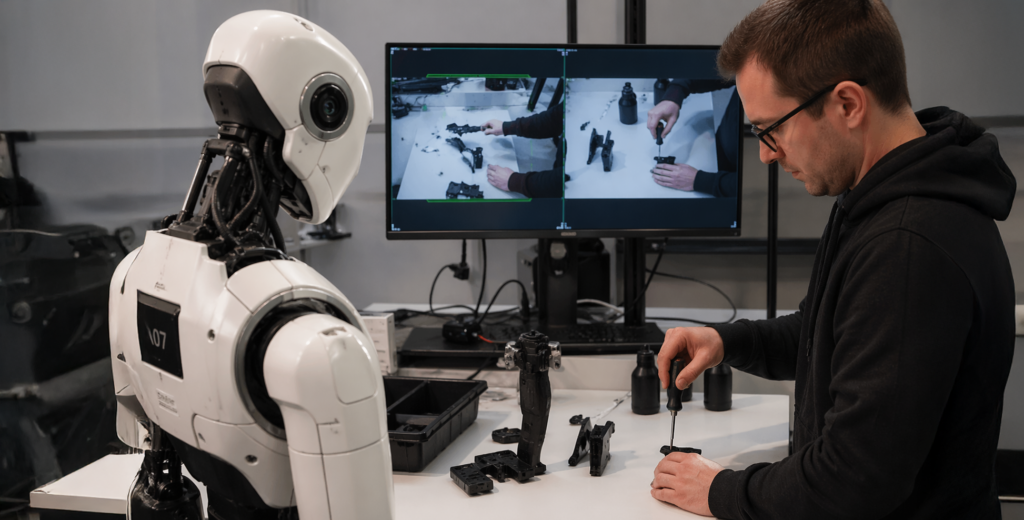
Robot imitation learning is a technique where machines learn a policy by observing expert demonstrations rather than relying on explicit programming or reward-based trial and error. The robot essentially watches a human perform a task and figures out how to replicate those actions.
There are a few key paradigms within this field. Behavioral Cloning (BC) maps observations directly to actions, treating the process like a supervised learning problem. Another approach, Inverse Reinforcement Learning (IRL), attempts to deduce the underlying goal or reward function the expert is trying to maximize.
Creating a robust behavioral cloning dataset robotics engineers can rely on is foundational for these paradigms. We are already seeing this applied across various industries. Warehouse picking robots observe human handlers to safely grasp oddly shaped packages. Autonomous driving systems learn how to navigate tricky intersections by analyzing human driver responses. Meanwhile, advanced humanoid robots study human motion to perform intricate manipulation tasks like folding laundry or assembling parts.
Types of Data Used in Robot Imitation Learning
Imitation learning relies on massive amounts of varied, multimodal information. Training a robot effectively requires several synchronized data streams.
Visual Data
Cameras provide the foundational context for robotic learning. This includes RGB video, depth sensing, and stereo vision. Engineers must carefully consider the perspective, balancing egocentric views (what the robot sees) against third-person perspectives (watching the robot perform the task).
Motion and Kinematic Data
A robot needs to understand physical movement. Datasets capture joint angles, movement trajectories, and force feedback. This information usually comes from human motion capture suits or direct robot telemetry during teleoperation.
Sensor Fusion Data
Vision and basic motion are rarely enough for complex environments. Integrating LiDAR, Inertial Measurement Units (IMUs), and tactile sensors helps the robot understand spatial depth, balance, and the physical pressure required to hold delicate items.
Annotation Layers
Raw data requires context to be useful. Experts add action labels to define what is happening at a given moment. Temporal segmentation breaks long tasks into discrete steps, while intent labeling explains the underlying goal of a specific movement.
Ultimately, high-quality robot imitation learning data demands perfectly synchronized multimodal streams. If the visual data lags behind the tactile feedback by even a fraction of a second, the resulting model will fail.
Key Dataset Challenges in Robot Imitation Learning
While the concept of learning by observation is intuitive, building the datasets to support it is notoriously difficult.
Data Collection Complexity
Setting up the hardware to capture human demonstrations is expensive and technically demanding. Furthermore, tasks require genuine expert demonstrations; a robot learning from a clumsy human will become a clumsy robot. There is also a persistent gap between data gathered in clean, simulated environments and the chaotic reality of the physical world.
Scalability Issues
Gathering enough data to train a deep neural network is a massive hurdle. It is incredibly hard to collect large-scale datasets that cover a wide diversity of tasks, lighting conditions, and environments. Most labs end up with narrow datasets that only work under highly specific conditions.
Annotation Challenges
Labeling robotic data takes a vast amount of time. Human annotators struggle to label continuous motion accurately. Unlike a static image that clearly shows a dog or a cat, a human demonstration is fluid. Identifying exactly when an action starts, stops, or transitions requires deep expertise, and human demonstrations often contain subtle ambiguities.
Generalization and Bias
Because a behavioral cloning dataset robotics teams build is often limited in scope, models frequently overfit to specific training environments. If a robot learns to chop vegetables in a bright, white kitchen, it might freeze entirely in a dimly lit kitchen with dark countertops. Datasets consistently lack the edge cases and rare scenarios needed for robust real-world deployment.
Safety and Noise in Data
Humans are not perfect machines. Demonstrations inherently contain inconsistencies, hesitations, and corrections. When combined with natural sensor noise and calibration misalignments, this messy data confuses learning algorithms and creates unsafe robotic behaviors.
Opportunities in Robot Imitation Learning Data
Despite these hurdles, the robotics industry is rapidly developing innovative ways to source, process, and apply imitation data.
Multimodal Data Pipelines
Engineers are moving beyond simple visual inputs. By combining vision, natural language commands, and motion data, researchers are building comprehensive embodied AI datasets. This allows a user to tell a robot to “pick up the red cup,” and the machine understands both the language and the physical steps required.
Synthetic and Real Data Hybrid Models
Simulation environments like Isaac Gym and MuJoCo are becoming hyper-realistic. Developers can generate millions of synthetic demonstrations overnight. By using advanced domain adaptation techniques, engineers successfully blend this synthetic data with real-world examples to train models faster and cheaper.
Scalable Data Collection via Teleoperation
Virtual and augmented reality tools have revolutionized teleoperation. Human operators can remotely control robot arms from across the world, seamlessly capturing high-quality kinematics and visual data. This remote capture approach drastically increases the volume of usable data.
Self-Supervised and Foundation Models
The industry is shifting toward models capable of learning from unlabeled demonstrations. By leveraging large, pre-trained foundation models, robots can transfer learning across different tasks. A robot that learns to open a microwave can use those same foundational concepts to learn how to open a cabinet.
Data-as-a-Service (DaaS) in Robotics
Building infrastructure to collect and label data distracts robotics companies from their core mission of building hardware and algorithms. Outsourcing dataset creation to specialized Data-as-a-Service providers is becoming an industry standard. Partners like Macgence act as vital enablers, providing scalable, high-quality custom robot imitation learning data pipelines tailored to specific enterprise needs.
Best Practices for Building High-Quality Imitation Learning Datasets
Creating functional datasets requires strict adherence to quality standards. Ensure your collection process captures diverse scenarios, varied lighting, and unexpected edge cases to prevent overfitting. Maintain strict temporal consistency across all annotations so that vision, motion, and tactile data align perfectly.
Rely on multi-angle and egocentric capture methods to give the model a complete understanding of the workspace. Always implement rigorous quality validation pipelines to catch sensor noise or human errors before they poison the training pool. Finally, balance real-world demonstrations with synthetic data to scale efficiently without losing physical accuracy.
Future Trends in Imitation Learning for Robotics
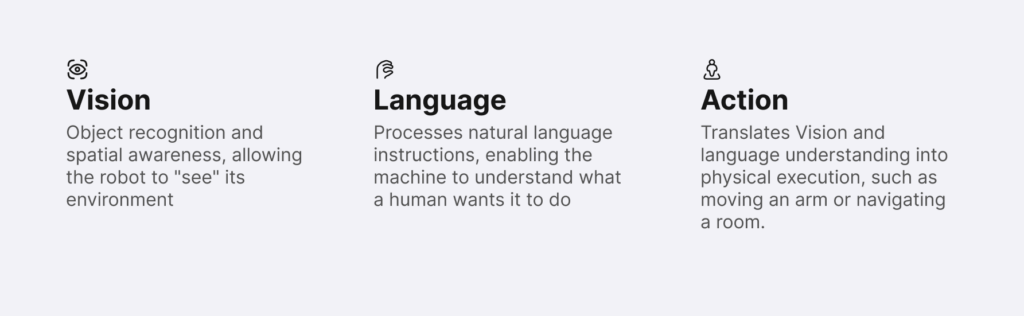
The next few years will see a massive shift toward generalist robots trained on massive, internet-scale datasets, moving away from single-purpose machines. The integration of Vision-Language-Action (VLA) models will allow robots to seamlessly process verbal instructions, visual cues, and physical movement simultaneously. We will also see an increasing reliance on capturing real-world human motion data at scale, moving beyond the lab environment. Eventually, autonomous data collection loops will allow robots to self-correct and update their own datasets without continuous human intervention.
Overcoming the Data Bottleneck
High-quality datasets remain the absolute foundation of capable robotic systems. While scalability, annotation limits, and generalization present real challenges, advances in multimodal pipelines and teleoperation provide clear paths forward. Ultimately, data is the primary limiting factor in scaling robotics AI for commercial use. Organizations looking to deploy next-generation machines need robust, experienced partners to navigate the complexities of dataset development.
FAQs
It is the collection of visual, kinematic, and sensor information captured during an expert demonstration of a task, used to teach a robot how to perform that exact behavior.
A behavioral cloning dataset maps specific observations (like camera feeds) directly to the corresponding expert actions (like motor torques), allowing the robot to mimic the behavior through supervised learning.
The algorithm can only learn from what it sees. High-quality, diverse data ensures the robot learns the correct behavior and can adapt to different environments without failing.
Major challenges include the high cost of data collection, the difficulty of accurately annotating continuous motion, and the model’s inability to handle edge cases not present in the training data.
Companies scale by mixing real-world demonstrations with massive synthetic datasets generated in simulation, using VR teleoperation, and partnering with Data-as-a-Service providers.
Key industries include logistics and warehousing, autonomous vehicles, manufacturing, and healthcare for surgical assistance or elderly care.
Imitation learning teaches a robot by having it copy an expert’s demonstration. Reinforcement learning teaches a robot through trial and error, rewarding it when it accidentally achieves the correct goal.
 Previous Blog


You Might Like

October 12, 2026
DataRobot Training for Enterprises: How High-Quality AI Training Data Improves Model Performance
DataRobot Training refers to the data preparation process, followed by machine learning model creation and evaluation on the DataRobot platform. It requires AI training data to be reliable in terms of labels and datasets as well as consistency of records – otherwise, there will be no valid predictions. As businesses transition AI from pilot to […]

October 5, 2026
Data Annotation Company for AI Training: From Healthcare Data Labeling to Robotics & Multimodal Datasets
AI is transitioning from pilot to production, and models do not fail due to their architecture but due to the quality of the data which was used to train them. With the scaling of projects in computer vision, NLP, healthcare, robotics, companies need a data annotation company that will provide domain-specific labeling of all kinds […]

September 28, 2026
Annotation Provider for AI Training: Computer Vision, NLP, Healthcare and Robotics Annotation
All effective AI models, from robots to clinical NLP engines, require one crucial layer: annotation. As enterprises race to deploy computer vision, NLP, healthcare, and robotics solutions, the quality of an annotation provider now makes all the difference between the success or failure of a model outside of lab conditions. Generic labeling cannot meet the […]