


How Smart LLM Prompting Drives Your Tailored AI Solutions
In today’s AI world, every business increasingly relies on LLMs for automating content creation, customer support, lead generation, and more. But one crucial factor people tend to ignore, i.e., LLM Prompting.
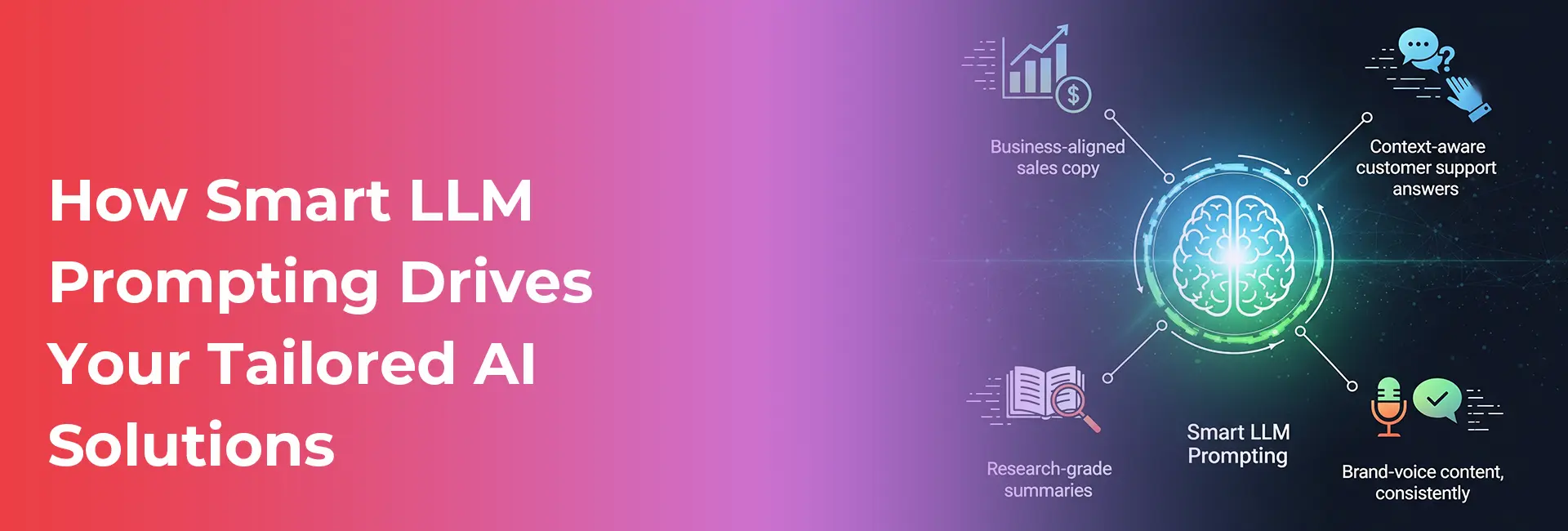
Poorly crafted prompts result in hallucinations or sycophancy—even with the most advanced models. You might get chatty copy but not conversions, or a generic support response instead of brand-voice clarity. Well‑designed prompts, in contrast, unlock the model’s full capability to generate:
- Business-aligned sales copy
- Context‑aware customer support answers
- Research‑grade summaries
- Brand-voice content, consistently
Prompting isn’t optional—it’s one of the key factors for turning your AI into a high‑ROI asset tailored to your business needs.
What Is LLM Prompting Engineering?
Prompting, or prompt engineering, is the process of designing, refining, and tuning the inputs you give an LLM so it consistently produces the exact kind of output you need.
Core Components of Effective Prompting:

1. Role & Context
Assume that you’re hiring a consultant. You wouldn’t just say, “Help me with my business,” right? You will tell him/her what exactly they are supposed to act as, a man SEO expert, a marketing strategist, or maybe a SaaS onboarding specialist.
The role and context in prompting work are exactly the same. When you start a prompt with something like:
“You are a Senior Chairman of the IEEE Research Paper Organization with over 10 years of experience in peer-reviewing, curating, and guiding world-class research in Machine Learning, Federated Learning, Trustworthy AI, and Distributed Systems.”
You are setting a clear persona or an environment for the AI to work on. This single line helps the model understand the frame through which it should act, behave, and produce output. It influences the tone (professional yet friendly), vocabulary (industry-specific terms), and priorities (conversion-focused or educational). Without this role assignment, your AI outputs may feel scattered or generic, lacking that industry-specific touch.
2. Task Definition & Output Format
Even the smartest AI can hallucinate if you’re not crystal clear about what you want. A vague instruction like “Check Contribution of the Research” will give you something, but it’s rarely what you envisioned.
Instead, being specific about the task and the output structure transforms the results. For example:
“You are reviewing and validating the FALSE_MCNet project for its potential submission as an IEEE research contribution. Your primary goal is to analyze the novelty, clarity, and completeness of its implementation and provide actionable suggestions to bring it in line with IEEE publication standards, both in terms of research depth and engineering rigor.”
This tells the AI exactly what format the answer should take, how many points to include, and even sets a boundary for headline length. It’s like giving your AI a blueprint instead of a blank canvas—making the output sharp, concise, and usable right away.
3. Concise Constraints & Tone
AI models thrive on constraints. When you add boundaries like word count, tone, or style, you’re helping the model stay laser-focused on your needs.
For instance:
- – Maintain alignment with IEEE standards (reproducibility, clarity, integrity)
- – Do not fabricate experiments or claim functionality not present in the codebase.
- – If something is partially complete, clearly label it and suggest how to finish it.
This prompt ensures that the AI doesn’t go off into verbose explanations or overly technical language. Instead, it hones in on a crisp, easy-to-read, and business-ready tone. These constraints act like guardrails—without them, the model might take detours, adding fluff or irrelevant details.
4. Few-Shot or Template Examples
If you’ve ever shown someone a sample of “how it should look,” you know how powerful examples can be. Few-shot prompting does the same thing for AI. By giving two or three input-output examples, you help the model mimic the structure, style, and quality you want.
For instance:
- The system is modular, implemented in Python using PyTorch, Hydra, and Flower (Flwr). Several integration points like `trust_module`, `trust_weighted_strategy`, and `dynamic_trust_evaluator` already exist.
By providing multiple such examples, the AI learns the pattern of responses you expect, whether that’s a formal tone, storytelling approach, or punchy sales copy. It’s like training the AI in real-time to match your voice.
5. Iterative Refinement
Prompting isn’t a one-shot game. You rarely hit perfection with the first attempt. Iterative refinement is the art of tweaking your prompts based on what the AI delivers.
For example, if your first prompt produces something too generic, you might add:
“Focus on new research in the related field and compare, and tell me the areas of improvement.”
This level of adjustment, clarifying instructions, tightening the format, or adding more context, helps move the output from “good enough” to “exactly what I need.”
When layered together, these prompt‑engineering best practices create predictable, high-quality output, with up to 95% relevance accuracy when refined properly.
Macgence AI’s LLM Prompting Services
We, Macgence, are a leading one in combining human-quality data with expert AI workflows. Our services extend beyond annotation and dataset sourcing to full-spectrum LLM augmentation and prompt engineering.
1. Prompt Engineering & Design
- Our expert-curated prompts are tailored and designed to your industry and goals
- Our role definitions, tone frameworks, and output specs help your AI produce refined outputs
- We design templates and a few‑shot learning prompts that are optimized for your AI consistency
2. Prompt Library Development
- We’ve reusable libraries of prompts across email sequences, landing pages, chatbot scripts, SEO copy, and more, ready for you and your AI workflow/pipeline
3. Iterative Refinement & Testing
- Real‑time collaboration: Our professional experts review outputs, revise prompts, and optimize performance. It enables you to find your AI breaking points
4. RLHF-Based LLM Tuning Support
- We also provide services, i.e, Reinforcement learning from human feedback (RLHF) to fine-tune your AI behavior. According to your uniques solution demands.
- Adapts LLM responses to align with ethical, factual, and brand‑safe standards.
5. LLM Augmentation & Integration
- Supplement existing LLMs with Macgence’s high‑accuracy datasets and prompt frameworks
- Enables smooth deployment and consistent performance across AI tools.
6. Domain-Specific Prompting
- Our expert workforce creates custom prompts for verticals such as healthcare, e-commerce, tech, and finance
- We ensure that output aligns with your domain terminology, tone, and regulatory constraints, without compromising quality.
Why Partner with Macgence AI? The Benefits Unpacked
Human-in-the-Loop Excellence & Quality Assurance
Macgence blends expert human oversight with technology. Their teams validate outputs at each prompt iteration to maintain ~95% accuracy and relevancy across domains.
Compliance & Security Built-In
Fully GDPR, HIPAA, and ISO 27001 compliant, Macgence ensures that prompt engineering workflows respect global privacy and data standards.
Domain Expertise & Vertical Alignment
From healthcare to finance to SaaS, we include subject-matter experts who craft prompts aligned with industry norms, jargon, and regulatory compliance.
Multi-Modal & Multi-Lingual Reach
Macgence supports prompt-driven AI workflows across text, audio, and visual modalities. We also deliver multilingual prompt frameworks in languages like Hindi, Tamil, Arabic, and more.
Proven Results & Client Feedback
Clients describe Macgence as “a game‑changer for our AI projects” and praise their communication and responsiveness. Reviews highlight their ability to scale skill availability and deliver consistent quality.
Deep Dive: The Prompting Ecosystem at Macgence
Macgence offers a holistic ecosystem around prompting that spans beyond just template building:
Linked Services that Power Prompting:
| Service | Role in Prompting Workflow |
| Custom Data Sourcing | Builds high-quality, domain‑specific data to support LLM tuning |
| Data Annotation & Validation | Ensures training datasets align with prompts and outputs |
| LLM Augmentation & RLHF | Fine-tunes model behavior using prompt-based feedback loops |
| Talent Augmentation | Access to domain experts for prompt review and refinement |
Each piece strengthens the prompting outcome, ensuring not only good prompts but good data and good behavior from the AI systems behind them.
Why Now Is the Time to Invest in Strong Prompting
- Models are evolving fast, but without tailored prompts, you risk wasting time and ballooning costs.
- Your competitors may already be optimizing prompting workflows, gaining an unfair efficiency and precision advantage.
- Prompting is now your competitive moat, a form of IP embedded in how your model behaves and delivers value.
Conclusion: Elevate Your AI with Macgence’s LLM Prompting Expertise
Prompting is no longer an afterthought—it’s a strategic lever. We at Macgence AI combine human-in-the-loop quality, domain expertise, secure workflows, and prompt-engineering excellence to transform generic LLMs into business powerhouses.
By partnering with Macgence, you’re not just hiring a service, you’re building a sustainable prompting infrastructure that:
- Delivers consistent, high‑conversion output
- Scales across tools and teams
- Maintains compliance and domain integrity
- Evolves with your business needs
Ready to turn AI into a conversion machine? Book your free discovery session with Macgence AI today and start crafting prompts that drive real results.
FAQs
Ans: – LLM Prompting is the art of crafting precise instructions to guide AI models, ensuring outputs are accurate, relevant, and business-aligned.
Ans: – By defining clear roles, context, and constraints, smart prompting reduces vague or fabricated responses from AI.
Ans: – Macgence provides prompt engineering, reusable prompt libraries, iterative refinement, RLHF-based tuning, and domain-specific prompts.
Ans: – With human-in-the-loop quality assurance, compliance, domain expertise, and multilingual support, Macgence ensures our solutions are designed for tailored, high-ROI AI solutions.
Ans: – Effective prompting drives higher conversion rates, consistent brand voice, and faster deployment of AI-powered workflows.
 Previous Blog


You Might Like

October 21, 2026
Best Image Annotation Companies in 2026: Compare Services, Accuracy and Pricing
Leading image annotation companies help computer vision teams create consistent, high-quality labels that support model training and evaluation. In 2026, enterprise teams train their detection, inspection, and robotics models on millions of images, so one poor vendor selection can delay full-scale implementation. Image annotation providers generally fall into two broad categories: managed annotation services and […]

October 12, 2026
DataRobot Training for Enterprises: How High-Quality AI Training Data Improves Model Performance
DataRobot Training refers to the data preparation process, followed by machine learning model creation and evaluation on the DataRobot platform. It requires AI training data to be reliable in terms of labels and datasets as well as consistency of records – otherwise, there will be no valid predictions. As businesses transition AI from pilot to […]

October 5, 2026
Data Annotation Company for AI Training: From Healthcare Data Labeling to Robotics & Multimodal Datasets
AI is transitioning from pilot to production, and models do not fail due to their architecture but due to the quality of the data which was used to train them. With the scaling of projects in computer vision, NLP, healthcare, robotics, companies need a data annotation company that will provide domain-specific labeling of all kinds […]