


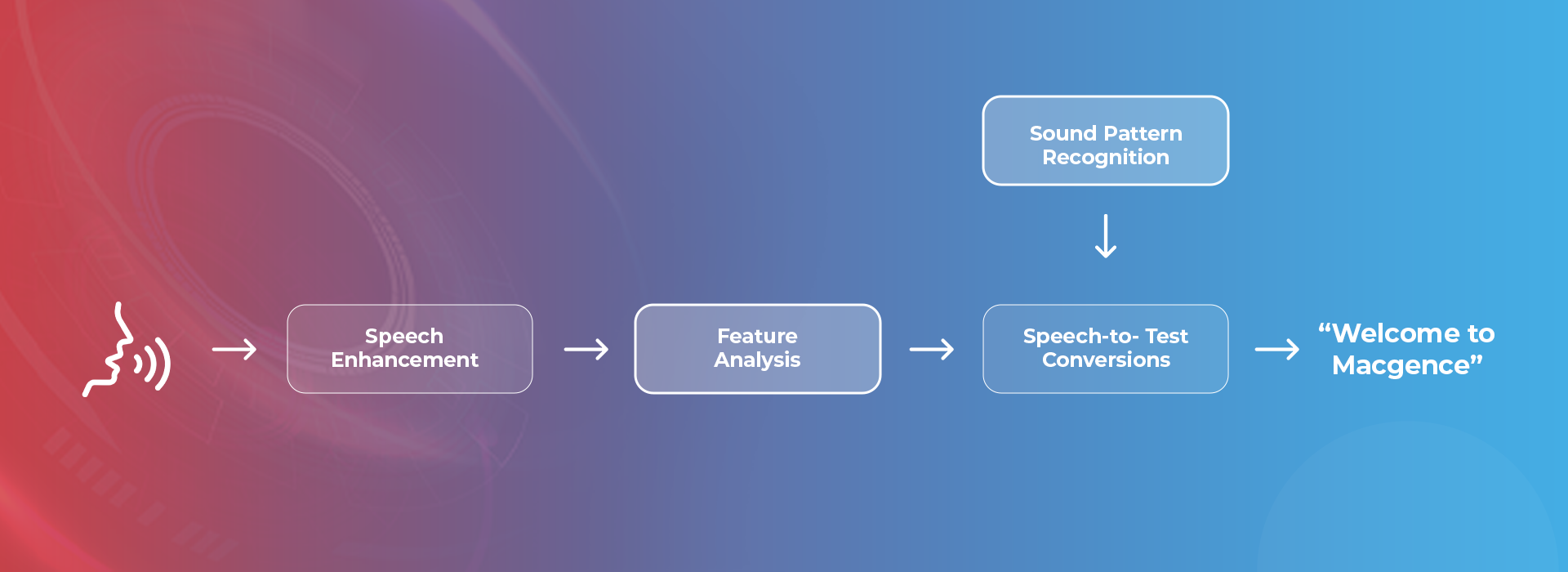
Training Data for ASR Model
Table of Contents
Introduction – What is ASR and its Applications
Artificial Intelligence changed the way we teach, learn, work, and function as a society. Automated Speech Recognition (ASR), a sub-field of AI, is tech that uses AI & ML to transform the spoken word into the written one (Speech to Text) and written one to spoken (Text to Speech)
The global Automatic Speech Recognition(ASR) Software market size was valued at USD 14 billion in 2022 and is expected to expand at a CAGR of 6.0% during the forecast period, reaching USD 20 billion by 2028.
To put it simply, ASR is a technology that uses machine learning (ML) and artificial intelligence (AI) to convert human speech into text and vice versa. It’s a common technology encountered by many of us on a daily basis – think Siri, Okay Google, or any speech dictation software.
Some Key Examples of Automatic Speech Recognition Variants
- Directed Dialogue – It is the elementary variant of the two, in which the machine needs you to respond using a specific word from a set list of choices, and can process directed response requests only, for example: “Do you wish to re-purchase an item, see other similar items, or speak to a voice executive?
- Natural Language Conversations – is the more advanced variant of the two, which is a combination of natural language understanding and automatic speech recognition, using natural language processing (NLP) technology, which can imitate a real-world open-ended chat conversation, for example: the system being able to visualize and interpret responses from a wide range of responses, even before posing a question, “How can I help you today?”
Some Key Use Cases

Live Assistant
Captioning and live assistance can be very useful during online meetings, as they will remove the need for manual processes and shift our focus to the main task.

Sentiment Analysis
The sentiment, typically positive, negative, or neutral, for a specific segment or as whole audio can be analyzed

Acoustic Modelling
The acoustic model takes in audio waveforms and wavelengths and predicts what words are present in the wavelength for the frequency.

Custom Vocabulary
Known as word boost, custom vocabulary can improve the accuracy of a particular list of phrases or keywords when transcribing an audio file.

Speaker Diarization
Through speaker labeling i.e. assigning participants to detected speakers in an input audio stream to identify, who spoke what & when.
How ASR Works
Most ASR voice technology begins with an acoustic model to represent the relationship between audio signals and the basic building blocks of words. An acoustic model transforms sound waves into bits that a computer can use. From there, language and pronunciation models take that data, apply computational linguistics, and consider each sound in sequence and in context to form words and sentences.
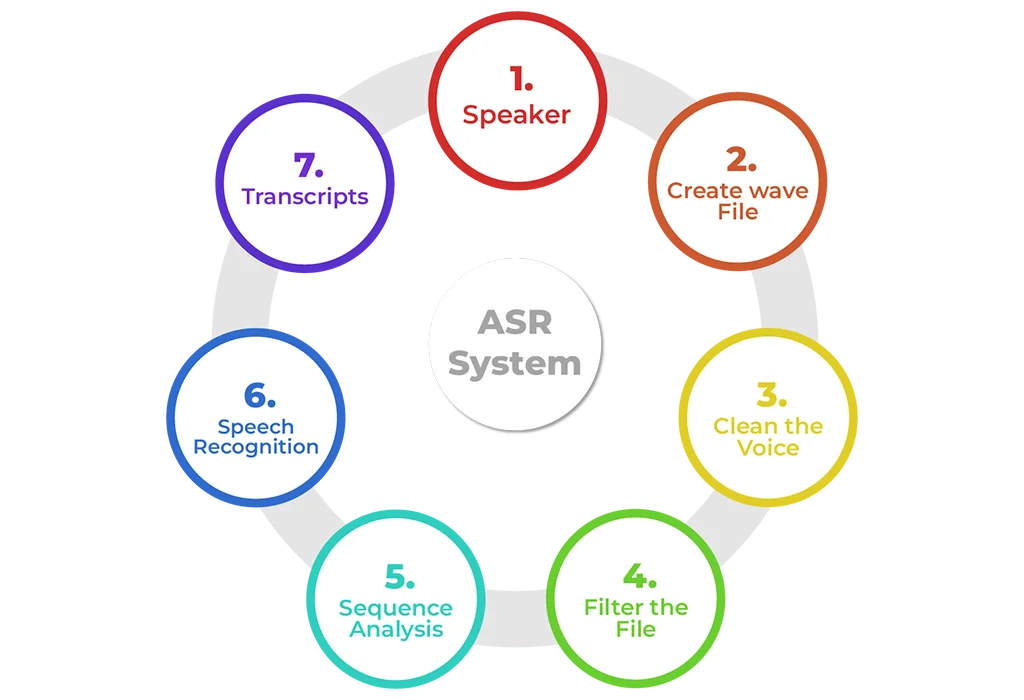
Simply put, ASR follows a set of steps/processes, which are:
- An individual or a group speaks, and the ASR software detects this speech.
- The device then creates a wave file of the words it hears.
- The wave file is cleaned to delete background noise and normalize the volume.
- The software then breaks down and analyzes the filtered wave file in sequences.
- The automatic speech recognition software analyzes these sequences and employs statistical probability which then finally outputs the words we see as transcripts.
- Some technology providers’ ASR service includes editing by professional human transcribers. Adding this layer to the process helps correct any errors to achieve greater accuracy.
Applications of ASR Macgence could help with
ASR technology is putting firmer steps in sectors like – higher education, legal, finance, government, health care & other industries. In all these fields, conversations are continuous and it’s often necessary to capture word-for-word records.

Voice Assistants
Common voice assistants, such as Amazon’s Alexa, Apple’s Siri, Microsoft’s Cortana, and Google’s Google Assistant are technologies that use ASR daily.

Virtual Meetings
Meeting platforms like Google Meet, WebEx, Zoom, Zuddl, etc., all need precise transcriptions to derive key insights.

Transcription
Multiple industries largely depend on speech-to-text and text-to-speech transcribing services. These services are useful for transcribing customer voice calls in sales, customer meetings, interviews and podcasts, etc.

Media
Media production companies use ASR to provide live captions and media transcription

Legal
In legal proceedings, it becomes crucial to capture every word that a witness or other involved party states. Keeping in mind the current shortage of court reporters makes it even more challenging to carry out this important step.

Corporate
ASR captioning and transcription provide more accessible training material and use virtual assistants like Zoom, WebEx, etc. for transcription purposes.

Healthcare
Doctors are using ASR to transcribe notes from meetings with patients or document steps during surgeries.
Challenges and Opportunities Ahead for ASR
We’re going to have to overcome some serious challenges to tap into the immense opportunity ASR has created:
- Inclusivity – Technology must serve all of us equally, but research shows that even the best speech recognition systems are biased. To counteract this, we must employ more diverse training datasets that represent different accents, vernaculars, and speakers.
- Privacy – Anonymization methods aim to suppress personally identifiable information in speech while leaving other attributes such as linguistic content intact.
- Technology – Complicating factors include overlapping speech, diversity in pronunciation, and the ever-changing nature of language. Technology requires constant training of these models to adapt to different inputs given to it.
- Accuracy – Different accents and dialects spoken by people all around the world pose a challenge to achieve a human-like accuracy level of transcription in the real-time world.
The Macgence Way

TAT
Compliant high-quality data available at your disposal that comes with benefits of customization as well that can be quickly delivered

QUALITY
Our dataset goes through rigorous 2-level quality checks before delivery

COMPLIANCE
Adherence to both the mandatory compliances of HIPAA & GDPR

ACCURACY
Provides ~98% accuracy across different annotation types and model datasets

NO. OF USE CASES SOLVED
Experience across a diverse range of use cases
 Previous Blog


You Might Like
October 12, 2026
DataRobot Training for Enterprises: How High-Quality AI Training Data Improves Model Performance
DataRobot Training refers to the data preparation process, followed by machine learning model creation and evaluation on the DataRobot platform. It requires AI training data to be reliable in terms of labels and datasets as well as consistency of records – otherwise, there will be no valid predictions. As businesses transition AI from pilot to […]

October 5, 2026
Data Annotation Company for AI Training: From Healthcare Data Labeling to Robotics & Multimodal Datasets
AI is transitioning from pilot to production, and models do not fail due to their architecture but due to the quality of the data which was used to train them. With the scaling of projects in computer vision, NLP, healthcare, robotics, companies need a data annotation company that will provide domain-specific labeling of all kinds […]

September 28, 2026
Annotation Provider for AI Training: Computer Vision, NLP, Healthcare and Robotics Annotation
All effective AI models, from robots to clinical NLP engines, require one crucial layer: annotation. As enterprises race to deploy computer vision, NLP, healthcare, and robotics solutions, the quality of an annotation provider now makes all the difference between the success or failure of a model outside of lab conditions. Generic labeling cannot meet the […]