


- 1. What Are Multimodal Datasets? A Complete Definition
- 2. Types of Multimodal Datasets: From Text and Images to Video and Sensor Data
- 3. Why AI Robotics Training Datasets Rely on Multimodal Datasets for Superior Performance
- 4. How to Build Multimodal Datasets: Collection, Synchronization, Annotation, and QA
- 5. Multimodal Annotation: Turning Raw Data Into Model-Ready Training Data
- 6. Multimodal Sensor Fusion Datasets for Robotics, Autonomous Driving, and Physical AI
- 7. Multimodal Datasets Across Industries: Healthcare, Generative AI, and Enterprise AI
- 8. What Makes High-Quality Multimodal Datasets Enterprise-Ready?
- 9. Why Choose Macgence for Multimodal Datasets and AI Training Data?
- 10. Frequently Asked Questions
Multimodal Datasets: The Complete Guide to AI Training Data for Modern AI Models
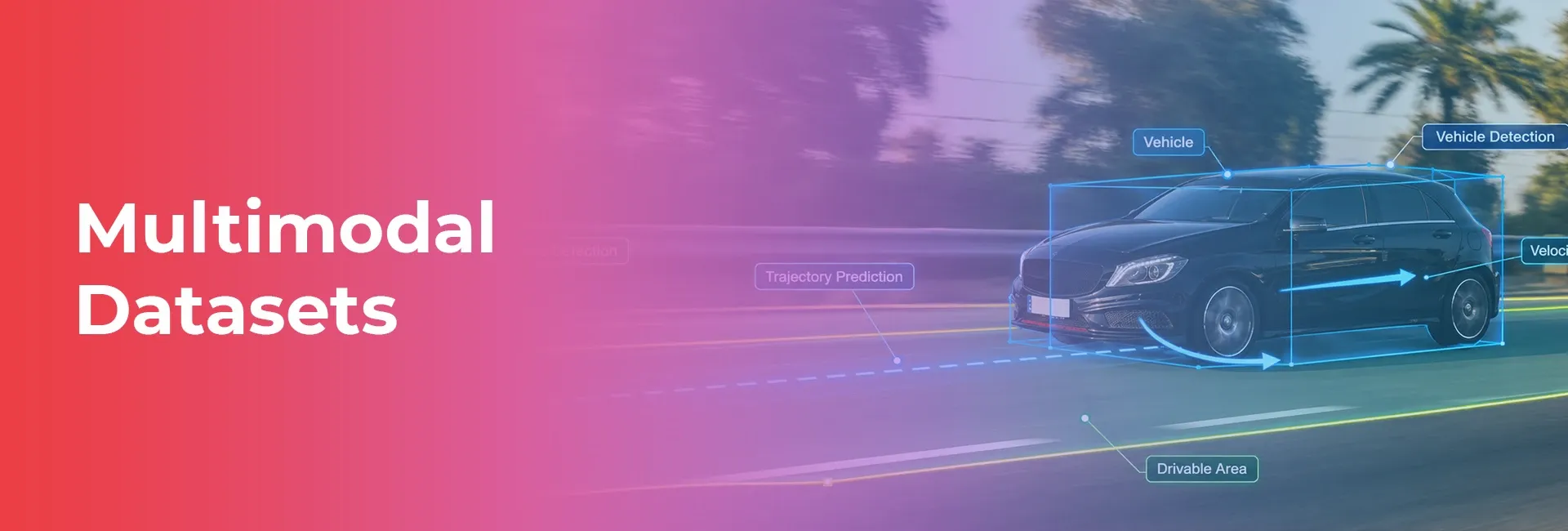
AI models do not perceive the world through just one sense, and neither should their training datasets. A self-driving car does not just “see”; it senses distance and tracks movements. In the same vein, conversational AI agents do not just analyze text; they hear, interpret tones, and process visual information. This is the very essence of multimodal datasets: blending multiple data modalities into one coherent training dataset to enable AI models to contextualize naturally.
With the development of generative AI, robotics, healthcare AI, and autonomous systems becoming increasingly advanced, companies building AI-powered products realize that multimodal training datasets are a requirement for creating models capable of generalizing to the real world.
This article will help you learn more about multimodal datasets, their types, collection and annotation techniques, use cases across industries, and what makes a production-ready multimodal dataset. As an experienced AI training data provider, Macgence is here to help your company at all stages of your multimodal datasets journey.
1. What Are Multimodal Datasets? A Complete Definition
What Is a Multimodal Dataset?
Multimodal datasets consist of multiple modalities of data, including text, images, sound, video, and sensor input, allowing AI systems to learn multiple types of information at once. Single-modality datasets, on the other hand, contain information only in a single modality, teaching text-only models about language, images-only models about vision, without learning the relationship between different modalities.
What Are the Most Common Multimodal Data Combinations?
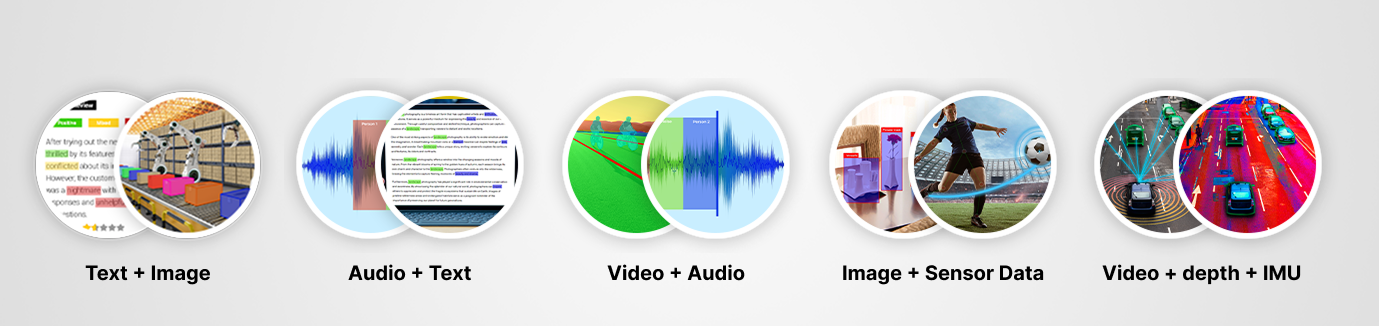
Text + image — image captioning, visual question answering, document understanding
Audio + text — transcription, voice assistants, conversational AI
Video + audio — narrated actions, dialogue-driven scenes, media understanding
Image + sensor data — robotics perception, industrial inspection
Video + depth + IMU — autonomous navigation, embodied AI
Think about any real environment — a warehouse floor, a hospital room, a busy street. None of these is unimodal. A warehouse robot may simultaneously process visual information, depth or LiDAR measurements, inertial signals, and other sensor inputs while interacting with its environment. Environments, therefore, being multimodal by definition, require multimodal datasets to train the models working in such environments.
2. Types of Multimodal Datasets: From Text and Images to Video and Sensor Data
As we will be looking at use cases, it helps to have a clear map of the different categories of multimodal datasets and where each one is typically used.
Text + Image Datasets
- Visual question answering (the model analyzes the image and then answers the question related to it)
- Image captioning (captioning images with natural language)
- Document understanding (extracting structured information forms, invoices, and reports)
Audio + Text Datasets
- Speech recognition and transcription
- Conversational AI and voice assistants
- Call-center analytics and sentiment detection from voice
Video + Audio + Text
- Video understanding and scene summarization
- Narration and action recognition
- Generative AI models that create or edit video content
Image/Video + Sensor Data
- Robotics perception and manipulation
- Autonomous vehicles and driver-monitoring systems
- Industrial AI and smart-factory environments
Furthermore, a combination of camera, LiDAR, depth, IMU, IoT, and health sensors gives rise to multimodal sensor fusion datasets. These are essential for creating physical or embodied AI systems which need to analyze the appearance, position, speed, and behavior of an object to react accordingly.
3. Why AI Robotics Training Datasets Rely on Multimodal Datasets for Superior Performance
A simplistic assumption would be that having different types of data will make the AI model intelligent, but there is a genuine reason why multimodal datasets have a better performance over unimodal ones in robotics. This is because AI robotics training datasets need to find answers to certain questions at the same time – What is this object, Where is it, How does it move, and What should the robot do about it?
How Multimodal Datasets Can Improve Model Performance
- Richer contextual understanding of dynamic, changing environments
- Better perception under difficult conditions — poor lighting, occlusion, clutter
- Cross-modal reasoning (the model correlates what it “sees” with what it “feels”)
- Greater generalization capabilities for scenarios that the model wasn’t explicitly trained on
- Reduced dependency on a specific feature that might be flawed, absent, or deceptive
Here is the brutal truth: more data doesn’t necessarily mean better data. A poorly coordinated, improperly labeled, or incomplete multimodal dataset can even be harmful to a model. The real advantage only shows up when the data is aligned, accurate, and relevant — which is the entire focus of the next section.
4. How to Build Multimodal Datasets: Collection, Synchronization, Annotation, and QA
Building a usable multimodal dataset is a process with real engineering discipline behind it — not a matter of dumping different file types into the same directory and hoping a model figures it out. Here’s roughly how it plays out in practice:
Define the model and use case — what specifically does the model need to learn, and what will “good performance” look like?
Identify the required modalities — text, image, video, audio, LiDAR, depth, IMU, or some combination
Design the collection protocol — decide on geography, demographics, environments, devices, and the scenarios that matter
Collect diverse real-world data — across conditions, locations, and edge cases, not just controlled lab settings
Synchronize the modalities — this step is especially critical for robotics and autonomous systems, where a few milliseconds of misalignment between camera and sensor data can throw off an entire training run
Annotate the data — connect objects, actions, and events across modalities
Run quality assurance — check for label consistency, accuracy, and completeness
Validate compliance and provenance — confirm the data was collected ethically and can be traced back to its source
Structure and deliver training-ready datasets — package everything so it’s usable for model development and evaluation, not just technically “complete”
5. Multimodal Annotation: Turning Raw Data Into Model-Ready Training Data
Here’s something teams often underestimate: having synchronized video, audio, and sensor data sitting in storage doesn’t teach a model anything by itself. Multimodal datasets only become useful once annotation connects the dots between modalities — linking what’s happening in a video frame to what a sensor recorded at that exact moment, or tying a spoken phrase to the on-screen action it describes.
What does multimodal annotation typically cover?
Image and video annotation — objects, boundaries, and scene elements
Audio and text annotation — transcription, intent, and speaker labeling
Sensor and temporal annotation — when something happened and for how long
Cross-modal synchronization — aligning corresponding signals across data types
Semantic annotation — meaning and relationships, not just labels
Object and event annotation — what changed, and what triggered it
3D bounding box annotation represents the three-dimensional extent, position, and orientation of objects, helping models understand spatial relationships in robotics and autonomous driving. Video narration annotation adds natural-language descriptions to frame-level actions, object interactions, and human intent. Together, these annotation types transform raw files into model-ready multimodal training data.
6. Multimodal Sensor Fusion Datasets for Robotics, Autonomous Driving, and Physical AI
Multimodal datasets are mission-critical for Physical AI—enabling robots and vehicles to act in the real world rather than just describe it. Multimodal sensor fusion datasets allow these systems to perceive environments from multiple angles simultaneously for safe operation outside controlled labs.
In robotics, this combines:
- RGB/video for visual context
- Depth and IMU data for 3D positioning and motion
- Force/torque and tactile sensors for physical interaction
- Motion capture and teleoperation data for human-guided demonstrations
In autonomous driving, it combines:
- Camera and LiDAR fusion for spatial awareness
- Radar and vehicle/environment sensors
- Object detection, tracking, and scene understanding across all modalities
This aligns directly with AI datasets for robotics industry requirements and robotics training data collection at scale. As a physical AI data provider, Macgence synchronizes 2D and 3D sensor feeds for applications in automotive and robotics domains to turn raw egocentric video and vehicle sensor logs into structured AI robotics training datasets.
7. Multimodal Datasets Across Industries: Healthcare, Generative AI, and Enterprise AI
Multimodal datasets may be essential in the robotics sector, but the underlying concepts are fundamental to any major AI project today. Using medical imaging, clinical notes, electronic health record (EHR), audio recordings, and physiologic sensor information helps in development of robust healthcare datasets for machine learning applications including diagnostics, monitoring, and clinical documentation. This infrastructure directly enables generative AI in medical applications—where compliance, consent, and annotation accuracy are critical due to sensitive data.
Leading generative AI models are multimodal by design, processing text, images, audio, and video together to generate multi-format content, analyze visual inputs, or edit video via text prompts.
Macgence’s collection and annotation services span healthcare, automotive, finance, and retail, making multimodal datasets a practical foundation across enterprise AI programs, well beyond Physical AI.
8. What Makes High-Quality Multimodal Datasets Enterprise-Ready?
“High-quality data” is something every vendor mentions and very few define. In the context of multimodal datasets, here is how an enterprise customer can actually evaluate a vendor:
Relevance: Is the data set reflective of real-life use cases or is it generic?
Diversity: Is it representative of different environments, users, and geographies?
Accuracy: Is it properly labeled and annotated?
Synchronization: Are corresponding modalities correctly time-aligned?
Coverage: Are edge cases represented, or just ideal conditions?
Compliance: Was the data ethically and legally sourced, with proper consent?
Provenance: Can you trace the data’s origin and processing history?
Scalability: Can the same methodology support 10x the volume later?
Macgence backs this framework with a global collection network spanning 150+ countries, 800+ languages, and a 10K+ resource network, alongside roughly 95% annotation accuracy and compliance practices aligned with standards like GDPR. Together, these capabilities provide the operational infrastructure needed to scale a multimodal training data program beyond the pilot stage.
9. Why Choose Macgence for Multimodal Datasets and AI Training Data?
Physical AI, generative AI, and enterprise AI all demand real, well-structured data that reflects how models will actually be used once deployed. Macgence combines data collection, multimodal processing, and specialized annotation within one accountable pipeline, rather than handing off pieces of the job to different vendors.
What makes Macgence a dependable partner for multimodal datasets?
Real-world data collection — image, video, audio, text, and sensor data gathered across real-world environments and edge cases, not just curated lab conditions
Multimodal processing — video, imagery, LiDAR, radar, and depth data synchronized into usable, time-aligned training sets
Specialized annotation — 2D and 3D bounding box annotation, segmentation, 3D point clouds, depth maps, pose estimation, and video narration annotation
Scalable delivery — datasets can be customized and expanded as project requirements grow.
Domain knowledge & QA — teams knowledgeable about embodied AI, sensor fusion, spatial reasoning, and compliance issues inherent to health and automotive datasets
Whether you’re training autonomous driving systems, robots operating in warehouses, industrial automation software, humanoid robots, or even a generative AI model requiring an understanding beyond text alone, Macgence can help assemble the multimodal datasets those models actually need.
Looking to create high-quality teleoperation or multimodal datasets for robotics, healthcare, and enterprise AI systems? Macgence can assist with collecting, annotating, and scaling the essential training datasets behind your models.
10. Frequently Asked Questions
1. What are multimodal datasets?
Multimodal datasets combine two or more data types — text, images, audio files, video clips, and/or sensor signals, integrated into one training dataset to provide rich context to the models.
2. What are the main types of multimodal datasets?
Text-image, audio-text, video-audio-text, and image/video-sensor combinations, plus multi-sensor datasets built from camera, LiDAR, depth, and IMU data.
3. What are multimodal sensor fusion datasets used for?
They power robotics, autonomous driving, and healthcare applications where multiple sensor perspectives lead to better perception and decision making.
4. How are multimodal datasets used in robotics specifically?
They combine robotics training data collection, teleoperation, 3D bounding box annotation, and video narration annotation to build AI robotics training datasets.
5. How can Macgence, as an AI training data provider, help build multimodal datasets?
Macgence collects, annotates, and validates multimodal datasets at scale — spanning Physical AI, robotics, healthcare, generative AI, and broader enterprise AI use cases.
 Previous Blog


You Might Like

August 31, 2026
Robotics Data Partner for Physical AI: Building the Data Pipeline Behind Intelligent Robots
Physical AI is revolutionizing the way robots sense, understand, and respond to the world. Unlike typical AI, intelligent robots need to understand dynamic environments, people, spatial relationships, motion, and changes in real-time. What data does Physical AI require? It requires diverse real-world inputs, including images, video, LiDAR, depth, sensor data, and human-object interaction data. For […]

August 26, 2026
Physical AI Data Providers: From Robotics Data Collection to Physical AI Annotation
Physical AI is moving AI beyond screens and into the physical world, where it will fuel robots, autonomous vehicles, and other kinds of intelligent machines that need to make sense of the environment and act accordingly. This development is expected to increase the demand for specialized data providers capable of generating multimodal Physical AI data. […]
August 17, 2026
Video Narration Annotation for Robotics Egocentric Data: Building AI Datasets for the Robotics Industry
Robotics has progressed beyond controlled lab settings and into Physical AI systems that can perceive, comprehend, and interact in the real world. In light of the rapid progress being made towards this technology, AI datasets that will feed the future needs of the robotics sector will no longer suffice without the context, structure, and multimodal […]