


How Image Segmentation Annotation Services Power Modern AI and Computer Vision Models
Artificial intelligence is only as smart as the data it learns from. If you want a computer vision model to distinguish a pedestrian from a lamppost, drawing a simple box around them often isn’t enough. The machine needs to understand the exact shape, boundaries, and context of the object. This is where the nuance of image segmentation comes into play.
Unlike standard bounding boxes that offer a rough estimate of an object’s location, image segmentation provides pixel-perfect accuracy. It is the process that allows autonomous vehicles to navigate complex intersections and helps medical AI detect tumors with life-saving precision. However, achieving this level of detail requires a rigorous, labor-intensive labeling process that can bottle-neck even the most advanced AI projects.
This guide explores the critical role of image segmentation annotation services, why they are indispensable for modern computer vision, and how outsourcing this complex task can accelerate your AI development.
What is Image Segmentation Annotation?
Image segmentation annotation is a computer vision technique that involves dividing a digital image into multiple segments or sets of pixels. The goal is to simplify the representation of an image into something that is more meaningful and easier to analyze.
In practical terms, annotators trace the exact outline of objects within an image. Instead of just identifying that a car is present, segmentation identifies which specific pixels belong to the car and which belong to the background road or nearby buildings.
There are primarily three types of segmentation used in AI training:
Semantic Segmentation
This method classifies every pixel in an image into a category. For example, in a street scene, all pixels belonging to “cars” might be colored blue, while all “pedestrian” pixels are red. It treats all objects of the same class as a single entity.
Instance Segmentation
This takes semantic segmentation a step further. It not only identifies the class (e.g., “car”) but also distinguishes between individual instances of that class. If there are five cars in an image, instance segmentation will label them as Car 1, Car 2, Car 3, etc., giving each a unique pixel mask.
Panoptic Segmentation
Panoptic segmentation combines the previous two methods. It provides a comprehensive understanding of the scene by labeling background elements (like the sky or road) semantically and distinct foreground objects (like cars or people) as instances.
Why Accuracy Matters in Image Segmentation Annotation
The phrase “garbage in, garbage out” is a cliché in data science for a reason. In computer vision, the quality of your training data directly dictates the performance of your model.
Simple bounding boxes include “noise”—background pixels that are captured inside the box but aren’t part of the object. For a general object detection model, this might be acceptable. But for high-stakes applications, this noise can lead to critical failures.
precise segmentation eliminates this background noise. It teaches the model the exact morphology of an object. When an AI understands the precise contours of a lung nodule or the jagged edge of a coastline, it can make decisions with a level of confidence that rough approximations simply cannot support.
Real-World Applications Transforming Industries
Image segmentation is the engine behind some of the most exciting technological advancements we see today. Its application spans across diverse sectors, driving innovation and efficiency.
Autonomous Driving
Self-driving cars rely heavily on segmentation to understand their environment. Vehicles must differentiate between drivable road surfaces, sidewalks, lane markings, and obstacles. A bounding box might tell a car that a pedestrian is nearby, but segmentation tells the car exactly where the pedestrian’s limbs are, helping predict movement and avoid collisions.
Medical Imaging and Healthcare
In healthcare, precision is non-negotiable. Image segmentation allows AI models to analyze CT scans, MRIs, and X-rays to identify anomalies. By outlining organs, tumors, or fractures at the pixel level, these models assist radiologists in diagnosing conditions earlier and more accurately. Macgence, for instance, specializes in collecting and annotating such sensitive medical data while adhering to strict compliance standards like HIPAA.
Agriculture and Precision Farming
Agri-tech uses segmentation to monitor crop health. Drones equipped with cameras fly over fields, and AI models analyze the footage to segment crops from weeds. This allows for precision spraying of herbicides, reducing chemical usage and costs while maximizing yield.
Retail and E-commerce
Visual search engines and virtual try-on features rely on this technology. Segmentation enables an app to recognize a specific piece of clothing on a model, separate it from the background, and find similar items in a catalog. It also powers augmented reality (AR) experiences where customers can see how a sofa might look in their living room.
The Strategic Advantage of Outsourcing Annotation
Creating high-quality segmentation masks is incredibly time-consuming. Annotating a single complex image can take anywhere from 15 minutes to an hour depending on the level of detail required. For a dataset of 50,000 images, the internal resources required are often prohibitive. This is why forward-thinking companies turn to specialized service providers.
Scalability on Demand
AI development often happens in bursts. You might need 10,000 images annotated next week, but none the week after. Outsourcing to a provider like Macgence gives you access to a scalable workforce. You can ramp up production without the headache of hiring and training temporary staff.
Access to Domain Experts
Annotation isn’t just about clicking pixels; it requires context. A medical dataset needs annotators who understand anatomy. A legal document dataset needs nuance. Premium providers offer access to subject matter experts (SMEs) who ensure that the data is interpreted correctly, not just mechanically labeled.
Cost Efficiency
Building an in-house annotation team requires significant investment in software, hardware, management, and salaries. Outsourcing converts these fixed costs into variable costs, allowing you to pay only for the data you need.
Quality Assurance Mechanisms
Top-tier providers have built-in quality control loops. At Macgence, for example, integrated quality assurance involves automated audits and human-in-the-loop reviews. This multi-layered approach ensures that the data fed into your models meets a 95%+ accuracy standard, which is difficult to maintain with an ad-hoc internal team.
How to Choose the Right Service Provider
Not all annotation services are created equal. When selecting a partner for your image segmentation needs, consider the following factors to ensure your project’s success.
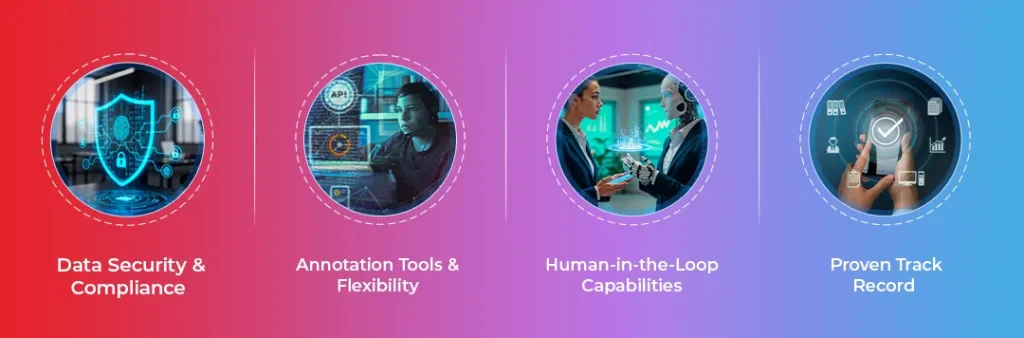
1. Data Security and Compliance
Your data is your intellectual property, and in some cases, it contains sensitive personal information. Ensure your provider complies with global standards like GDPR and HIPAA. Look for partners who prioritize secure data pipelines and have strict confidentiality protocols.
2. Annotation Tools and Flexibility
Does the provider use proprietary tools, or can they integrate with your existing workflow? The ability to customize labeling pipelines—from simple polygons to complex semantic segmentation—is crucial. You need a partner who can adapt their workflow to your specific project requirements.
3. Human-in-the-Loop Capabilities
While AI-assisted labeling tools speed up the process, human oversight is essential for edge cases and complex scenes. A provider that combines the efficiency of AI pre-labeling with the critical judgment of human annotators offers the best balance of speed and accuracy.
4. Proven Track Record
Look for case studies and testimonials. A provider with experience in your specific industry will anticipate challenges you haven’t even thought of yet. Whether it’s vehicle data collection or sentiment analysis, proven expertise reduces the risk of project delays.
Embracing the Future of Computer Vision
As AI models grow more sophisticated, the demand for high-quality, pixel-perfect training data will only increase. Image segmentation is no longer a “nice-to-have” feature; it is a fundamental requirement for building intelligent systems that can safely and effectively interact with the real world.
By leveraging expert image segmentation annotation services, you free your data science team to focus on what they do best: building and refining models. You gain the speed, accuracy, and scalability needed to move from concept to deployment faster.
If you are ready to elevate your AI models with precision data, partnering with a dedicated expert is the next logical step. High-quality data is the fuel for high-performing AI—ensure your tank is full of the best.
 Previous Blog


You Might Like

November 13, 2025
From Pre-Training to RLHF: A Complete Guide to How Generative AI Models Learn from Data
By 2025, generative AI will become the most talked-about technology shift since the internet itself. GPTs/chatbots crossed 100 million users in just two months. Image-based chatbots create millions of images daily. And yet, behind every impressive AI output lies a question most builders struggle to answer clearly: how exactly do these models learn from data? […]

November 12, 2025
How to Train Chatbot on Custom Data: The Complete Guide for AI Teams
Only 23% of chatbots today can handle complex, domain-specific conversations, actually. Without sounding robotic or giving wrong answers. The reason? Most of them were trained on generic datasets. That person doesn’t understand your business, your customers, or your industry’s unique language. If you’re building a chatbot for healthcare, finance, or customer support. Training it on […]

November 10, 2025
What Key Technologies Enable Effective Voice Agents?
Voice agents are everywhere nowadays. You ask, let’s Friday, your personal voice assistant for weather updates, and have Alexa order groceries. These AI assistants have become a part of everyday life. However, something interesting here – we interact daily, but most don’t understand what makes them work well. Behind smooth conversations with voice agents, a […]