


- What is Egocentric Gesture Recognition Labeling?
- Why Egocentric Gesture Recognition Labeling is Important
- Key Data Types Used in Egocentric Gesture Recognition
- Common Annotation Techniques for Gesture Recognition
- Challenges in Egocentric Gesture Recognition Labeling
- Best Practices for High-Quality Gesture Annotation
- Industries Using Egocentric Gesture Recognition Labeling
- How Macgence Supports Egocentric Gesture Recognition Projects
- Future of Egocentric Gesture Recognition in AI
- Powering the Next Generation of Spatial AI
- FAQs
How Egocentric Gesture Recognition Labeling Improves Human-Robot Interaction
Embodied AI and first-person perception systems are reshaping how machines understand human behavior. As wearable cameras and point-of-view (POV) devices become more advanced, they generate massive amounts of egocentric video data. This unique perspective allows AI models to see the world exactly as a human user does.
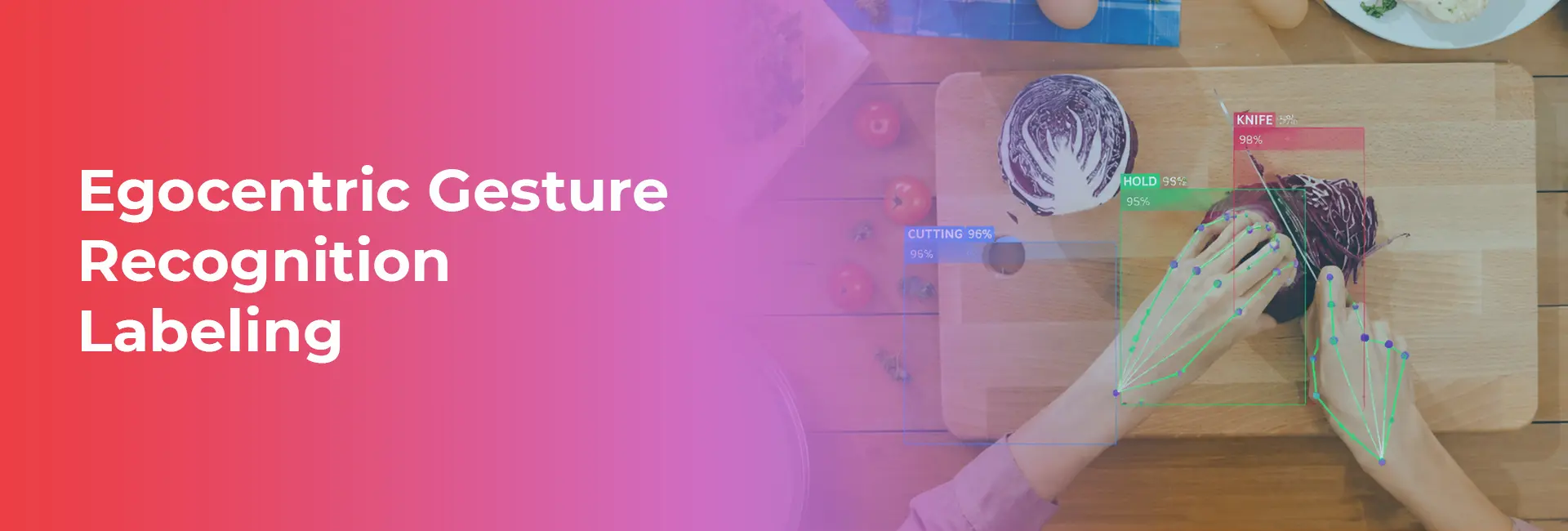
To make sense of this data, developers rely on Egocentric Gesture Recognition Labeling. This process involves carefully annotating first-person video to teach AI systems how to interpret hand movements, finger gestures, and physical interactions. The demand for these highly specialized datasets is growing rapidly across fields like AR/VR, smart glasses, robotics, human-computer interaction, and assistive AI systems.
Building accurate models requires precise, context-aware training data. Macgence provides industry-leading expertise in multimodal AI data annotation and gesture labeling. We help AI teams transform raw first-person video into high-quality datasets that power the next generation of spatial computing and robotics.
What is Egocentric Gesture Recognition Labeling?
Understanding Egocentric Data
Egocentric or first-person video is captured from the user’s perspective, typically using head-mounted displays, smart glasses, or body-worn cameras. Third-person gesture recognition observes a subject from the outside. First-person gesture recognition focuses on the user’s own hands and their immediate field of view. Common examples include hand tracking from AR smart glasses, recording warehouse worker actions, capturing robot learning demonstrations, and monitoring patient movements through healthcare wearable AI.
What Gets Labeled in Gesture Recognition?
Annotators must tag a wide variety of visual elements to create a complete picture of human action. The labeling process captures hand movements, finger gestures, and complex interaction sequences. Teams also label object manipulation, tracing motion trajectories over time. Annotators mark temporal gesture boundaries to define exactly when a movement starts and stops, while also tagging the underlying gesture intent or context.
Why Egocentric Gesture Recognition Labeling is Important
Human-Robot Interaction
Robots need to comprehend their surroundings to work safely alongside humans. First-person gesture labeling enables robots to understand human intent. This supports advanced imitation learning and collaborative robotics, allowing machines to seamlessly assist in complex tasks.
AR/VR and Smart Glasses
Spatial computing relies heavily on accurate hand tracking. Egocentric gesture recognition labeling powers gesture-based controls and hands-free user interfaces for AR and VR platforms. These spatial interaction systems allow users to navigate digital environments naturally without needing physical controllers.
Assistive AI Applications
First-person perception models greatly improve accessibility systems. Wearable cameras can monitor rehabilitation exercises or provide elderly assistance technologies. By tracking specific hand movements, AI can alert caregivers to potential issues or help individuals interact with their environment more easily.
Wearable AI and Consumer Devices
Modern consumer tech increasingly utilizes wearable AI. Smart headsets, fitness tracking devices, and industrial safety systems use first-person gesture recognition to monitor user activity, track performance, and ensure safe operation in hazardous environments.
Key Data Types Used in Egocentric Gesture Recognition
RGB Egocentric Video
Standard color video forms the foundation of most gesture recognition datasets. Annotators work with first-person action streams and head-mounted camera recordings to capture natural human movement in high resolution.
Depth and Stereo Data
Visual data alone often lacks spatial context. Depth and stereo data provide crucial information for hand positioning and distance estimation. This information allows AI models to build accurate 3D interaction mapping.
IMU and Sensor Data
Wearable devices often include Inertial Measurement Units (IMUs). Annotators align motion tracking signals with video feeds to create robust datasets. This wearable sensor synchronization helps models understand acceleration and rotation alongside visual cues.
Multimodal Data Streams
Advanced AI models learn best from multiple inputs. Multimodal datasets combine audio with gesture context, link eye gaze with hand motion, and integrate spatial mapping signals to create a comprehensive understanding of user intent.
Common Annotation Techniques for Gesture Recognition
Bounding Box Annotation
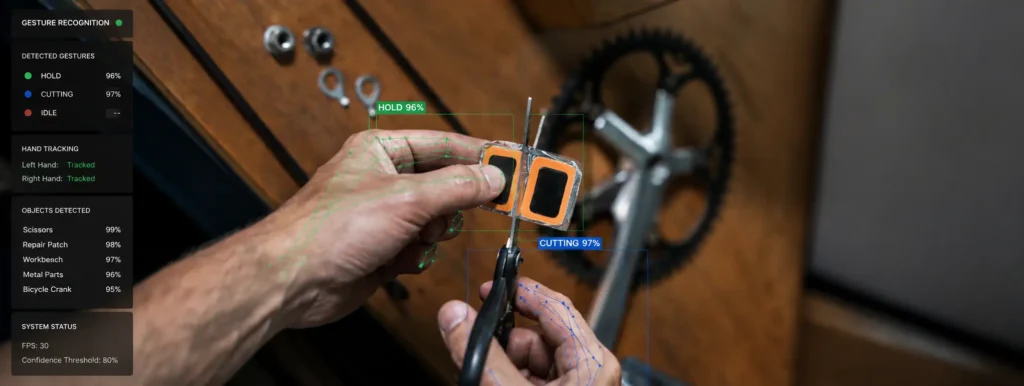
Bounding boxes remain a fundamental tool for tracking hands and objects. This technique supports real-time movement detection by placing 2D boxes around relevant items in every frame.
Keypoint and Skeletal Annotation
For precise hand tracking, annotators use keypoint and skeletal annotation. This involves finger joint mapping and hand pose estimation, placing specific points on knuckles and joints to map exact hand geometry.
Temporal Segmentation
Movements happen over a sequence of frames. Temporal segmentation requires annotators to label start and end frames, effectively tagging the exact duration of a specific gesture within a longer video clip.
Semantic Gesture Classification
Annotators must categorize specific movements. Semantic classification applies labels to actions like pointing, grabbing, swiping, pinching, rotating, and signaling.
Object Interaction Labeling
Hands rarely move in isolation. Object interaction labeling focuses on human-object relationships. This creates a deep action-context understanding, teaching AI how a user holds a tool, opens a door, or manipulates a digital interface.
Challenges in Egocentric Gesture Recognition Labeling
Motion Blur and Camera Shake
Wearable cameras naturally move with the user. This causes head-mounted movement issues and motion blur during fast hand motions, making it difficult for annotators to accurately place keypoints or bounding boxes.
Occlusion Problems
From a first-person perspective, hands frequently block objects or even each other. Partial visibility and occlusion problems force annotators to estimate joint positions and track items that temporarily disappear from view.
Lighting Variability
Users wear POV cameras in diverse settings. Lighting variability is a major challenge, especially during indoor/outdoor transitions or in poorly lit industrial environments.
Fine-Grained Gesture Complexity
Many hand movements look nearly identical. Similar hand poses and subtle finger movements require highly trained annotators who can distinguish between complex, fine-grained gestures.
Large-Scale Video Annotation Costs
Video annotation is resource-intensive. Frame-by-frame labeling complexity drives up large-scale video annotation costs, necessitating strict quality assurance requirements to avoid expensive rework.
Best Practices for High-Quality Gesture Annotation
Build Clear Annotation Guidelines
Consistency starts with documentation. Teams must develop a comprehensive gesture taxonomy, establish firm label consistency rules, and provide instructions for edge-case handling.
Use Multi-Level Quality Checks
Accurate models require flawless data. Implement consensus review processes, use automated validation scripts, and maintain rigorous human QA pipelines to catch errors early.
Combine Human Expertise with AI-Assisted Annotation
Speed up the labeling process by using pre-labeling workflows. Active learning loops allow AI models to suggest initial annotations, which human experts then correct and refine.
Synchronize Multimodal Signals
When working with sensor data and video, timing is everything. Teams must carefully align sensor streams with video frames and maintain strict timestamp consistency across all data sources.
Maintain Diverse Real-World Data
AI models must perform well for all users. Ensure your dataset includes different environments, multiple demographics, and varied hand shapes and motion styles to prevent model bias.
Industries Using Egocentric Gesture Recognition Labeling
Robotics and Embodied AI
Robotics companies use first-person data for robot imitation learning. This helps train collaborative robots (cobots) to perform complex manual tasks by watching human demonstrations.
AR/VR and Extended Reality
The extended reality industry relies on gesture-controlled interfaces. Accurate labeling enables highly immersive training systems and seamless spatial computing environments.
Healthcare and Rehabilitation
Medical professionals use wearable AI for physical therapy monitoring. Assistive gesture recognition helps track patient recovery and monitor daily living activities.
Manufacturing and Industrial Automation
Factories deploy smart glasses for worker activity understanding. This technology enables automated safety monitoring and helps optimize complex assembly workflows.
Automotive and Smart Mobility
Modern vehicles are adopting advanced in-cabin technology. First-person cameras enable driver hand monitoring and in-cabin gesture controls, allowing drivers to interact with navigation and entertainment systems safely.
How Macgence Supports Egocentric Gesture Recognition Projects
Custom Gesture Annotation Pipelines
Macgence builds scalable workforce solutions tailored to your specific needs. We design domain-specific annotation workflows that align perfectly with your model’s unique requirements.
Multimodal AI Data Expertise
Our teams excel at handling complex datasets. We manage video and sensor synchronization effortlessly, providing highly accurate human motion annotation across multiple data streams.
Quality-Focused Annotation Operations
Quality is built into every step of our process. Our robust QA frameworks ensure enterprise-scale delivery of pixel-perfect training data.
Support for Robotics and VLA Training Data
We are at the forefront of embodied AI datasets. Macgence provides expert human demonstration labeling and egocentric action understanding to power the next generation of robotics.
Future of Egocentric Gesture Recognition in AI
Vision-Language-Action (VLA) Models
The next frontier of AI involves Vision-Language-Action models. These AI systems learn directly from first-person demonstrations, linking visual input, verbal commands, and physical actions.
Real-Time Human Intent Understanding
As models improve, context-aware AI assistants will predict user needs before they are explicitly commanded. This will lead to highly adaptive robotics that collaborate flawlessly with human partners.
Wearable Spatial Computing
The hardware is shrinking while the AI gets smarter. AI-powered smart glasses will soon feature native gesture interfaces, making spatial computing an everyday reality.
Foundation Models for Human Motion Intelligence
The industry is moving toward large multimodal behavior datasets. These generalized action understanding models will serve as the foundation for countless new applications in physical AI.
Powering the Next Generation of Spatial AI
Egocentric Gesture Recognition Labeling is the bridge between human action and artificial intelligence. By providing models with a first-person view of human behavior, developers are unlocking incredible new capabilities in embodied AI, spatial computing, and human-centered technology. Building these systems requires high-quality, highly scalable annotation pipelines that can handle complex multimodal data.
Looking for scalable egocentric video annotation and gesture labeling services? Connect with Macgence to build high-quality AI training datasets today.
FAQs
Ans: – It is the process of annotating first-person video data to teach AI systems how to identify and interpret hand movements, object manipulation, and physical interactions from the user’s perspective.
Ans: – Egocentric data allows AI models to see the world from a human point of view. This perspective is vital for training smart glasses, AR/VR systems, and robots to understand user intent and spatial context.
Ans: – Common annotation types include bounding boxes, keypoint and skeletal mapping, temporal segmentation, semantic classification, and object interaction labeling.
Ans: – Major adopters include robotics, AR/VR, healthcare and rehabilitation, manufacturing, industrial automation, and the automotive sector.
Ans: – Key challenges include motion blur from head movement, occlusion when hands block objects, lighting variability, the complexity of subtle finger movements, and the high cost of large-scale video labeling.
Ans: – Macgence provides enterprise-grade data annotation services, offering custom annotation pipelines, multimodal data synchronization, rigorous QA frameworks, and specialized support for robotics and embodied AI datasets.
 Previous Blog


You Might Like

August 26, 2026
Physical AI Data Providers: From Robotics Data Collection to Physical AI Annotation
Physical AI is moving AI beyond screens and into the physical world, where it will fuel robots, autonomous vehicles, and other kinds of intelligent machines that need to make sense of the environment and act accordingly. This development is expected to increase the demand for specialized data providers capable of generating multimodal Physical AI data. […]

August 17, 2026
Video Narration Annotation for Robotics Egocentric Data: Building AI Datasets for the Robotics Industry
Robotics has progressed beyond controlled lab settings and into Physical AI systems that can perceive, comprehend, and interact in the real world. In light of the rapid progress being made towards this technology, AI datasets that will feed the future needs of the robotics sector will no longer suffice without the context, structure, and multimodal […]

August 10, 2026
Annotation for Robotics: How High-Quality Data Improves Robot Intelligence
Robots today must be able to maneuver through complex surroundings, identify objects, perceive human intent, and make smart decisions. All of this can only be achieved with the use of robotics annotation and high-quality annotation for robotics, which convert unstructured sensory inputs into high-quality AI robotics training datasets. In all industries, ranging from manufacturing and […]