


How to Evaluate an AI Training Data Partner Before Signing a Contract
Picture an AI team that has just received thousands of hours of multilingual conversational audio. The files look complete. Then the problems surface: transcripts disagree on spelling, consent documentation is missing for many speakers, and several regional accents are barely represented. Months of model development now rest on a weak foundation, and the retraining bill lands on the team, not the vendor.
This scenario explains why choosing an AI training data partner is one of the most consequential decisions in any AI project. The central question is simple: can your partner deliver the quality, diversity, licensing clarity, and scale your production model actually needs?
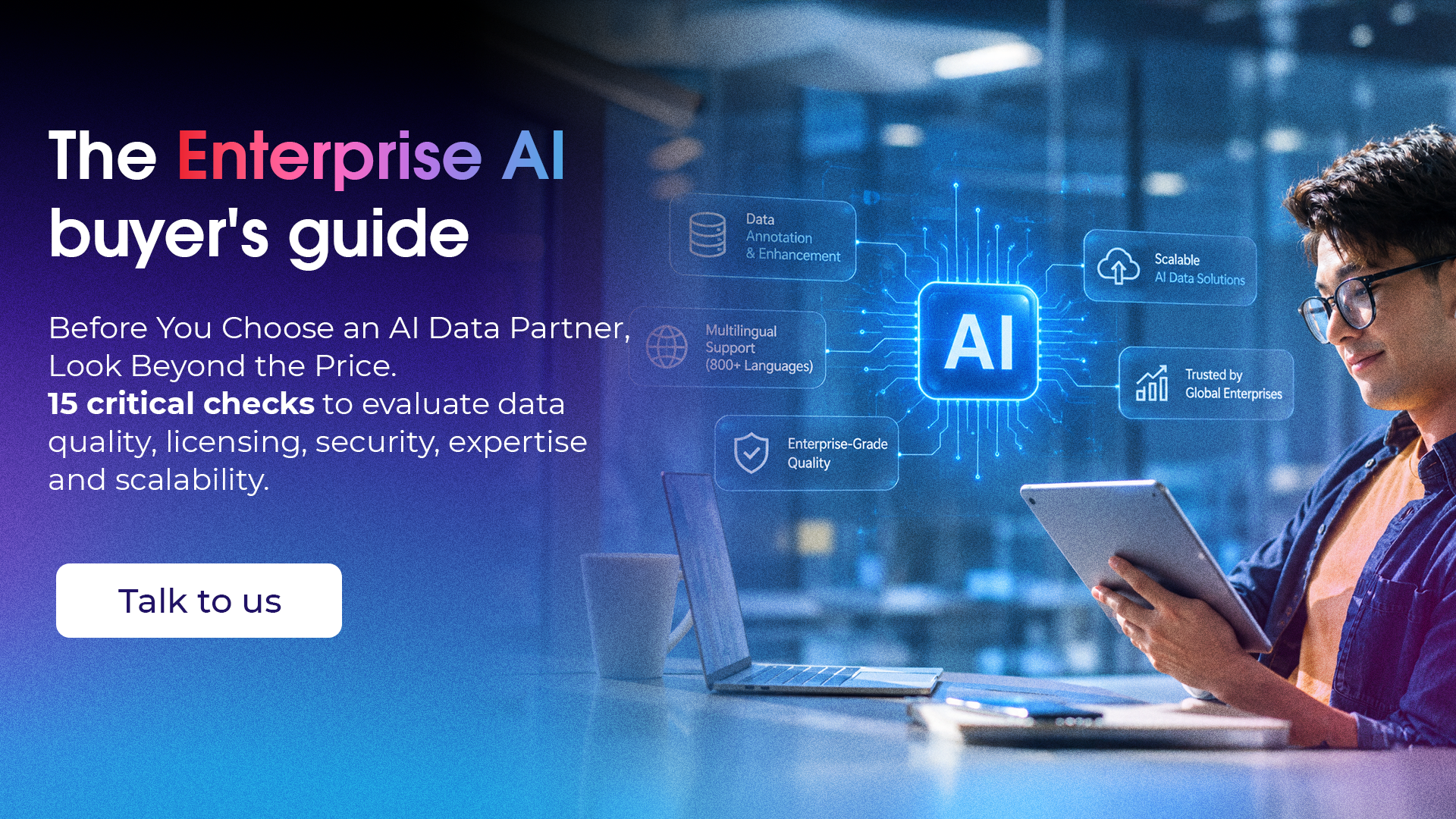
This guide gives you 15 practical questions to ask before you commit to any vendor contract, so the decision rests on evidence, not sales promises.
1. Why Choosing the Right AI Training Data Partner Matters More Than Price
Price is the easiest number to compare, which is why it misleads. A low quote from a data annotation vendor rarely includes relabeling cycles, delayed releases, and engineers pulled off modeling to clean datasets.
Data quality shapes everything downstream. Noisy labels reduce model accuracy, skewed samples introduce bias, and thin documentation slows deployment approvals. A support chatbot trained on inconsistent intent labels passes testing, then misroutes real customers at launch.
What poor data really costs
- Extra retraining cycles that stretch timelines
- Rework fees and change requests that erase early savings
- Bias and compliance findings after release
Treat vendor selection as a model-development decision, not a procurement task. A mature AI training data provider supports the whole lifecycle, from sourcing to validation, as Macgence’s AI training data services illustrate.
2. Define Your Dataset Requirements Before Evaluating AI Data Collection Services
To compare vendors fairly, provide each one with the same project requirements. Before reviewing proposals for AI data collection services, write down what you need.
Cover modality, intended model use, target languages, speaker demographics, geographic spread, volume, and delivery format. Then test the brief against a real scenario. An enterprise voice assistant must understand Hindi, English, and code-mixed speech across several accents. Developing this voice assistant may require speaker diarization, accurate transcription, and consistent intent labels.
A strong requirements brief states the following:
- Languages, dialects, and speaker age, gender, and region mix
- Recording environments, such as call-center lines or smartphones
- Annotation layers: transcripts, diarization, intent, entities
A precise brief helps a partner scope custom AI training datasets. Macgence’s custom data sourcing starts from your AI objectives and structures datasets around them.
3. Can the Vendor Prove Data Provenance, Consent, and Licensing Rights?
Data volume impresses in a sales deck, but documented licensing and usage rights determine whether you can actually use the data. A dataset that cannot legally support model training, fine-tuning, or commercial deployment is a liability.
Ask where each dataset came from. First-party collection, where the vendor recruits contributors directly, usually leaves a cleaner paper trail than third-party aggregation. Either way, insist on documented data provenance: who contributed, under what consent, with which rights.
Questions that expose weak licensing
- Does participant consent cover commercial model training?
- Are there redistribution restrictions?
- Is there a chain of custody to delivery?
- Who owns the delivered data and derived annotations?
Strong training data licensing puts these answers in writing. Macgence publishes its data licensing and sourcing capabilities. Confirm rights dataset by dataset, since terms vary.
4. How to Assess a Data Annotation Vendor’s Multilingual and Domain Expertise
Basic transcription is not the same as production-ready conversational AI annotation. The first captures words. The second captures meaning: who spoke, in which language, with what intent, and in which domain context.
When you assess a data annotation vendor, look for native-language competence, not translation by non-native reviewers. Ask how the team handles regional accents and code-switching, where speakers shift languages mid-sentence.
Capabilities worth testing
- Speech annotation services: transcription, speaker diarization, and timestamps
- Linguistic annotation: named entity recognition and intent classification
- Subject-matter reviewers for healthcare, finance, or legal content
Macgence reports 200+ languages of expertise and a network of 100+ vetted subject-matter experts. Its published case study covers digital-assistant training in 40+ languages for a cloud-based voice provider. See its data annotation services.
5. What Quality Assurance Standards Should You Demand Before Dataset Acceptance?
An accuracy claim is only a number until it is written into the contract. Vendor-reported accuracy describes past work. An acceptance threshold describes what you pay for.
Define dataset acceptance criteria using annotation guidelines, gold-standard samples, inter-annotator agreement, error categories, and sample-based audits. Pair them with human-in-the-loop annotation, where reviewers correct what automation misses.
Illustrative acceptance criteria
- Word error rate at or below an agreed percentage on a blind sample
- Label agreement between independent annotators above a set score
- Completeness: every file carries all required labels
- A maximum turnaround for corrections
Macgence reports approximately 95% annotation accuracy, supported by integrated QA, automated audits, sampling, and human review. Its data validation services show how AI training data quality assurance works.
6. How Secure Is Your AI Training Data Across Collection, Annotation, and Delivery?
Security questions tend to arrive late, usually from legal or procurement, and can stall a deal. Raise them early.
Training data often contains personally identifiable information: voices, faces, addresses, account numbers. Map how that information is protected during collection, annotation, and delivery, then ask what the vendor does when something goes wrong.
Due diligence topics
- Encryption and role-based access controls
- Retention, deletion, and subcontractor access
- Incident response and breach notification
- Cross-border transfers under GDPR, or HIPAA for health data
A marketing page is not evidence. Request certificates, audit summaries, and the data processing agreement itself. Macgence emphasizes secure, licensed data and highlights GDPR and ISO 27001 badges. Treat those as a reason to begin due diligence for enterprise data annotation, with safeguards confirmed during procurement.
7. Can the Partner Scale Multilingual Data Collection Without Sacrificing Quality?
Completing a small pilot demonstrates initial capability, but sustaining production-scale delivery across languages, regions, and shifting requirements is a different job.
Ask how the partner moves from pilot to production. Look at workforce capacity, language coverage, weekly throughput, milestone tracking, and escalation paths when volumes spike or scope changes. Multilingual speech data collection, for instance, adds recruitment, recording logistics, and per-language QA.
Evidence of scale to request
- Named projects of comparable size, with delivery timelines
- Contributor network size and geographic spread
- A staged plan: pilot, ramp-up, steady state
Macgence reports 50K+ hours of speech datasets, a 10K+ resource network, and coverage across 150+ countries. A Delhi multilingual collection project reportedly delivered 15,000+ hours of conversational audio. Review its AI data collection capabilities for enterprise AI training data programs.
8. Compare Vendor Proposals Using a 15-Question AI Training Data Evaluation Checklist
Score every proposal against the same yardstick. A buyer comparing three vendors for a multilingual voice assistant can see at a glance who has strong sourcing but weak quality controls. The questions below are grouped by theme, so gaps are easy to spot.
| # | Theme | Question |
| 1 | Scope | Can the vendor support our exact AI use case and data modalities? |
| 2 | Scope | Can it meet our required languages, dialects, and speaker demographics? |
| 3 | Scope | Can it demonstrate relevant projects or case studies? |
| 4 | Sourcing | How is training data sourced and its provenance recorded? |
| 5 | Sourcing | Are consent and commercial training rights documented? |
| 6 | Sourcing | Who owns the delivered data and derived annotations? |
| 7 | Expetise | Do annotators have verified linguistic and domain expertise? |
| 8 | Expertise | Are annotation guidelines and edge cases documented? |
| 9 | Quality | What quality metrics and acceptance thresholds will apply? |
| 10 | Quality | How are failed samples corrected and independently revalidated? |
| 11 | Security | How is sensitive information protected throughout the workflow? |
| 12 | Security | What are the retention, deletion, and subcontractor policies? |
| 13 | Delivery | Can the vendor meet pilot and production delivery milestones? |
| 14 | Delivery | What formats, metadata, and integration methods are supported? |
| 15 | Commercial | Does the proposal specify total costs, SLAs, rework, and change requests? |
How to score vendors
- Weight each theme, for example quality 25%, sourcing 20%, security 20%, delivery 15%, expertise 10%, commercial 10%
- Rate every answer from 1 to 5 using evidence, not promises
- Rank by weighted total, then compare price
Weighted scoring helps procurement, legal, and engineering teams evaluate vendors using consistent criteria instead of selecting solely on price.
Discuss your AI training data requirements with Macgence. Explore a tailored approach to multilingual data sourcing, annotation, quality validation, and production delivery.
9. Why Macgence Is Worth Shortlisting as Your AI Training Data Partner
Macgence is an AI data collection company for buyers who want one partner across sourcing, annotation, validation, and delivery. Its published experience in multilingual data collection, annotation, and validation makes Macgence a relevant provider to consider during vendor evaluation.
End-to-End Data Services
Custom sourcing, annotation, validation, licensing, and human-in-the-loop workflows.
Multilingual Readiness
200+ languages of expertise and 50K+ hours of speech datasets.
Demonstrated Delivery
5M+ files expertly annotated and 500+ projects delivered.
Domain Relevance
Conversational AI, NLP, healthcare, computer vision, and generative AI.
Share your dataset scope, language coverage, acceptance criteria, and delivery timeline with Macgence to discuss a potential pilot project.
Discuss your AI training data requirements with Macgence.
Book a Discovery with Macgence
Which of these 15 questions would your current vendor struggle to answer?
10. Frequently Asked Questions
1. What should I look for in an AI training data partner?
Look for relevant project experience, documented data rights, measurable quality controls, enterprise-grade security, and proven ability to scale from pilot to production across your languages and modalities.
2. How do I evaluate a data annotation vendor?
Run a pilot, audit samples against written guidelines, measure inter-annotator agreement, and define acceptance tests before signing. Check how failed samples are corrected and revalidated.
3. What makes multilingual conversational AI data production-ready?
Broad accent coverage, diverse speakers, documented consent, accurate transcripts, and structured metadata. Code-mixed speech and diarization labels should stay consistent across every language.
4. How much do AI data collection services cost?
Pricing depends on modality, languages, volume, sourcing complexity, and QA depth. Rare languages and expert annotation cost more. Compare total cost, including rework, not per-file price alone.
5. What should an AI training data contract include?
Deliverables, IP and licensing rights, SLAs, acceptance thresholds, security obligations, rework terms, change-request pricing, and termination clauses.
6. Can one provider handle data collection, annotation, and validation?
Yes. Coordinated workflows reduce handoff errors and speed delivery. Macgence offers custom sourcing, annotation, validation, and human-in-the-loop review under one engagement.
7. What is data provenance in AI training data?
Data provenance is the documented history of a dataset: who collected it, under what consent, with which usage rights, and how it reached you.
8. How do I compare AI training data vendors fairly?
Share one written brief, ask every vendor the same 15 questions, score answers with weighted criteria, and judge total cost, including rework, rather than headline price.
9. Should I run a pilot before signing with an AI training data provider?
Yes. A scoped pilot reveals annotation quality, turnaround, communication, and edge-case handling before you commit to production volumes or long-term pricing.
10. What security questions should I ask a data annotation vendor?
Ask about encryption, access controls, retention and deletion, subcontractors, incident response, and cross-border transfers. Request certificates and the data processing agreement.


You Might Like
November 21, 2026
How Macgence Built a Multilingual Conversational AI Dataset Across 40+ Languages
Macgence sourced over 20,600 hours of unbiased, real-world conversational audio across 40+ languages and regional dialects for a major cloud-based voice service provider. This data was used to train its virtual assistants on natural speech examples so they could understand and respond reliably in real-world customer interactions. Challenge 20,600+ hours of unbiased conversational audio, including […]
November 16, 2026
Teleoperation Data Collection for Robotics: Building High-Quality Training Datasets for Physical AI
Modern warehouses, factories, hospitals and even our houses need robots that can lift things, move and deal with unforeseen situations, and all of it relies heavily on the data used to train these robots. Teleoperation data collection is a more realistic way of doing this. In this kind of data collection, a person operates the […]
November 11, 2026
Natural Language Processing Services: A Complete Guide to NLP Data Collection, Annotation and AI Training
Language provides the most natural interaction between humans and machines. Today, businesses expect AI to understand contracts, respond to customers and convert calls to text and compose responses. Natural language processing services support these capabilities through data collection, annotation, validation and the preparation of high-quality datasets for AI training. Whilst AI systems can process huge […]