


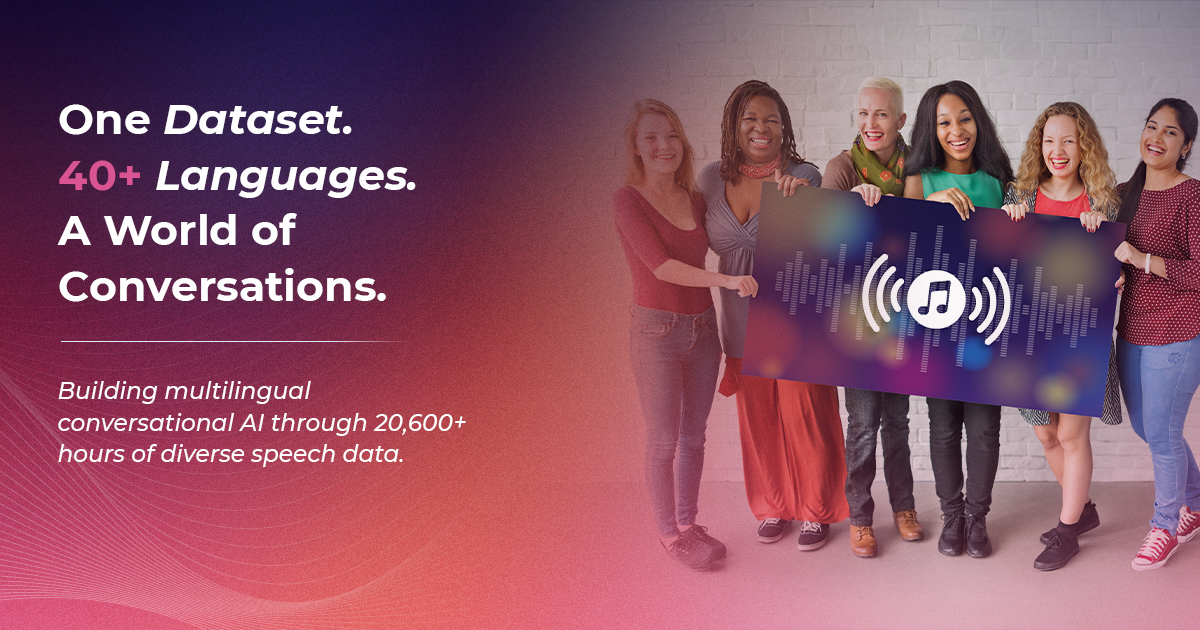
How Macgence Built a Multilingual Conversational AI Dataset Across 40+ Languages
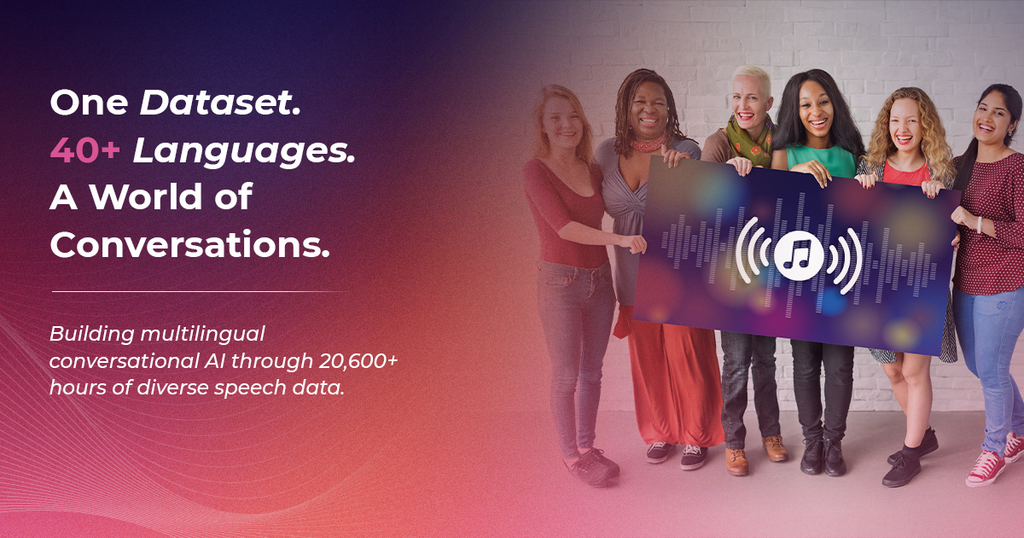
Macgence sourced over 20,600 hours of unbiased, real-world conversational audio across 40+ languages and regional dialects for a major cloud-based voice service provider. This data was used to train its virtual assistants on natural speech examples so they could understand and respond reliably in real-world customer interactions.
Challenge
20,600+ hours of unbiased conversational audio, including children’s speech, across many diverse languages and regional dialects.
Execution
13,000+ hours of PI-normalized data sourced in 8 weeks at 95%+ accuracy
1. Client and Project Context
A major cloud-based voice service provider asked Macgence to train its virtual assistants to talk naturally in each customer’s language. Virtual assistants now sit at the front line of customer service, banking and in-car experiences, and the global conversational AI is estimated at roughly $18 billion in 2026, and voice is its fastest-growing segment. The catch is that an assistant is only as capable as the data it was trained on.
- Client: a major cloud-based voice service provider for virtual assistants
- Need: multilingual AI training data for conversational AI in more than 40 languages and dialects
- Partner: Macgence, through its AI training data services
2. The Data Challenge: Conversational AI Data Collection at Scale
A shortage of quality conversational training data has held back conversational AI for long. This project added four layers of difficulty on top of raw volume.
- Diversity without bias: Speakers needed a wide mix of accents, genders, ages, and backgrounds so the AI would understand everyone equally instead of favoring a single group.
- Children’s speech: Recording children is much harder than recording adults due to strict parental consent rules and a smaller pool of available speakers.
- Two audio standards: Delivering both 8 kHz (standard phone-call quality) and 16 kHz (high-definition media quality) audio in a single product.
- Privacy at speed: Anonymizing personal information to meet privacy rules within an 8-week deadline.
The core question for the buyer was simple: Can a partner collect and prepare real-world conversational data at the scale and quality that production AI demands? Imagine a customer switching between two languages mid-sentence while asking their bank about a late payment. A conversational AI-assistant trained on clean, single-language scripts will fail in this scenario.
3. Languages and Dataset Scope
Scope
Figure
- Total audio
- Languages
- 8 kHz (call center, general)
- 16 kHz (media domains)
- Linguists
- Average per language
- 20,600+ hours
- 40+
- 9,900+ hours
- 10,800+ hours
- 3,000+
- ≈500 hours
The 8 kHz audio mirrors standard telephone and call-center lines, where most business voice bots operate. The 16 kHz audio captures clearer, wider sound frequencies for voice assistants used on smartphones, smart speakers, and inside vehicles.
4. Collection Methodology for Multilingual Speech Data
8 kHz stream
unbiased, unscripted call-center and general conversations recorded across 17 topics, including finance, insurance, retail, telecom, hospitality, legal, family, friends and culture.
16 kHz stream
high-quality audio from a wide range of media domains, such as arts and culture, beauty and lifestyle, biography, and cars and motors.
Diversity by design
Speakers were selected for variety in accent, gender, age and demographics, so no single group dominates the training distribution. Children’s speech was intentionally included, managed with the extra privacy safeguards and care that younger participants require.
A certified linguist network
More than 3,000 experienced, credentialed linguists contributed from around the world, supported by Macgence’s 10K+ resource network and coverage across 150+ countries. Native speakers mattered most for dialects, since the same word can sound very different from one region to the next.
5. Transcription and Annotation Workflow
Raw audio only becomes training data once it is transcribed, labelled and cleaned. Macgence ran each recording through a structured, human-in-the-loop pipeline built on its transcription and annotation tools.
- Split and tag audio: Break long recordings into short clips and log key details like language, dialect, speaker age group, topic, and audio quality.
- Transcribe natively: Native linguists write out each clip in its original language and script using strict language-specific rules.
- Label speakers and turns: Annotators mark who is talking and when, teaching the AI how natural back-and-forth conversations flow.
- Normalize personal information: Handle names, numbers and other personal details under the PI-normalization rules agreed with the client.
- Add context tags: Label topics, timestamps, and background sounds (like laughter or pauses), using AI tools for a fast first pass that human experts verify.
- Run final quality checks: Send finished batches to the quality assurance team for review before anything reaches the client.
The output suits automatic speech recognition (ASR), natural language understanding and dialogue model training alike.
6. Quality Assurance
- Two-level quality checks: Every batch passes through Macgence’s strict two-step review process, catching and fixing errors before any files leave our hands.
- Proven accuracy: This project achieved 95%+ accuracy, aligning with Macgence’s ~98% benchmark across data labeling and AI training projects.
- Bias balancing: Our team continuously tracks speaker coverage across accents, genders, and age groups to keep the dataset fair and balanced as it grows.
- Strict security compliance: All workflows follow HIPAA and GDPR privacy laws, backed by Macgence’s ISO 27001 certification for information security.
Why this matters is because transcription errors compound. Industry research shows that every 1% error in human transcription adds roughly 2% more word-recognition mistakes to the final AI assistant. Catching errors at the source is the most reliable way to build an accurate voice assistant.
7. Delivery and Verified Outcome
Macgence delivered 20,600+ hours across multiple languages and dialects. This included 13,000+ hours of PI-normalized data in 8 weeks (an average pace of roughly 1,600 hours per week) at 95%+ accuracy.
With this data, the client trained its conversational AI on topics from telecom and hospitality to legal, in more than 40 languages and dialects. Its assistants can now talk with people in their own language and serve different age groups.
8. Lessons for Enterprise Buyers
If you are evaluating a vendor for multilingual AI training data, ask these seven questions before you sign:
- How many hours do you have, by sampling rate and domain?
- What is the accent, gender and age split per language?
- Do you use native, credentialed linguists for each dialect?
- How do you govern children’s and personal data?
- Is there a multi-level QA process with a measurable accuracy target?
- Are you compliant with GDPR, HIPAA and ISO 27001?
- Can we run a pilot to test turnaround?
When a partner can answer all seven questions, they do more than just hand over raw data files. They manage the speakers, protect privacy, and ensure the data actually works in production, acting like an extension of your own team. Explore Macgence’s custom data sourcing services and sample datasets to see how this looks in practice.
9. Applications of Multilingual Conversational AI
- Customer support and service: automate chat and call support in the customer’s language, from order status to billing queries.
- Healthcare: apply NLP to conversational AI to automate medical transcription and reports.
- Financial services: help customers with banking transactions, account inquiries and financial guidance across languages.
- Automotive: assist with navigation, in-car controls and real-time information, hands-free.
See Macgence’s conversational AI solutions for more use cases.
10. The Macgence Way
- TAT: compliant, high-quality, customizable data, delivered quickly.
- Quality: every dataset passes rigorous 2-level quality checks before delivery.
- Compliance: adherence to HIPAA and GDPR requirements.
- Accuracy: ~98% across annotation types and model datasets.
- Use cases solved: experience across a diverse range of AI use cases.
Macgence at a glance: 50K+ hours of speech datasets · 500+ projects delivered · 5M+ files annotated · 150+ countries covered · 10K+ resource network
Planning a voice assistant, chatbot or ASR model for new markets? Share your languages, domains and volumes, and our team will scope a dataset for you.
Request a multilingual dataset consultation · View a sample dataset


You Might Like
November 16, 2026
Teleoperation Data Collection for Robotics: Building High-Quality Training Datasets for Physical AI
Modern warehouses, factories, hospitals and even our houses need robots that can lift things, move and deal with unforeseen situations, and all of it relies heavily on the data used to train these robots. Teleoperation data collection is a more realistic way of doing this. In this kind of data collection, a person operates the […]
November 11, 2026
Natural Language Processing Services: A Complete Guide to NLP Data Collection, Annotation and AI Training
Language provides the most natural interaction between humans and machines. Today, businesses expect AI to understand contracts, respond to customers and convert calls to text and compose responses. Natural language processing services support these capabilities through data collection, annotation, validation and the preparation of high-quality datasets for AI training. Whilst AI systems can process huge […]

November 2, 2026
How AI Data Collection Companies Build High-Quality AI Training Datasets for Modern Enterprises
AI data collection companies help enterprises gather, structure, and annotate data to train machine learning and AI models. This is a central part of almost every serious AI roadmap in 2026. However, despite the growing accessibility of AI models, many projects are held back by low-quality, unstructured or irrelevant data that does not reflect real-world […]