


- 1. Why High-Quality AI Training Data Is Critical for Modern Enterprises
- 2. How AI Data Collection Companies Turn Business Requirements into Custom AI Training Datasets
- 3. From Raw Data to Reliable Labels: The Role of a Data Annotation Company
- 4. Building Multimodal AI Training Datasets Across Text, Image, Audio, Video and Sensor Data
- 5. Industry-Specific AI Training Datasets: Healthcare, Autonomous Driving and Robotics
- 6. How a Data Annotation Company Ensures Dataset Quality, Accuracy and Consistency
- 7. Scaling AI Data Collection: From Custom Datasets to Enterprise-Ready Delivery
- 8. How to Choose the Right AI Data Collection Company for Your Enterprise
- 9. Build Enterprise-Ready AI Training Datasets with Macgence
- 10. Frequently Asked Questions
How AI Data Collection Companies Build High-Quality AI Training Datasets for Modern Enterprises
AI data collection companies help enterprises gather, structure, and annotate data to train machine learning and AI models. This is a central part of almost every serious AI roadmap in 2026. However, despite the growing accessibility of AI models, many projects are held back by low-quality, unstructured or irrelevant data that does not reflect real-world deployment conditions.
Why it matters now
- Volume alone does not make data useful. Relevance and labeling quality do.
- Public datasets rarely cover your edge cases, languages or sensors.
- A good data annotation company will help you turn your raw data into quality AI training data.
This article will explain how this works and what to look out for when choosing a data collection company as a partner. We’ll also explain how Macgence does it.
1. Why High-Quality AI Training Data Is Critical for Modern Enterprises
Why is high-quality AI training data important for enterprises? High-quality AI training data is important because models learn patterns from their training data and may struggle to generalise to scenarios that differ significantly from the data they were trained on. For example, a retail team training a visual search tool needs diverse, high-quality product images captured across different angles, backgrounds, lighting conditions and product variations.
Common enterprise data problems
- Fragmented sources spread across teams and tools
- Missing edge cases and rare scenarios
- Inconsistent labels between annotators
- Limited domain or language coverage
This is why more teams now work with specialist AI data collection companies instead of relying only on public datasets. A data annotation company then makes that collected material ready for model training.
2. How AI Data Collection Companies Turn Business Requirements into Custom AI Training Datasets
Good AI data collection starts with questions, not collection. What will the model do, where will it run, and what will it see?
Defining the requirement
- Modality, volume and diversity needed
- Geography, language and annotation specifications
Sourcing and preparation
Custom training data can be sourced through crowdsourcing, expert-led collection, licensed datasets or integrations with enterprise systems, depending on the project requirements. This raw data will then be cleaned, de-duplicated, normalised and organised.
For example, if you’re building a driver monitoring system, generic vehicle images will not be sufficient. The team needs in-cabin footage across lighting conditions, camera angles and driver behaviours. Macgence worked on exactly this in its driver monitoring case study. A good AI training data provider will ensure that your data is collected in line with your use case. This is how Macgence collects custom data.
3. From Raw Data to Reliable Labels: The Role of a Data Annotation Company
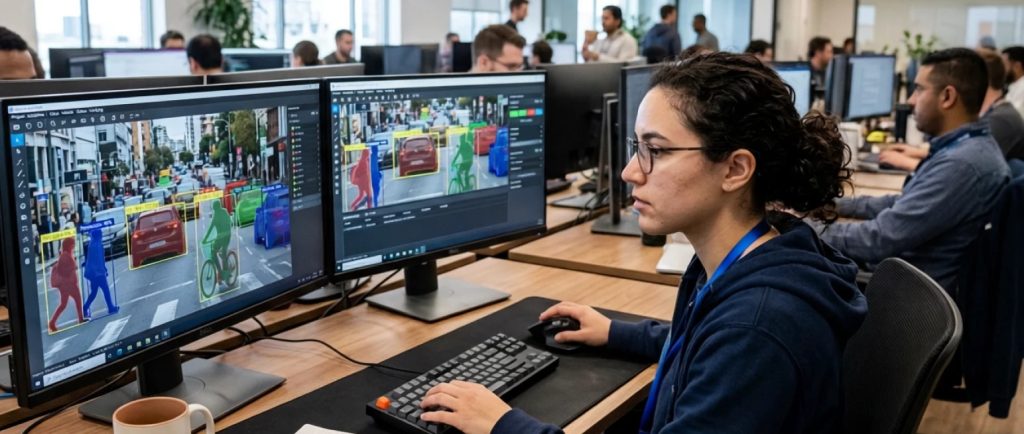
For supervised learning, raw data generally needs to be labelled so that the model can learn from examples paired with the correct outputs. To ensure consistency, guidelines will be created. A data annotation company will create guidelines, taxonomies and definitions to ensure ten annotators all understand how to annotate the same image. Many pipelines will use AI-assisted annotation with human-in-the-loop review to complete the annotation.
Annotation by data type
- Images: Image Annotation Services, object detection, segmentation
- Video: frame-level labeling, object tracking, captioning
- Text: NLP Data Annotation, entity recognition, semantic annotation services
- Audio: transcription, speaker identification, linguistic annotation services
- Sensor data: LiDAR and multimodal labeling
Judge any data annotation company on method, quality controls and scalability, not volume alone. Macgence has expertly annotated 5M+ files through its data annotation services.
4. Building Multimodal AI Training Datasets Across Text, Image, Audio, Video and Sensor Data
Enterprise AI rarely runs on one data type. A voice assistant needs audio and text. A warehouse robot needs video and sensors. Synchronized, consistently labelled multimodal datasets help these systems combine information across different data types.
What each modality powers
- Text: LLMs, sentiment analysis, multilingual text annotation
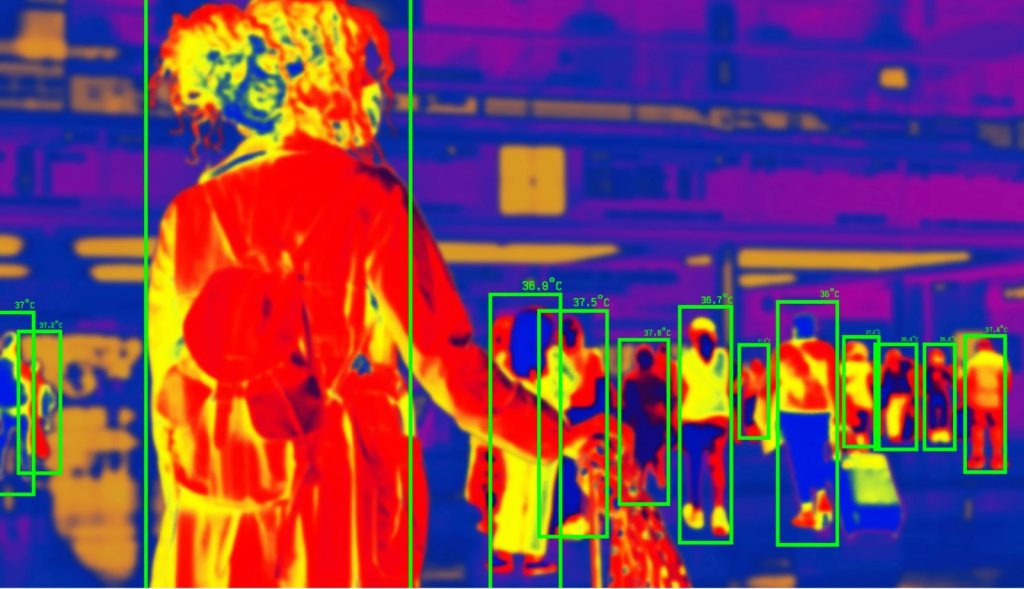
- Image: visual inspection, optical character recognition (OCR), object detection and image classification, AI training data scanning
- Audio: voice data collection for AI and speech data collection services
- Video: activity recognition and autonomous systems
- Sensor: multimodal sensor fusion datasets from LiDAR, RADAR and IoT signals
Language work shows the scale involved. Macgence has built 50K+ hours of speech datasets and trained assistants in 40+ languages in its multilingual conversational AI case study. Choosing one coordinated partner means that you don’t have to manage multiple vendors.
5. Industry-Specific AI Training Datasets: Healthcare, Autonomous Driving and Robotics
Different applications need different collection protocols, annotation standards and domain expertise.
Healthcare datasets for machine learning
Healthcare data labeling, medical image annotation and clinical NLP annotation need a clinical annotation specialist, strict access controls and privacy compliance. The same rigour applies to named entity recognition annotation on clinical records, and to generative AI in radiology.
Autonomous driving data collection
Camera, LiDAR and RADAR feeds call for 3D bounding box annotation and LiDAR annotation services, plus coverage of night driving, weather and rare road events. See Macgence’s autonomous driving case study.
Robotics and Physical AI
AI datasets for the robotics industry depend on robotics training data collection and egocentric data collection. Teleoperation data and operator-in-the-loop demonstrations can be annotated at the task level to support robotics training and imitation learning.
6. How a Data Annotation Company Ensures Dataset Quality, Accuracy and Consistency
Annotation accuracy does not equal model accuracy. Whilst clean labeled data will provide your model with high quality data to learn from, there are steps to ensure quality throughout the process.
A six-step quality framework
- Collection-level checks
- Cleaning, deduplication and format validation
- Guideline validation and annotator calibration
- Human review, audits and inter-annotator agreement
- Balance, bias and completeness checks
- Final delivery validation
Provenance, consent and licensing belong in this list too. Using automated audits, sampling and human-in-the-loop review, Macgence achieves approximately 95% annotation accuracy. A good annotation provider will show you how they do this, not just a percentage, and strong data annotation services make that process visible to your team.
7. Scaling AI Data Collection: From Custom Datasets to Enterprise-Ready Delivery
One dataset rarely finishes the job. Models will be used by new users, in new languages and new edge cases. This means data collection for AI becomes an ongoing process of collection, annotation, validation and retraining.
What scale looks like
- 150+ countries covered
- 800+ languages supported
- 10K+ resource network
- 50K+ hours of speech datasets
What enterprises need from delivery
- Versioned datasets with metadata and documentation
- Formats that fit existing ML pipelines
- Licensing, privacy and security built in
Global reach only helps when workflows repeat reliably, so a long-term AI training data provider should integrate collection, annotation and validation into one process. For teams building speech models, that continuity matters most with speech data collection services. A skilled data annotation company in the loop keeps each retraining cycle cleaner.
8. How to Choose the Right AI Data Collection Company for Your Enterprise
What should enterprises look for when choosing an AI data collection company? Look for proven sourcing, strong annotation, domain expertise, measurable quality, global reach, compliance and flexibility.
Evaluation checklist
- Collection: custom, representative datasets
- Annotation: multiple modalities, complex labeling
- Domain depth: healthcare, automotive, NLP, robotics
- Quality: defined QA and accuracy measurement
- Compliance: privacy, consent and licensing
- Delivery: usable, structured datasets
In-house teams give control. A specialist annotation provider gives flexible capacity and experience. Choosing a data annotation company based solely on the lowest price can lead to additional costs through rework, inconsistent labels and quality issues. When looking at data annotation companies, look at the whole data lifecycle. The best AI data collection company for you will provide specific and measurable answers. Ask for examples of their output and run a pilot.
9. Build Enterprise-Ready AI Training Datasets with Macgence
Macgence can support you throughout the whole AI data process. We assist you at every stage of the data lifecycle, from custom sourcing and multimodal collection to annotation, enhancement and validation. As a data annotation company, we use AI-assisted annotation with human-in-the-loop review. We also have domain expertise.
Macgence at a glance
- 5M+ files expertly annotated
- 500+ projects delivered
- 200+ languages of expertise
- 150+ countries and 800+ languages supported
- 50K+ hours of speech datasets
- 10K+ resource network
- ~95% annotation accuracy
No matter what data you need, whether it’s multilingual speech data, computer vision data annotation, healthcare data or automotive training data, Macgence builds AI training datasets around your model requirements, with GDPR and ISO 27001 credentials behind its security practices. Contact us to discuss your AI data collection and annotation requirements.
Discuss Your AI Data Requirements
10. Frequently Asked Questions
1. What do AI data collection companies do?
They collect, structure and prepare text, images, audio, video and sensor data to train and test AI models. Annotation and validation are often included.
2. What is the role of a data annotation company in AI model development?
A data annotation company labels raw data using defined guidelines, turning it into structured, validated AI training data for AI models using supervised learning.
3. What types of data can be collected for AI training?
Text, image, audio, video, sensor and multimodal datasets, including speech, LiDAR, RADAR and IoT data, depending on the AI use case.
4. How do I choose the right data annotation company for my business?
Check domain expertise, annotation quality, scalability, compliance and delivery formats. Ask for measurable QA standards, not just price per label.
5. What are the benefits of outsourcing AI data collection and annotation?
Access to specialists, flexible capacity, tailored workflows and less operational overhead. Outsourcing complements in-house teams rather than always replacing them.


You Might Like

October 26, 2026
AI Data Learning: How AI Training Data and Custom Datasets Improve Model Performance
As AI moves into production, teams are finding that the performance of their models is more dependent on the examples used to train their models, not the actual algorithm. AI data learning is now a core part of every serious AI roadmap. It involves preparing relevant training examples from which models can learn patterns and […]
October 21, 2026
Best Image Annotation Companies in 2026: Compare Services, Accuracy and Pricing
Leading image annotation companies help computer vision teams create consistent, high-quality labels that support model training and evaluation. In 2026, enterprise teams train their detection, inspection, and robotics models on millions of images, so one poor vendor selection can delay full-scale implementation. Image annotation providers generally fall into two broad categories: managed annotation services and […]

October 12, 2026
DataRobot Training for Enterprises: How High-Quality AI Training Data Improves Model Performance
DataRobot Training refers to the data preparation process, followed by machine learning model creation and evaluation on the DataRobot platform. It requires AI training data to be reliable in terms of labels and datasets as well as consistency of records – otherwise, there will be no valid predictions. As businesses transition AI from pilot to […]