


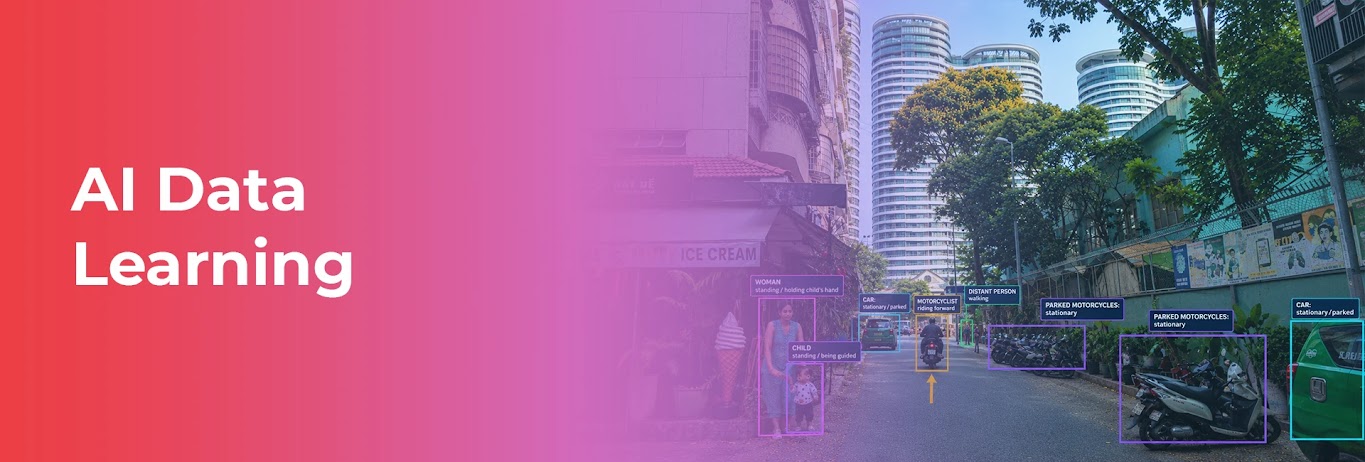
- 1. AI Data Learning: What Is It and Why Does It Matter for AI Model Performance?
- 2. How AI Data Learning Improves Model Accuracy, Generalization, and Reliability
- 3. From AI Data Collection to Custom Datasets Training: Building Data That Fits Your Model
- 4. AI Training Data Scanning and Annotation Quality: Finding the Gaps Before Training
- 5. AI Robotics Training Datasets: How AI Data Learning Supports Physical AI
- 6. Operator-in-the-Loop Training Data and Multimodal Sensor Fusion Datasets for AI Data Learning
- 7. Custom AI Datasets Across Industries: Computer Vision, Healthcare, Speech, and Autonomous Driving
- 8. How to Choose an AI Training Data Provider for Scalable, Reliable AI Data Learning
- 9. Improve Your AI Data Learning Pipeline with Macgence
AI Data Learning: How AI Training Data and Custom Datasets Improve Model Performance
As AI moves into production, teams are finding that the performance of their models is more dependent on the examples used to train their models, not the actual algorithm. AI data learning is now a core part of every serious AI roadmap. It involves preparing relevant training examples from which models can learn patterns and relationships. If your AI training data is incomplete, inconsistent, or unrepresentative, even a well-designed model may perform poorly on real-world tasks.
Why this matters now
- Multimodal AI needs accurate image, video, audio, text and sensor data.
- Physical AI and robotics require accurate training data that reflects real-world actions, objects, and environments.
This guide will discuss how using custom datasets training improves model performance, how to identify gaps in your data and how to choose the right data partner. Macgence does it end to end, from AI data collection to annotation and validation.
1. AI Data Learning: What Is It and Why Does It Matter for AI Model Performance?
AI data learning is the process of training AI models to detect patterns using training examples. The quality, relevance, variety and labeling of the data will affect how well your models perform on real-world tasks.
Four data types to know:
- Raw data: unprocessed images, text, audio or sensor streams.
- Curated datasets: raw data cleaned and structured for a purpose.
- Annotated training data: Curated data with labels (for example boxes, entities and intents)
- Evaluation data: held-out examples to test the model fairly.
High-quality AI training datasets will be relevant, representative, consistent and complete. This will affect how your model will perform with unseen inputs, which is also known as generalisation. Choosing appropriate AI datasets and a reliable AI training data provider from the outset can help establish a stronger foundation for AI data learning.
2. How AI Data Learning Improves Model Accuracy, Generalization, and Reliability
More data does not always mean high-quality data. In AI data learning, problems usually hide in the details, for example, incomplete examples, inconsistent labeling, noisy examples and imbalanced classes.
What representative data fixes
- Models cope better with real-world variation seen after deployment.
- Separate training, validation and test sets helps produce more reliable performance estimates.
- Task-specific evaluation will show if your model has improved with new data.
If your vision model was trained on mostly well-lit product images, it may have issues with glare, occlusion and unknown backgrounds. By collecting targeted data and consistently labeling, you can close these gaps. This is the core of custom datasets training.
Macgence reports approximately 95% annotation accuracy. When designing your AI training data, consider your model’s observed failure cases rather than relying solely on generic examples.
3. From AI Data Collection to Custom Datasets Training: Building Data That Fits Your Model
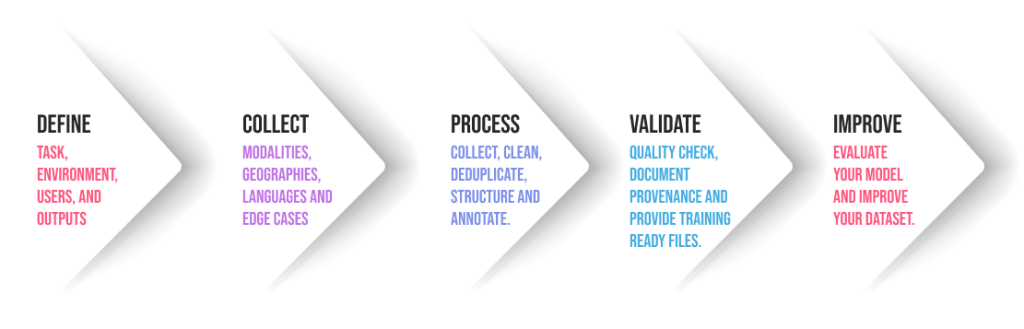
Building a repeatable AI data learning workflow starts with defining the model’s requirements before collecting or processing data.
A practical workflow
- Define – What task, environment, users, and outputs do you require?
- Collect – What modalities, geographies, languages and edge cases do you need?
- Process – Collect, clean, deduplicate, structure and annotate.
- Validate – Quality check, document provenance and provide training ready files.
- Improve – Evaluate your model and improve your dataset.
Sometimes you may need to opt for custom datasets training if your AI datasets don’t include your language, sensor setup and environment. Using off-the-shelf datasets is great for prototyping but targeted data collection will be better for production. By choosing an experienced AI training data provider, you can reduce the time taken for AI data collection. Macgence has delivered 500+ projects and annotated 5M+ files. We provide scalable AI data solutions including data collection, annotation, and validation.
4. AI Training Data Scanning and Annotation Quality: Finding the Gaps Before Training
AI training data scanning is the process of auditing your dataset to ensure there are no issues with your AI data learning. This will help prevent any issues from occurring later on which could be expensive to resolve.
What an audit checks
- Data issues: Missing fields, duplicates, corrupt files, inconsistent formatting and incomplete metadata.
- Balance and coverage: Imbalanced classes, sparse edge cases and potential leakage between training and test data.
- Annotation health: guideline clarity, label consistency, and disagreement between annotators.
High-quality data annotation services will include human review, automated checks and clear acceptance criteria. Issues will also be prioritized based on how impactful they are likely to be. This means you can focus on resolving the most important issues first. For example, if your robotics data annotation has incorrect labeling for grasp phases, this will be much more important than incorrect metadata.
The key point: you may have a large amount of data but it won’t be suitable for your model. Macgence provides data annotation services using human-in-the-loop review and quality assurance.
5. AI Robotics Training Datasets: How AI Data Learning Supports Physical AI
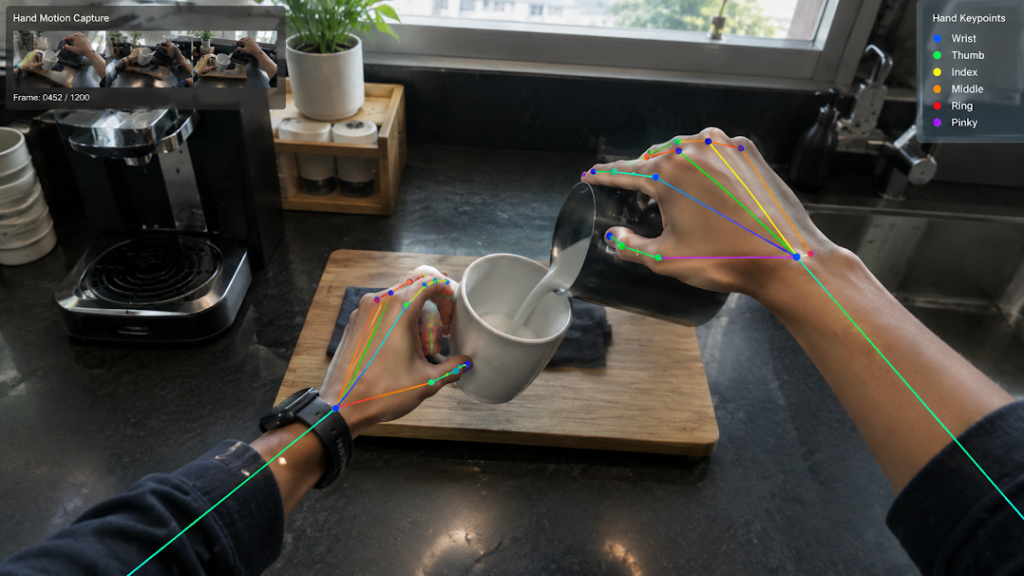
As robots operate in the real world, AI data learning for Physical AI projects must include examples of actions, objects, spatial relationships and varied environments.
What the data covers
- Robotics data collection – Examples of manipulation, navigation, picking and placing.
- Robotics data annotation – Object location, pose, contact points and task phases. This is the core of Physical AI annotation.
- Training data – Egocentric video, motion capture, teleoperation and simulation data.
Data collected in the lab is rarely representative of all scenarios your robot will encounter. Therefore, real-world data from homes, warehouses and clinics will be important. High-quality AI robotics training datasets will include relevant data collection with consistent annotation.
6. Operator-in-the-Loop Training Data and Multimodal Sensor Fusion Datasets for AI Data Learning
Human expertise and synchronized signals make training examples richer. Operator-in-the-loop training data captures demonstrations, human feedback and review of model outputs or task execution. This will help your AI data learning system understand how skilled humans complete tasks.
Why multimodal sensor fusion datasets matter
- Video, audio, depth and motion each carry different information.
- Timestamp alignment, consistent coordinate systems and metadata keep streams usable together.
- Human reviewers find ambiguous labeling and unrealistic actions that automated checks miss.
Quality multimodal datasets will help your warehouse robot understand how objects behave based on what they see, or help an autonomous system understand context from camera and LiDAR data. Robotics data collection pipelines depend on this synchronization. Macgence can help you scope data collection and annotation requirements for AI projects that rely on multiple data modalities.
7. Custom AI Datasets Across Industries: Computer Vision, Healthcare, Speech, and Autonomous Driving
Depending on what task you are trying to complete, you will need a different dataset. There is no one-size-fits-all when it comes to data collection and annotation schemas. Therefore, your AI data learning will look different depending on your use case:
- Computer Vision – Images and video with labels for detection, classification, segmentation and tracking.
- Healthcare – Clinical text and medical imaging sourced appropriately with consideration for privacy and governance.
- Speech and NLP – Audio, transcripts and intents with consideration for accents and variation. Macgence has 200+ languages of expertise.
- Autonomous Driving – Roadside examples, sensor data and object tracking. Autonomous driving data collection will be used with multimodal sensor fusion datasets.
- Robotics – Task demonstrations, object interaction and synchronized sensor data.
This is why custom AI datasets, prepared with data annotation services matched to each domain, usually serve specialized applications better than generic AI training data.
8. How to Choose an AI Training Data Provider for Scalable, Reliable AI Data Learning
When choosing an AI training data provider don’t just focus on cost per label. Ask these questions:
- Can they collect new data or customize existing data?
- Do they support your modalities, languages, domains and annotation types?
- Do they have clear QA, validation, provenance and data handling processes?
- Can they scale whilst maintaining consistent labeling? Do they have clear acceptance criteria?
- Are delivery formats compatible with your training pipeline?
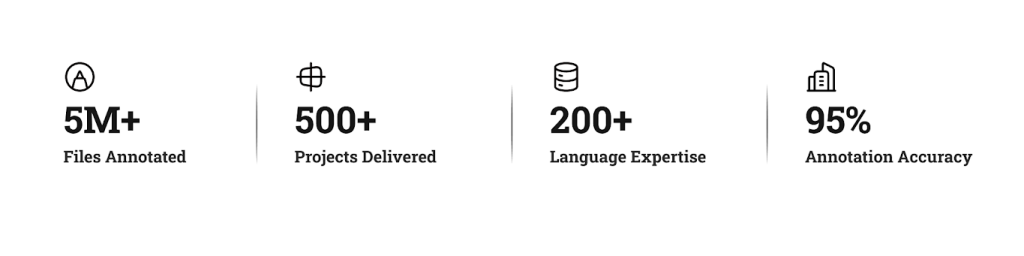
Macgence has 5M+ files annotated, 500+ projects delivered, 200+ languages of expertise, and approximately 95% annotation accuracy. Enterprises can either build every AI data learning capability in-house, or partner with a specialist like Macgence for added scale, language coverage, collection capacity and annotation expertise.
9. Improve Your AI Data Learning Pipeline with Macgence
To build reliable AI systems you need training data that represents your models requirements in the real world. Macgence can help you create custom datasets, through scalable data collection, consistent annotation and validation. We can help you prepare data aligned with your use case, required modalities, and quality criteria. From identifying dataset gaps to preparing training-ready data, work with Macgence to strengthen the data foundation behind your next AI project.
A good starting point would be to discuss:
- Your model and its known failure cases
- Required modalities, scale and languages
- Quality criteria and delivery format
As an AI training data provider, Macgence can provide end-to-end custom datasets training. By having a focused consultation, you can reduce avoidable iteration during development.
Discuss Your AI Data Requirements · Explore Macgence’s AI training data services
10. Frequently Asked Questions?
1.What is AI data learning?
AI data learning is the process of training models using examples. The quality, relevance, variety and labeling of the data will affect how well the model performs in the real world.
2.How does AI training data affect model performance?
Having representative and consistently labeled AI training data will help your models generalize to new inputs. Having gaps, noise and bias in your data will cause errors in the real world. This will also depend on your architecture and evaluation choices.
3.Why are custom datasets better suited to some AI projects than generic datasets?
Custom datasets will be tailored to your task, environment, languages and edge cases. This is often not included in generic datasets. Custom datasets training will focus on what your model is failing at.
4.How do data annotation services improve dataset quality?
Data annotation services will have clear guidelines, trained annotators, human review and quality checks. This will ensure consistent labeling. AI training data scanning will help identify any gaps.
5.How can Macgence support AI data collection and dataset preparation?
Macgence offers AI data collection, annotation, validation and custom dataset curation, backed by 500+ projects, 5M+ files annotated and 200+ languages.
 Previous Blog


You Might Like

October 21, 2026
Best Image Annotation Companies in 2026: Compare Services, Accuracy and Pricing
Leading image annotation companies help computer vision teams create consistent, high-quality labels that support model training and evaluation. In 2026, enterprise teams train their detection, inspection, and robotics models on millions of images, so one poor vendor selection can delay full-scale implementation. Image annotation providers generally fall into two broad categories: managed annotation services and […]

October 12, 2026
DataRobot Training for Enterprises: How High-Quality AI Training Data Improves Model Performance
DataRobot Training refers to the data preparation process, followed by machine learning model creation and evaluation on the DataRobot platform. It requires AI training data to be reliable in terms of labels and datasets as well as consistency of records – otherwise, there will be no valid predictions. As businesses transition AI from pilot to […]

October 5, 2026
Data Annotation Company for AI Training: From Healthcare Data Labeling to Robotics & Multimodal Datasets
AI is transitioning from pilot to production, and models do not fail due to their architecture but due to the quality of the data which was used to train them. With the scaling of projects in computer vision, NLP, healthcare, robotics, companies need a data annotation company that will provide domain-specific labeling of all kinds […]