


- 1. What Are Video Captioning Services? Definition, Process, and Core Benefits
- 2. Why Video Captioning Services Are Essential for Accessibility and Engagement
- 3. Video Captioning Services for Multilingual Content and Global Audiences
- 4. Human, Automated, and AI Video Captioning: What's the Difference?
- 5. How Video Captioning Services Support AI Training Data, Video Annotation, and Custom Datasets
- 6. Combining Video Captioning Services and Video Annotation for Multimodal AI
- 7. Key Applications of Video Captioning Services: Accessibility, Localization, and Multimodal AI Data
- 8. How to Choose the Right Video Captioning Services Provider
- 9. How Macgence Supports Video Captioning Services Across Localization, Accessibility, and AI Data Workflows
- 10. Frequently Asked Questions
Video Captioning Services for Multimodal AI Training, Video Annotation, Accessibility, and Multilingual Content
Businesses across industries use video for training, product demonstrations, marketing, education, internal communications, and more recently, AI development. But raw video is messy: spoken dialogue is embedded in audio, and visuals have not been labeled yet. This is where video captioning services come into play, which help transform unstructured video into structured, searchable, and AI-friendly material. As requirements of the global audience and machine learning models increase, video captioning services become the crossroads of accessibility, multilingual content, and multimodal AI datasets. Together with video annotation and transcription, captioned videos provide structured data for computer vision, natural language processing, and speech models. Enterprises evaluating vendors for compliance, translation, or AI training datasets need one partner who understands both content and data — which is exactly what Macgence delivers.
1. What Are Video Captioning Services? Definition, Process, and Core Benefits
What are video captioning services? Video captioning services are solutions to convert spoken dialogue, narration, and audio cues in the video to synchronized text, timed precisely to match a video’s audio track. Unlike a transcript, which is just text without any time indications, video captions are readable segmented texts appearing and disappearing in sync with audio.
Professional video captioning typically includes:
- Speech-to-text conversion of dialogue and narration
- Timestamping and segmentation for readability
- Formatting into standard caption files (SRT, VTT, SCC, DFXP)
- Quality review for accuracy and timing
Captions are different from video subtitles in one essential aspect – subtitles primarily represent spoken dialogue, often in a translated language, while captions can also include relevant non-speech audio information such as music, sound effects, and speaker identification. The exact distinction can vary by platform and accessibility standard.
2. Why Video Captioning Services Are Essential for Accessibility and Engagement
How do video captioning services improve video accessibility?
Video captioning services make spoken content available to viewers who cannot rely on audio alone — turning a passive limitation into full participation. Video accessibility isn’t a compliance checkbox; it’s a design requirement for any enterprise publishing content publicly.
Video captioning services directly support:
- Deaf and hard-of-hearing viewers who depend on closed captions to follow dialogue
- Sound-off viewing, common across social feeds, offices, and public spaces
- Learners engaging with educational and training content, where comprehension depends on reading along
- Public-facing digital content held to accessibility standards
Closed captions are different from a static transcript because they remain synchronized with the speech and allow following the tone, pace, and speaker changes in real time. Accessible video content can improve comprehension and make audiovisual information easier to follow, particularly for viewers who benefit from reading along with spoken content.
3. Video Captioning Services for Multilingual Content and Global Audiences
Once speech becomes structured text, it becomes portable across languages. That is precisely why video captioning services form the foundation of any multilingual content strategy – it is not just about accessibility. Multilingual video captioning allows one video asset to serve as content for dozens of markets without creating any additional footage.
Macgence’s approach distinguishes between:
- Intralingual captions, that is, same-language captions built for accessibility
- Interlingual captions which are translated captions producing true multilingual subtitles
- Machine-generated subtitles refined through human-supervised editing for cultural and contextual accuracy
- Regional dialect, idiom, and terminology handling during video localization
How do video captioning services facilitate multilingual content development?
Video captioning services transcribe speech into text only once but make its localization efficient across many languages possible after that. Macgence’s broader language pipeline spans data collection across 300+ languages and dialects, supporting captioning, subtitling, and localization at enterprise scale.
4. Human, Automated, and AI Video Captioning: What’s the Difference?
Not all captions are produced the same way, and the method matters for accuracy. Enterprises comparing video captioning services should understand three distinct approaches before selecting a vendor.
Approach | Strengths | Watch-outs |
Human captioning | Contextual accuracy, specialized terminology, quality review | Slower for very high volumes |
Automated video captioning | Fast, uses speech-to-text (ASR), handles large volumes | Can misread names, jargon, overlapping speech |
AI video captioning + human review | Automation for scale, human review for quality | Requires a workflow that blends both well |
Are AI video captioning services better than manual captioning? Neither approach is universally better. Automated and AI-assisted captioning can provide speed and scalability, while human review can help identify context, terminology, speaker, and formatting issues that automated systems may miss. The right approach depends on the content, quality requirements, language, and volume of the project.
5. How Video Captioning Services Support AI Training Data, Video Annotation, and Custom Datasets
Video isn’t made only for human viewers. It carries speech, actions, objects, and events that can feed AI training data pipelines — and video captioning services play a specific role here: converting speech into a structured, timestamped text layer that models can actually use.
This text layer typically includes:
- Speech-to-text output aligned to timestamps
- Speaker labels and turn-taking information
- Natural-language descriptions of dialogue context
- Metadata usable for indexing, retrieval, and evaluation
An important distinction to understand is that captions alone are not a complete AI training dataset. Can captioned videos be used for AI training? Yes, but only as one layer within a larger pipeline that also includes video annotation, custom datasets training, and multimodal AI datasets. Macgence’s data collection spans video, audio, text, and image modalities, so the same pipeline producing captions can feed downstream annotation and dataset development.

6. Combining Video Captioning Services and Video Annotation for Multimodal AI
Captioning and annotation provide solutions to completely different tasks and it is the combination of the two that supports multimodal AI datasets. Captioning of a video tells about what is being said in the video (dialogues, narrations). Annotation of the same tells about what is going on in the video (objects, actions, interactions).
What is the difference between video captioning and video annotation?
Layer | Captures |
Speech/text (captioning) | Dialogue, narration, timestamps, language |
Visual (annotation) | Objects, actions, scene changes, movement, interactions |
Combined | Richer, structured multimodal AI datasets for model training |
Macgence’s video annotation services include object tracking, action recognition, and temporal/action labeling, which can complement captioned and transcribed video data in multimodal AI workflows. For robotics, autonomous driving data collection, and computer vision, this fusion of video captioning services and video annotation produces custom datasets far more useful than either layer alone.
7. Key Applications of Video Captioning Services: Accessibility, Localization, and Multimodal AI Data
Video captioning services support a wide range of industries, each with different requirements for accuracy, language coverage, formatting, and data handling.
- Media & Entertainment: Video captioning, subtitles, and multilingual localization.
- Education & E-Learning: Accessible education materials, tutorials, training courses.
- Corporate & Enterprise Training: Onboarding, training materials, compliance and internal communications.
- Marketing & Social Media: Multilingual captioning for short and long videos.
- AI & Machine Learning: Structured speech and video information supporting AI training data workflows.
- Automotive, Robotics & Computer Vision: Professional video captioning combined with video annotation and sensor metadata for richer AI training datasets.
Across every use case, video accessibility and multilingual video captioning remain the common thread connecting content strategy to AI-readiness.
8. How to Choose the Right Video Captioning Services Provider
Selecting the right video captioning services provider affects accuracy, compliance, and how usable your video becomes for downstream AI workflows. Before choosing a provider, evaluate:
- Accuracy: Handling of accents, terminology, and context.
- Human quality control: Are automated outputs reviewed by professional video captioning teams?
- Language coverage: Can they deliver multilingual video captioning and video localization at scale?
- Scalability: From a handful of clips to enterprise-volume video transcription services.
- Technical capability: ASR, timestamping, caption formats (SRT, VTT, SCC, DFXP), and workflow integration.
- Video annotation capability: Can the same vendor extend into video annotation services when a project needs it?
- AI-data expertise: Proven experience supporting AI training data and custom datasets training beyond captions.
- Security & compliance: How client content and language data are handled end-to-end.
What should you take into account when looking for video captioning services? It has to offer accuracy, human verification of the captioning, multilingual capabilities, scalability and also the capacity of expansion into annotation and AI training data as projects evolve.
9. How Macgence Supports Video Captioning Services Across Localization, Accessibility, and AI Data Workflows
Macgence brings video captioning services, transcription, subtitling, and video annotation together under one quality-controlled pipeline, so enterprises don’t need to juggle separate vendors for accessibility, localization, and AI training data.
- Professional video captioning and video subtitles across interlingual and intralingual formats.
- Multilingual video captioning support spanning 300+ languages and dialects.
- Native subtitlers fluent in 120+ languages for broadcast-grade closed captions.
- Video annotation services like object tracking, action recognition, temporal labeling are layered onto captioned content.
- ~95% annotation accuracy, backed by experience across 500+ completed projects, backed by ISO 27001, SOC 2, GDPR, and HIPAA-aligned data handling practices.
- Access to custom dataset sourcing and tailored dataset development for specific AI requirements.
Looking for Video Captioning Services for Your AI or Content Workflows?
Whether you require video captioning services for localized content or custom datasets training for your multimodal AI applications, Macgence has solutions that can be customized to your project needs and scale — accurately, securely, and on schedule.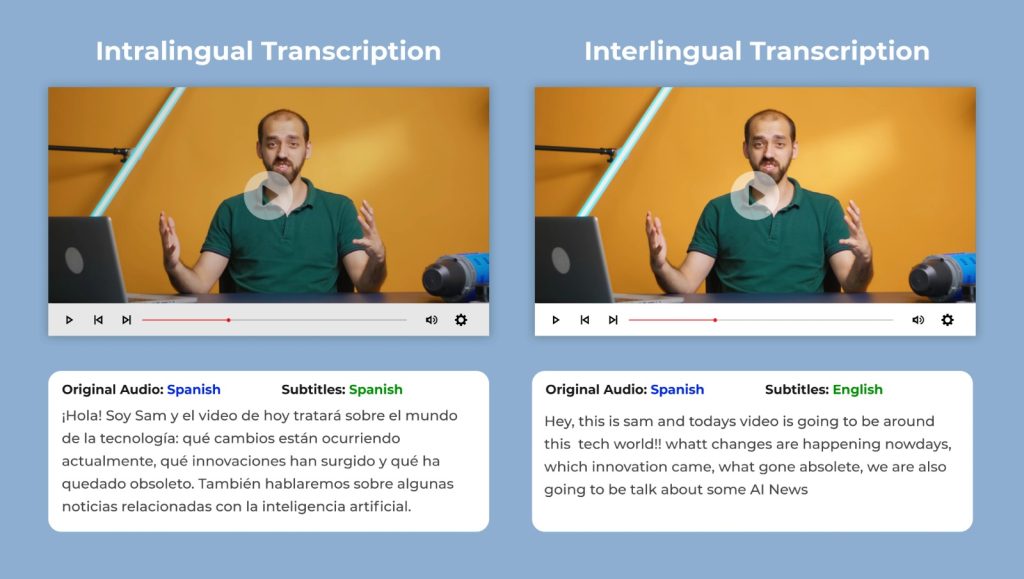
10. Frequently Asked Questions
1.What are video captioning services?
Video captioning services convert spoken dialogue and relevant audio information into synchronized, time-aligned text displayed alongside the video, helping make video content more accessible and searchable.
2. What is the difference between video captioning and video transcription?
Video transcription provides a plain text document of speech, whereas video captioning includes timestamping, segmentation, and formatting to make sure that text is synchronized with the video.
3. How do video captioning services enhance accessibility?
Video captioning helps deaf and hard-of-hearing viewers, people watching without sound, and learners follow video content through synchronized captions.
4.How does video captioning by AI work?
AI video captioning commonly uses automatic speech recognition (ASR) to generate time-aligned captions. Depending on the required quality, these outputs can then be reviewed and refined by human linguists or editors.
5.Can video captioning be used as AI training data?
Yes, captioned speech provides a structured text layer for AI training datasets, most valuable when combined with video annotation and other modalities.
6. Can Macgence provide custom video captioning and subtitling services?
Yes. Macgence offers high-quality captioning, multilingual subtitling, transcription, and video annotation services with enterprise-grade accuracy, language coverage, scalability, and security.
 Previous Blog


You Might Like

September 14, 2026
Teleoperations Robotics Data for Physical AI: Building Better AI Robotics Training Datasets
Physical AI only earns trust when it acts correctly in the real world, not just when it recognizes patterns on a screen. Robots performing tasks in warehouses, manufacturing facilities, hospitals, and urban environments need to translate their perceptions into safe and accurate physical action, which static training datasets alone cannot fully capture. Here, teleoperations robotics […]

September 8, 2026
Multimodal Datasets: The Complete Guide to AI Training Data for Modern AI Models
AI models do not perceive the world through just one sense, and neither should their training datasets. A self-driving car does not just “see”; it senses distance and tracks movements. In the same vein, conversational AI agents do not just analyze text; they hear, interpret tones, and process visual information. This is the very essence […]

August 31, 2026
Robotics Data Partner for Physical AI: Building the Data Pipeline Behind Intelligent Robots
Physical AI is revolutionizing the way robots sense, understand, and respond to the world. Unlike typical AI, intelligent robots need to understand dynamic environments, people, spatial relationships, motion, and changes in real-time. What data does Physical AI require? It requires diverse real-world inputs, including images, video, LiDAR, depth, sensor data, and human-object interaction data. For […]