


- 1. What Is Teleoperations Robotics Data and Why Does Physical AI Need It?
- 2. How Does Teleoperations Robotics Data Move From Human Demonstrations to Operator-in-the-Loop Training?
- 3. AI Robotics Training Datasets: Why Teleoperations Robotics Data Needs Multimodal Sensor Fusion
- 4. How Robotics Training Data Collection Turns Teleoperations Robotics Data into Training-Ready Datasets?
- 5. Transforming Raw Teleoperations Robotics Data with High-Precision Robotics Data Annotation
- 6. How Teleoperations Robotics Data Supports AI Datasets for the Robotics Industry
- 7. Teleoperations Robotics Data Across Physical AI, Healthcare, and Autonomous Systems
- 8. What Defines High-Quality Teleoperations Robotics Data for Physical AI Models?
- 9. How Macgence Supports Teleoperations Robotics Data for Physical AI?
Teleoperations Robotics Data for Physical AI: Building Better AI Robotics Training Datasets
Physical AI only earns trust when it acts correctly in the real world, not just when it recognizes patterns on a screen. Robots performing tasks in warehouses, manufacturing facilities, hospitals, and urban environments need to translate their perceptions into safe and accurate physical action, which static training datasets alone cannot fully capture. Here, teleoperations robotics data comes in handy, connecting human observations, decisions, and actions with the way the robot reacts to them in real time.
As enterprises scale their humanoid robots, industrial robots, and autonomous robotics programs, the need for multimodal, human-guided AI robotics training datasets becomes increasingly high. High-quality teleoperations robotics data helps models learn manipulation, navigation, and recovery behavior faster and more reliably than generic labeled datasets alone.
This blog explains how this data is captured, structured, and delivered — and how Macgence helps enterprises build this foundation for Physical AI.
1. What Is Teleoperations Robotics Data and Why Does Physical AI Need It?
Physical AI needs to perform in the physical world, not just analyze text or pictures. While a language model learns from documents, a robot needs to be able to perceive its environment, understand positions of objects, movements, predict the next action, know the right amount of force to use, and respond appropriately to changing circumstances. It can capture this relationship — the bridge between human expertise and machine learning.
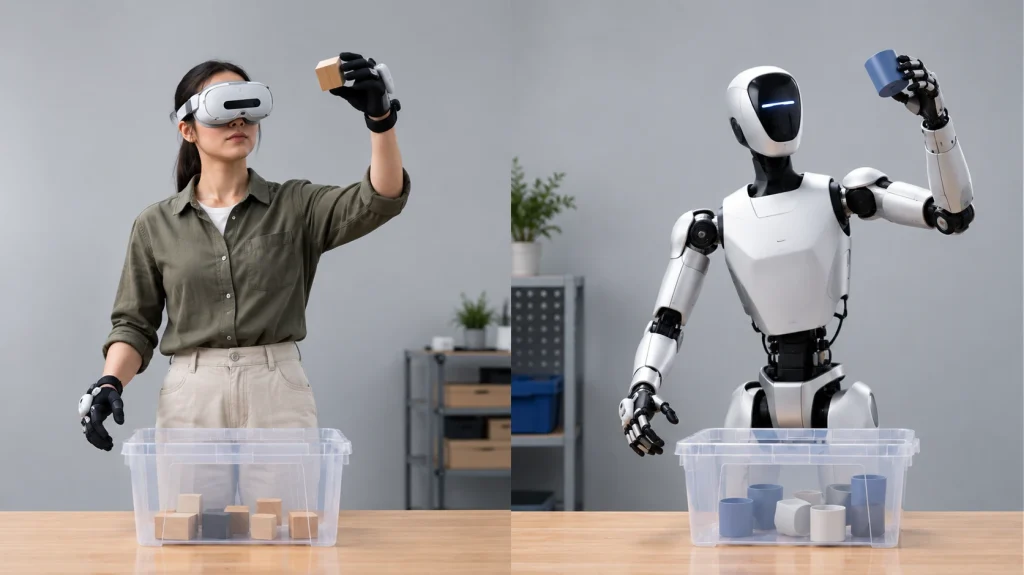
What is teleoperations robotics data? Teleoperations robotics data is data captured while a human remotely operates or demonstrates tasks through a robotic system, recording the robot’s observations, actions, sensor signals, and task context for training and evaluating AI models.
This human-guided approach is what makes AI robotics training datasets more representative of physical work, giving Physical AI data providers a realistic basis for building AI datasets for the robotics industry.
2. How Does Teleoperations Robotics Data Move From Human Demonstrations to Operator-in-the-Loop Training?
Collecting robot video alone isn’t enough — a useful training example needs the full chain: observation, human decision, robot action, and outcome. Let us take an example of a warehouse arm: a camera watches the box, the operator recognizes the target, the arm approaches the box, the gripper closes, the object is lifted up, and the trajectory and outcome are registered. These actions turn teleoperations robotics data into genuinely trainable experience rather than passive footage.
This is the foundation of operator-in-the-loop training data, which captures:
- Action trajectories and manipulation sequences
- Task-level decision context
- Real-time corrections and recovery from errors
- Failure and retry behavior that static datasets rarely include
For enterprises, human-in-the-loop robotics training data collection offers a practical way to capture difficult behaviors that can be challenging to represent accurately through simulation or synthetic data alone.
3. AI Robotics Training Datasets: Why Teleoperations Robotics Data Needs Multimodal Sensor Fusion
Many robotic systems rely on multiple sensors to understand their environment. Teleoperations robotics data becomes far more valuable once video, spatial, and motion signals are fused into one synchronized record rather than treated as separate files.
Modality | What It Contributes |
RGB / video | Visual appearance and operator actions |
Depth | Spatial understanding of objects |
LiDAR | 3D point-cloud and spatial information |
Radar | Range, motion, and environmental sensing |
IMU | Motion, orientation, and balance |
Robot telemetry | System state and movement |
Control commands | Operator intent and issued action |
This is the essence of multimodal sensor fusion datasets: a grasp event is only fully useful when video, depth, pose, telemetry, and commands are aligned to the same instant, giving AI robotics training datasets a richer representation of the physical environment and the actions performed within it.
4. How Robotics Training Data Collection Turns Teleoperations Robotics Data into Training-Ready Datasets?
Transforming raw demonstrations into model-ready teleoperations robotics data requires a structured pipeline starting with use-case definition, operator setup, and synchronized multimodal capture. From there, the raw streams undergo preprocessing, precise robotics data annotation, and rigorous QA before final dataset delivery for model training.
- Producing reliable teleoperations robotics data at scale means accounting for:
- Environment diversity like warehouses, construction sites, urban streets, industrial facilities
- Multiple operators demonstrating varied strategies
- Task variation and staged edge cases like adverse weather or lighting changes
- Sensor synchronization and consistent recording protocols
- Privacy and compliance requirements
Macgence structures robotics training data collection exactly this way, capturing real production environments alongside deliberately engineered edge cases so AI datasets for the robotics industry reflect genuine operating conditions rather than idealized lab scenarios.
5. Transforming Raw Teleoperations Robotics Data with High-Precision Robotics Data Annotation
Collection creates the raw experience; annotation makes that experience machine-readable. Once teleoperations robotics data is captured, it needs structured labeling before a model can learn from it. Robotics-specific robotics data annotation typically covers:
- Object detection and instance segmentation
- Pose estimation and trajectory annotation
- Action and temporal segmentation
- Object interaction and spatial relationships
- Task-phase and scene understanding
A key technique here is 3D bounding box annotation, which represents objects spatially for robotics perception and autonomous navigation — critical when teleoperations robotics data feeds manipulation or self-driving models. This annotation layer, sometimes called annotation for robotics or simply robotics annotation, turns demonstrations into consistent, trainable signals.
6. How Teleoperations Robotics Data Supports AI Datasets for the Robotics Industry
Different types of robots use teleoperations robotics data in varied ways, but all share the common requirement of having data that connects perception and physical action.
- Industrial robotics – picking and placing, assembling, inspecting, controlling machines
- Warehouse robotics – packaging, sorting, navigating, human-robot interactions
- Humanoid robotics – manipulating objects, locomotion, household and interaction tasks
- Autonomous robots – navigating and avoiding obstacles, making decisions real-time
- Autonomous vehicles – human intervention and demonstration data supporting autonomous driving data collection
Across every category, AI datasets for the robotics industry built from teleoperations robotics data can capture operator actions and decision sequences that generic labeled datasets may not contain. This makes demonstration-based AI robotics training datasets an important component of many robotics training data collection strategies.
7. Teleoperations Robotics Data Across Physical AI, Healthcare, and Autonomous Systems
The multimodal principles behind teleoperations robotics data extend well beyond factory floors. In Physical AI, synchronized sensor and action data lets systems perceive and respond within real environments. In healthcare robotics, comparable demonstration-based approaches support assisted-living robots, patient-support systems, medical object handling, and hospital navigation, creating genuine relevance for healthcare datasets for machine learning, healthcare data labeling, and emerging generative AI in medical and generative AI in radiology applications, where images, video, and clinical text increasingly work together.
Human-robot interaction also depends on language. Voice commands and natural-language instructions require voice data collection for AI, speech data collection services, linguistic annotation services, and multilingual text annotation that complement teleoperations robotics data wherever robots must understand spoken human intent.
8. What Defines High-Quality Teleoperations Robotics Data for Physical AI Models?
Enterprise buyers evaluating vendors should ask one practical question: what actually makes teleoperations robotics data training-ready? A dependable dataset should demonstrate:
- Multimodal synchronization — video, LiDAR, depth, IMU, telemetry, and actions aligned in time
- Diverse real-world environments — not overfitted to one lab or controlled setting
- Operator diversity — multiple strategies and behaviors represented
- Edge-case coverage — rare events that matter most for autonomous systems
- High-quality annotation — mislabeled data propagates errors into robot behavior
- Temporal accuracy — actions represented as sequences, not isolated frames
- Rigorous QA — human-in-the-loop validation throughout the pipeline
- Scalability — pilot-ready datasets that also scale to production
- Compliance and provenance — clear documentation of how data was collected
9. How Macgence Supports Teleoperations Robotics Data for Physical AI?
End-to-end data collection
Macgence designs real-world data collection around the environments, sensors, tasks, and use cases required by each robotics program.
Multimodal robotics datasets
Video, LiDAR, radar, depth, and telemetry are synchronized into structured, training-ready multimodal sensor fusion datasets.
Robotics data annotation
Object and instance annotation, pose estimation, 3D/spatial labeling, action and temporal tagging, and human-in-the-loop validation ensure every dataset is model-ready.
Custom datasets for robotics
Datasets can be designed around the robot type, environment, task, sensor configuration, and annotation requirements of each project.
Scalable AI training data operations
As a trusted AI training data provider, Macgence scales custom datasets training from pilot to enterprise-ready pipelines.
Looking to build reliable teleoperations robotics data for Physical AI, autonomous robotics, or next-gen robotics? Macgence assists in collecting, structuring, annotating, validating, and scaling the multimodal training data your AI needs. From robotics training data collection and multimodal datasets to robotics data annotation and custom datasets training, Macgence provides the infrastructure for the transformation from raw demonstrations to training datasets.
Talk to Macgence about your robotics data requirements.
10. Frequently Asked Questions?
1. What is teleoperations robotics data?
Real-world data collected when a person is operating a robot remotely, observing the task being done, making observations and actions, sending sensor signals, and task context for AI training.
2. Why is this important for Physical AI?
It connects perception and human decision-making, providing real-world variability that cannot be captured by static or synthetic datasets.
3. How is teleoperations robotics data collected?
An operator guides the robot while synchronized sensors, telemetry, and control commands record every observation, decision, and action.
4. What is operator-in-the-loop training data?
Human-guided demonstrations — including corrections and recovery behavior — captured as structured, trainable data for robotics AI models.
5. Can Macgence build custom teleoperations robotics data for Physical AI?
Yes. Macgence delivers end-to-end collection, multimodal fusion, annotation, QA, and scalable delivery tailored to your robotics use case.
 Previous Blog


You Might Like

September 8, 2026
Multimodal Datasets: The Complete Guide to AI Training Data for Modern AI Models
AI models do not perceive the world through just one sense, and neither should their training datasets. A self-driving car does not just “see”; it senses distance and tracks movements. In the same vein, conversational AI agents do not just analyze text; they hear, interpret tones, and process visual information. This is the very essence […]
August 31, 2026
Robotics Data Partner for Physical AI: Building the Data Pipeline Behind Intelligent Robots
Physical AI is revolutionizing the way robots sense, understand, and respond to the world. Unlike typical AI, intelligent robots need to understand dynamic environments, people, spatial relationships, motion, and changes in real-time. What data does Physical AI require? It requires diverse real-world inputs, including images, video, LiDAR, depth, sensor data, and human-object interaction data. For […]

August 26, 2026
Physical AI Data Providers: From Robotics Data Collection to Physical AI Annotation
Physical AI is moving AI beyond screens and into the physical world, where it will fuel robots, autonomous vehicles, and other kinds of intelligent machines that need to make sense of the environment and act accordingly. This development is expected to increase the demand for specialized data providers capable of generating multimodal Physical AI data. […]